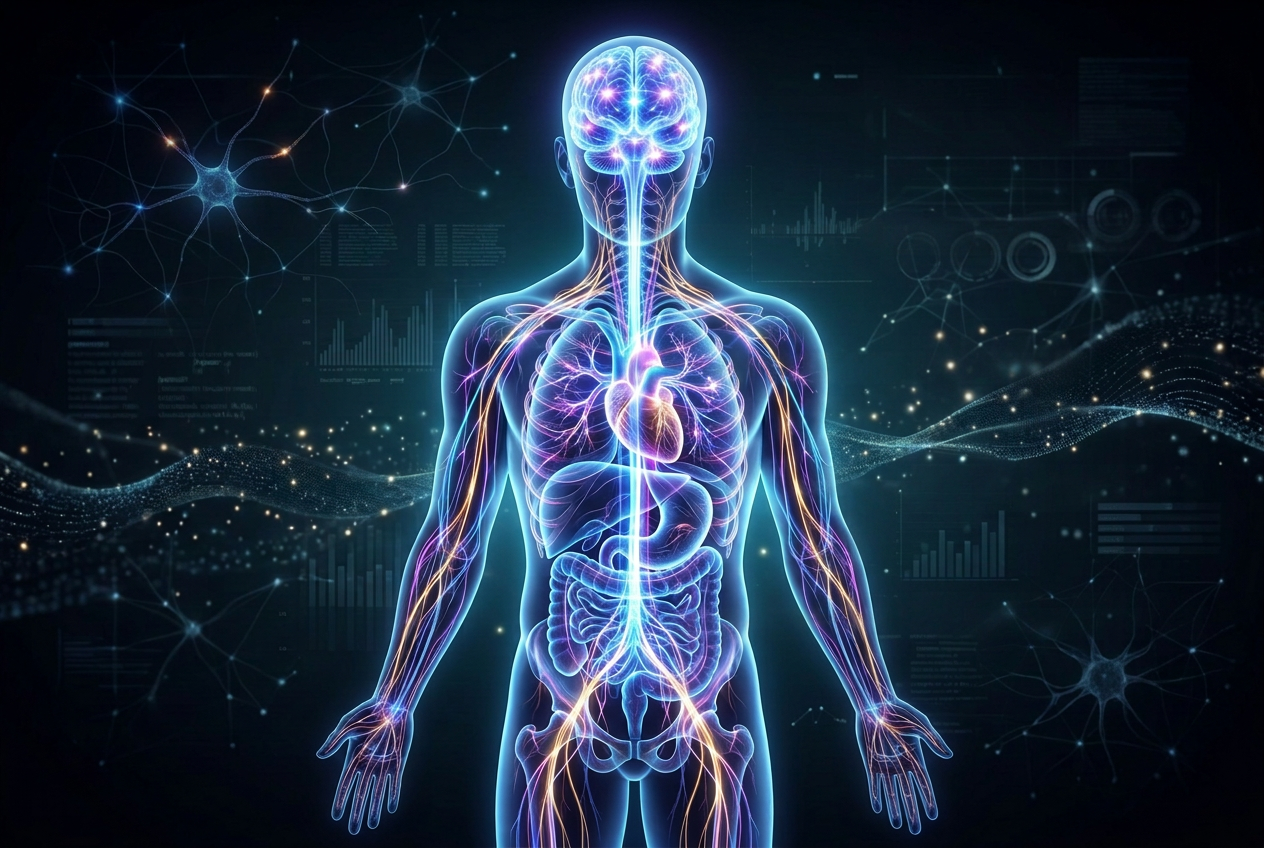
Neuroscientists Discover How the Brain Knows Which Body Parts Belong to Us
Researchers at Sweden’s Karolinska Institutet have identified a sequence of neural activity underlying the fundamental sensation of body ownership. By tracking participants’ brain activity millisecond by millisecond, scientists discovered that the process begins even before physical contact occurs. Activity in the right parietal lobe was detected approximately 76 milliseconds before touch, while activity in the right premotor cortex appeared approximately 120 milliseconds afterward. The findings suggest that the experience of owning a body emerges through coordinated interactions between brain regions rather than from a single neurological center. Published November 23 in Nature Communications, the research offers insights into bodily self-awareness, sensory integration and the construction of subjective experience. It could eventually help researchers understand disturbances in body perception experienced by some stroke patients. (Karolinska Institutet)
Scientists Discover Record-Deep Volcanic Eruption Deposits in the Mariana Trench
Marine geologists have discovered evidence of explosive volcanic activity approximately 6,148 meters beneath the Pacific Ocean’s surface, establishing a new depth record for known deposits of this kind. Using a remotely operated submarine, researchers examined volcanic formations along the walls of the Mariana Trench near Challenger Deep. The recovered rocks contained fragments of volcanic material that apparently fused together while still extremely hot. The discovery challenges conventional expectations because immense water pressure ordinarily suppresses the gas expansion responsible for explosive eruptions. Published November 23 in Frontiers in Earth Science, the findings also provide clues about tectonic processes shaping the world’s deepest ocean trench. Researchers have proposed that unusual fluid behavior under extreme pressure could explain the eruptions, although their precise mechanism and age remain uncertain. (National Geographic)
Scientists Create Nearly 7,000 Digital Brain Twins to Investigate Dementia
An international research team has constructed personalized computer models of 6,986 human brains to investigate how biological aging, environmental conditions and neurodegenerative diseases influence brain function. Researchers used functional magnetic resonance imaging data to develop computational representations of the biological mechanisms underlying each individual’s brain activity. Unlike conventional imaging studies that primarily describe observed differences between individuals, these digital twins provide a framework for simulating underlying neurological processes. Scientists hope the models will help disentangle the relationships between individual biology, environmental exposures and social conditions throughout life. Published November 23 in Nature Biomedical Engineering, the research brings together computational neuroscience, personalized medicine and environmental health. However, these models are not complete replicas of human brains, and their potential usefulness in individual clinical diagnosis or treatment remains to be established. (Medical Xpress / Trinity College Dublin)
Ancient Egyptian Garbage Reveals a Surprisingly Widespread Curse Ritual
Archaeologists investigating a rubbish deposit at the mortuary temple of Thutmose III in ancient Thebes have discovered 40 burned papyrus fragments associated with an Egyptian ritual intended to combat supernatural forces. Known as the Apophis ritual, the practice originally targeted a mythological serpent that threatened the sun god Ra during his nightly journey through the underworld. The fragments show evidence of burning and deliberate piercing, consistent with ritual instructions preserved in later historical documents. Evidence of standardized production suggests the practice may have been considerably more common than previously believed. Dating back approximately 3,400 years, the fragments extend physical evidence of the ritual by roughly a millennium. Reported November 23, the discovery demonstrates how discarded materials can illuminate everyday religious practices overlooked by monumental archaeology. (Phys.org / University of Copenhagen)
Thin Mountain Air Protects Honeybees From a Devastating Parasite
Scientists studying honeybee colonies on the Tibetan Plateau have discovered that reduced oxygen availability can suppress reproduction in Varroa destructor, one of the world’s most destructive honeybee parasites. Researchers relocated 60 infested colonies to four different elevations, monitoring their survival and parasite populations. At elevations exceeding 3,500 meters, 13 of 15 colonies survived for two years without chemical mite treatments, whereas colonies at lower elevations failed to survive beyond one year. Laboratory-style experiments conducted at lower elevations under artificially reduced oxygen conditions produced similar reductions in parasite reproduction. Published November 19 in PLOS Biology, the findings reveal a previously unrecognized physiological vulnerability in the mites. Researchers hope the discovery could eventually support chemical-free parasite control, although safe and effective methods for commercial beekeeping require further investigation. (Phys.org / PLOS Biology)


Leave a Reply