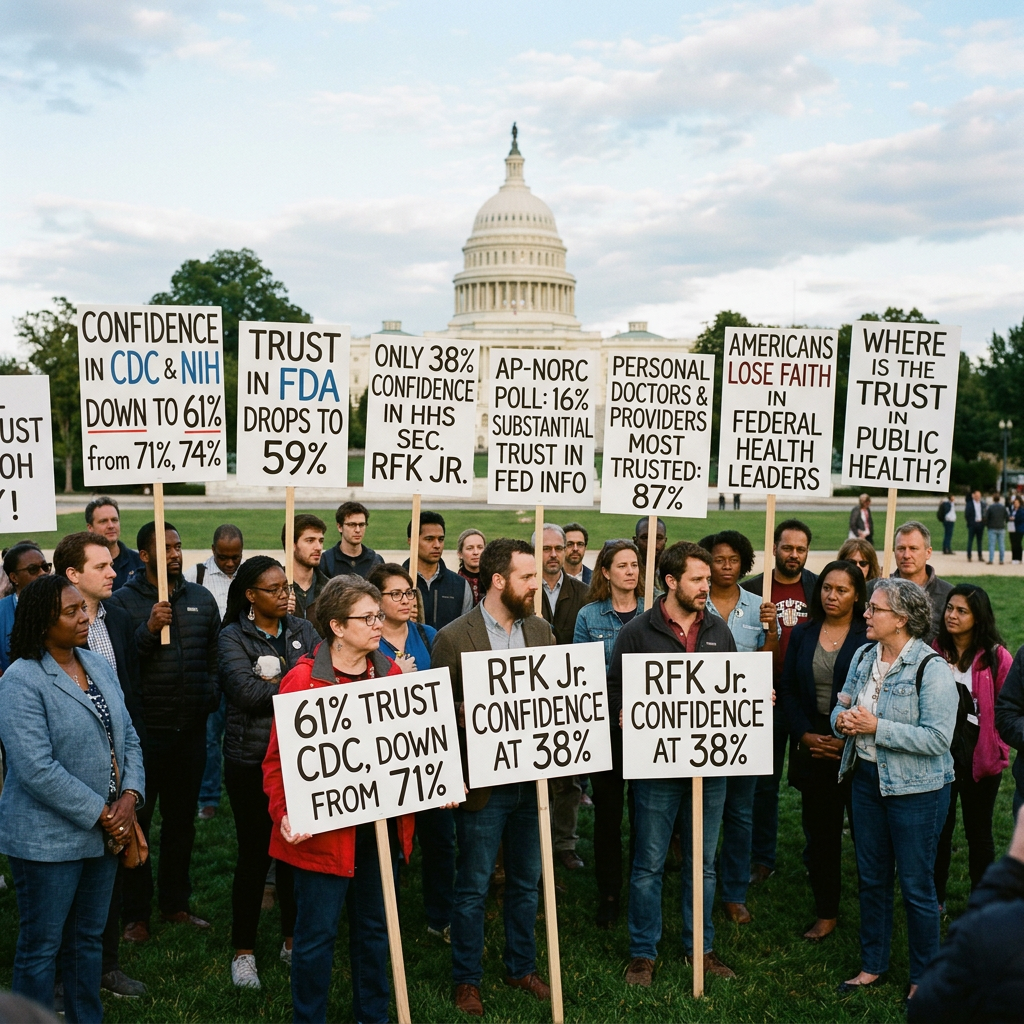
Americans’ Trust in Federal Public Health Continues to Fall: Two new national polls show declining American confidence in federal health institutions and public health leaders. An Annenberg Public Policy Center survey found 61% of adults trust the CDC and NIH to provide reliable public health information, while 59% trust the FDA—down from 71%, 74%, and 73%, respectively, in 2024. Only 38% expressed confidence in Health and Human Services Secretary Robert F. Kennedy Jr., while 50% trusted former NIAID director Anthony Fauci, down five percentage points since April. Meanwhile, an AP-NORC poll found just 16% of Americans have substantial trust in federal information about healthcare, compared with 26% in 2024. Personal healthcare providers remain far more trusted, with 87% of respondents expressing confidence in them. (cidrap.umn.edu)
Chinese Cave Reveals Denisovans as Skilled Hunters: Fossils and artifacts from Bianfu Cave in southwestern China are providing the clearest picture yet of Denisovan behavior. Researchers identified five Denisovan remains—including skull fragments, teeth and part of an arm bone—using ancient protein analysis. The fossils indicate Denisovans occupied the region roughly 167,000–134,000 years ago, while archaeological layers span about 190,000–70,000 years. Excavations uncovered bone tools alongside stone scrapers and choppers, suggesting technological abilities comparable in some respects to Neanderthals. Animal remains, particularly prime-aged medium and large mammals, show signs of systematic butchery and marrow extraction, indicating effective hunting and carcass processing. Bianfu Cave’s unusually long archaeological sequence offers researchers an unprecedented opportunity to reconstruct Denisovan life and explore whether these ancient humans interacted with other populations in southern Asia. (Nature)
Candida Auris Frequently Contaminates Healthcare Workers’ Protective Gear: A new study suggests the multidrug-resistant fungus Candida auris frequently transfers from colonized patients to healthcare workers’ gloves and gowns during routine hospital care. Researchers followed 109 patients at nine acute-care hospitals in California, Illinois, Maryland, and New York, recording 1,083 interactions with healthcare personnel. C. auris was detected on gloves or gowns after 29% of encounters. Transfer was especially common among nursing assistants, physical and occupational therapists, and respiratory therapists. Direct patient contact carried more than triple the transmission risk compared with touching environmental surfaces alone. Patients colonized at all five body sites tested were 15 times more likely to contaminate protective equipment than those colonized at one site. Researchers say improved screening and infection-control strategies are needed to limit healthcare-associated spread. (cidrap.umn.edu)

Gene Editing Reaches Every Target in Human Embryos: Researchers have achieved highly efficient base editing in human embryos while avoiding many of the damaging DNA breaks associated with conventional CRISPR-Cas9. Scientists delivered an adenine base editor during fertilization and successfully modified all targeted copies of PCSK9, a gene involved in cholesterol regulation. Edited embryos developed to the blastocyst stage, and researchers derived stem-cell lines carrying the modification. Unlike Cas9 editing, the technique produced no detectable insertions or deletions. However, the results also exposed serious safety problems: rare chromosome breakage occurred, unintended edits appeared at off-target and nearby sites, and delivering the editor as mRNA frequently caused embryos to stop developing. Published in Nature, the work illuminates how early human embryos repair edited DNA but explicitly concludes that current risks preclude reproductive use. (Nature)
Pink Noise Boosts Brain Waste-Clearing Waves: Precisely timed bursts of pink noise can strengthen the waves of cerebrospinal fluid that sweep through the human brain during sleep, researchers at Massachusetts Institute of Technology report. The team simultaneously monitored EEG activity and fMRI signals in 14 healthy volunteers, using an algorithm to predict peaks in the brain’s slow electrical waves during non-REM sleep. Delivering 50-millisecond sound bursts at those moments increased both the electrical slow waves and accompanying cerebrospinal-fluid waves. The researchers found that slow brain waves trigger blood vessels to constrict and dilate, effectively helping pump CSF through the brain. Because this fluid participates in clearing metabolic waste, the findings raise the possibility of enhancing brain cleanup during sleep. Researchers now plan studies involving insomnia and neurodegenerative diseases such as Alzheimer’s, but no clinical benefit has yet been demonstrated. (Medical Xpress)
Chandra Discovers Mysterious New Cosmic Objects: Astronomers using Chandra X-ray Observatory have identified what appears to be a previously unknown class of cosmic object. Researchers found 84 “hypersoft X-ray sources” across six galaxies, including Andromeda and the Pinwheel Galaxy. The objects emit unusually low-energy X-rays accompanied by intense ultraviolet radiation and appear in both young star-forming regions and older stellar populations. Scientists suspect they are binary systems in which a black hole, neutron star or white dwarf pulls matter from a companion, although known binaries do not normally display this combination of emissions. The objects could potentially address two astrophysical puzzles: identifying systems that eventually produce Type Ia supernovae and explaining sources of energetic ultraviolet radiation capable of ionizing interstellar gas. Their unusual emissions also help explain why previous surveys overlooked them. (NASA Science)
Neolithic Burial Contains Two Human Heads: Archaeologists investigating a cemetery near Wrocław, Poland, have uncovered an extraordinary roughly 4,900-year-old burial containing a man interred alongside two human heads. The grave, dated to around 2900 B.C., also contained amber beads, a flint blade, a serpentinite battle ax and a necklace assembled from 42 carefully perforated teeth. Researchers identified many of the teeth as incisors and canines belonging to large mammals including wolves, deer and bears, although some may be human. The elaborate objects suggest the deceased could have been an important warrior, hunter or clan leader. The two skulls may have been offerings accompanying the burial. Researchers will examine whether they show evidence of decapitation and use additional analyses to determine whether the individuals were biologically related. The discovery represents the second Neolithic burial unexpectedly found within the later Roman-era cemetery. (Archaeology Magazine)
Quantum Materials Could Amplify Dark Matter Signals: Unconventional quantum materials could provide dramatically more sensitive detectors for elusive forms of light dark matter. An international team investigated materials including titanium diselenide that possess low-energy collective excitations—coordinated movements of electrons that could respond strongly to otherwise nearly undetectable dark-matter interactions. Instead of waiting for hypothetical particles to produce conventional atomic or electronic recoils, the approach exploits the material’s intrinsic quantum behavior to amplify tiny energy deposits. The researchers argue that these excitations could open parameter space inaccessible to many existing detectors, which are often optimized for heavier dark-matter candidates. Published in Physical Review Letters, the work is currently a detector concept rather than a dark-matter detection. But it suggests that materials originally studied for unusual condensed-matter physics could become powerful tools in one of fundamental physics’ longest-running searches. (phys.org)


Leave a Reply