Frozen Clams Linked to Multistate Hepatitis A Outbreak: A multistate hepatitis A outbreak linked to imported frozen clams has sickened at least 37 people, according to the CDC and FDA. Cases have been identified in Massachusetts, Minnesota, New York and Pennsylvania, with New York accounting for 27 infections. Thirty people have required hospitalization, though no deaths have been reported. Patients range from 6 to 40 years old, with illnesses beginning between July 2025 and June 2026. Among those interviewed, 77% reported eating ceviche, 76% ate raw or undercooked shellfish and 47% consumed raw or undercooked black clams. Investigators traced the outbreak to imported frozen clams. La Serranita brand black shell clam meat from Ecuador had already been recalled in April after distribution to several US states. (cidrap.umn.edu)
OpenAI Cuts Costs With New GPT-6 Models: OpenAI has expanded its GPT-6 family with new versions of GPT-6 Sol and Luna, promising lower operating costs alongside improved accuracy. Sol is aimed at complex work such as programming and knowledge-intensive tasks, while Luna targets high-volume jobs such as summarization, extraction and routine questions. OpenAI says API prices for both models are roughly half those of the previous 5.6 generation, thanks partly to improvements in caching and inference efficiency. The company also reports that Sol makes about half as many factual mistakes as its predecessor in an internal evaluation based on real-world conversations where users flagged errors. The models arrive amid unusually rapid competition at the AI frontier, with Anthropic releasing an upgraded flagship model the same day. (TechCrunch)
Anthropic Releases Cheaper, Faster Opus 5.5: Anthropic has released Claude Opus 5.5, an upgraded version of its most powerful commercially available model, claiming improvements in coding and knowledge work while reducing the computational cost of running it. Output pricing falls from $25 to $20 per million tokens, and Anthropic says the model is faster than its predecessor. The company also adjusted the model’s communication style to reduce jargon and move important information earlier in responses. Anthropic says Opus 5.5 rivals or exceeds larger models on several benchmarks while carrying enhanced safeguards for potentially dangerous biology and cybersecurity capabilities. The launch is particularly notable because CEO Dario Amodei has recently argued that frontier AI development should proceed more cautiously, allowing safety research and oversight mechanisms time to catch up with rapidly improving capabilities. (TechCrunch)
AI Gives Scientists More Ideas Than Experiments: Artificial intelligence may be accelerating the intellectual side of science faster than laboratories can test the resulting ideas. A report from Google, Google DeepMind and MIT FutureTech examined a survey of 637 scientists, 15 million Gemini conversations and more than 2,600 specialized AI models. Roughly 44 percent of surveyed researchers said their primary research bottleneck had moved downstream during the previous two years, toward physical experiments and data collection. Forty-one percent said their backlog of untested hypotheses had increased. AI has made particularly visible progress in mathematics and computational research, where answers can often be checked relatively quickly. Biology, medicine and chemistry remain constrained by physical experiments, safety requirements, clinical trials and regulatory processes, suggesting that generating scientific hypotheses may increasingly become easier than verifying them. (Scientific American)
Virtual Biotech Employs 37,000 AI Scientists: Stanford Medicine researchers have created a virtual biotechnology company staffed by roughly 37,000 artificial-intelligence agents rather than human employees. The agents are organized into specialized divisions resembling those of a real pharmaceutical company, covering tasks ranging from identifying biological targets to designing clinical trials. In one demonstration, thousands of agents analyzed approximately 50,000 clinical trials in less than a week, searching for biological features associated with successful drugs. The system identified a signal useful for predicting clinical success and independently designed a potential lung-cancer therapy that a pharmaceutical company subsequently developed and tested separately. Researchers say the project explores whether coordinated populations of specialized AI agents can manage much larger portions of drug development than individual AI assistants. (Stanford Medicine)
Scientific Papers Become Collaborating AI Agents: Stanford Medicine researchers have developed Paper2Agent, a system that converts scientific papers into interactive artificial-intelligence agents capable of explaining the research, applying its methods and communicating with agents representing other papers. Rather than merely summarizing manuscripts, the system examines text, figures, code and accompanying datasets and attempts to reproduce the original research inside a virtual environment. That process allows the resulting agent to capture experimental procedures and technical knowledge that may not be obvious from simply reading the paper. Agents can then apply those methods to new datasets or interact with agents created from other studies, potentially revealing useful methodological combinations or new research directions. The researchers envision scientific literature becoming an active computational resource rather than a static archive. The work appeared September 16 in Nature. (Stanford Medicine)
Quantum Nanostructures Could Slash AI Energy Needs: University of Wisconsin–Madison engineers have proposed quantum nanostructures that could help overcome one of the biggest obstacles facing optical neural networks: performing nonlinear computations using light. Conventional neural networks rely on nonlinear mathematical operations to recognize complicated patterns, but photons interact only weakly with one another, making those operations difficult in optical hardware. Researchers computationally designed a nanostructure around a quantum emitter that greatly enhances the required nonlinear behavior. Simulations suggest the component could support full optical neural networks that are substantially faster and more energy efficient than conventional GPU-based systems. The design remains theoretical, but the researchers argue that recent progress in diamond quantum photonics could make experimental construction feasible. Such hardware could eventually reduce the enormous electricity requirements associated with large-scale AI inference and training. (Phys.org)
AI Makes Tiny Flying Robot 450 Percent Faster: MIT researchers have used artificial intelligence to dramatically improve the agility of an insect-scale flying robot. A deep-learning-based control system increased the microrobot’s flight speed by roughly 450 percent and its acceleration by about 250 percent compared with earlier versions. During demonstrations, the tiny robot completed ten consecutive somersaults in just 11 seconds while compensating for wind disturbances. The controller combines learned models with predictive control, allowing the machine to execute complicated movements without overwhelming its limited computational resources. Researchers are trying to make miniature flying robots maneuver more like insects, which can rapidly negotiate cluttered and unpredictable environments. Potential applications include searching collapsed buildings after earthquakes, where tiny robotic aircraft could enter gaps and narrow spaces inaccessible to conventional drones or human rescuers while avoiding debris and obstacles. (ScienceDaily)
AI Finds More Reliable Forms of Drug Molecules: New York University researchers have trained a graph neural network to predict the most stable forms of drug-like molecules, addressing a persistent problem in computational drug discovery. Many molecules can shift between closely related structures called tautomers as hydrogen atoms change position. Choosing the wrong tautomer can distort predictions about how a candidate drug interacts with a protein. Researchers assembled more than 1.1 million experimentally informed tautomeric states from crystallographic databases and used them to train the model. Testing suggested that about 2.5 percent of more than 5,000 examined protein-bound ligands may have been assigned the wrong tautomeric representation. The open-source Tautomer-Predictor can also operate rapidly: researchers report screening roughly 4.6 million compounds in 3.2 hours using a single GPU-equipped computing node. (EurekAlert!)
AT&T Turns to AI While Shrinking Workforce: AT&T says automation and artificial intelligence will become increasingly important as the telecommunications giant restructures its workforce and retires older infrastructure. The company has already eliminated more than half its workforce over the past decade and cut approximately 2,100 jobs during the first half of 2026. Chief technology officer Jeremy Legg told WIRED that AT&T expects its headcount to continue declining as artificial intelligence automates internal processes. The company is simultaneously replacing aging copper landlines with fiber networks, changes that have also reduced electricity consumption. AT&T nevertheless expects to continue hiring for different types of jobs, including developing and governing AI agents, supervising automated processes and maintaining fiber infrastructure. The transformation provides an unusually concrete example of how AI deployment can restructure rather than simply eliminate work inside a major corporation. (WIRED)
Artificial General Intelligence Loses Its Clear Meaning: Claims that artificial general intelligence may be approaching are exposing a fundamental problem: researchers increasingly disagree about what AGI actually means. OpenAI has suggested that its recent Astra model may represent or approach the threshold, but Scientific American reports that definitions of AGI vary dramatically. Some older definitions focused on machines capable of performing a broad range of intellectual tasks at human levels, while newer interpretations emphasize autonomy, adaptability or the ability to improve other AI systems. Depending on which standard is chosen, current systems could already qualify—or remain well short. The ambiguity matters because enormous investments, regulatory debates and forecasts about employment increasingly invoke AGI as though it were a precise technical milestone. Researchers argue that assessing individual capabilities and risks may ultimately prove more meaningful than declaring that one universal intelligence threshold has been crossed. (Scientific American)
Fire Amoeba Shatters Heat Limit for Complex Life: Scientists have discovered a single-celled organism capable of reproducing at temperatures previously considered beyond the limit for eukaryotic life. Incendiamoeba cascadensis, isolated from hot springs in California’s Lassen Volcanic National Park, divided normally at 63°C (145°F), remained partly active at 66°C and recovered after five-minute exposures to 70°C. Researchers found that the amoeba possesses unusually robust systems for protecting proteins, repairing DNA and coping with heat-induced cellular damage. The organism also changes shape and develops a protective outer layer when temperatures become extreme. Published in Cell, the discovery pushes the known thermal boundary for organisms possessing nuclei and other complex cellular structures. Beyond revealing how adaptable eukaryotic life can be, the findings could inform biotechnology and the search for potentially habitable environments beyond Earth. (NASA Science)
Nanoparticles Make Blind Retinas Detect Light: Researchers at Aarhus University have developed injectable light-sensitive nanoparticles that enabled severely damaged retinas to respond to illumination without genetically modifying their cells. The hollow graphitic carbon-nitride particles, about 300 nanometers across, absorb visible light and convert it into biological signals. Injected into mice with advanced retinitis pigmentosa, the particles settled near retinal ganglion cells. Light exposure subsequently generated activity in the animals’ visual cortex and produced measurable behavioral responses. Researchers also demonstrated activation of ganglion cells in isolated pig retinas. Published in Nature Biomedical Engineering, the experiments did not restore normal vision, but they demonstrate a mutation-independent strategy for returning light sensitivity to retinas after photoreceptor degeneration. Considerable safety, durability and efficacy testing would be required before the technology could be evaluated in humans. (Phys.org)
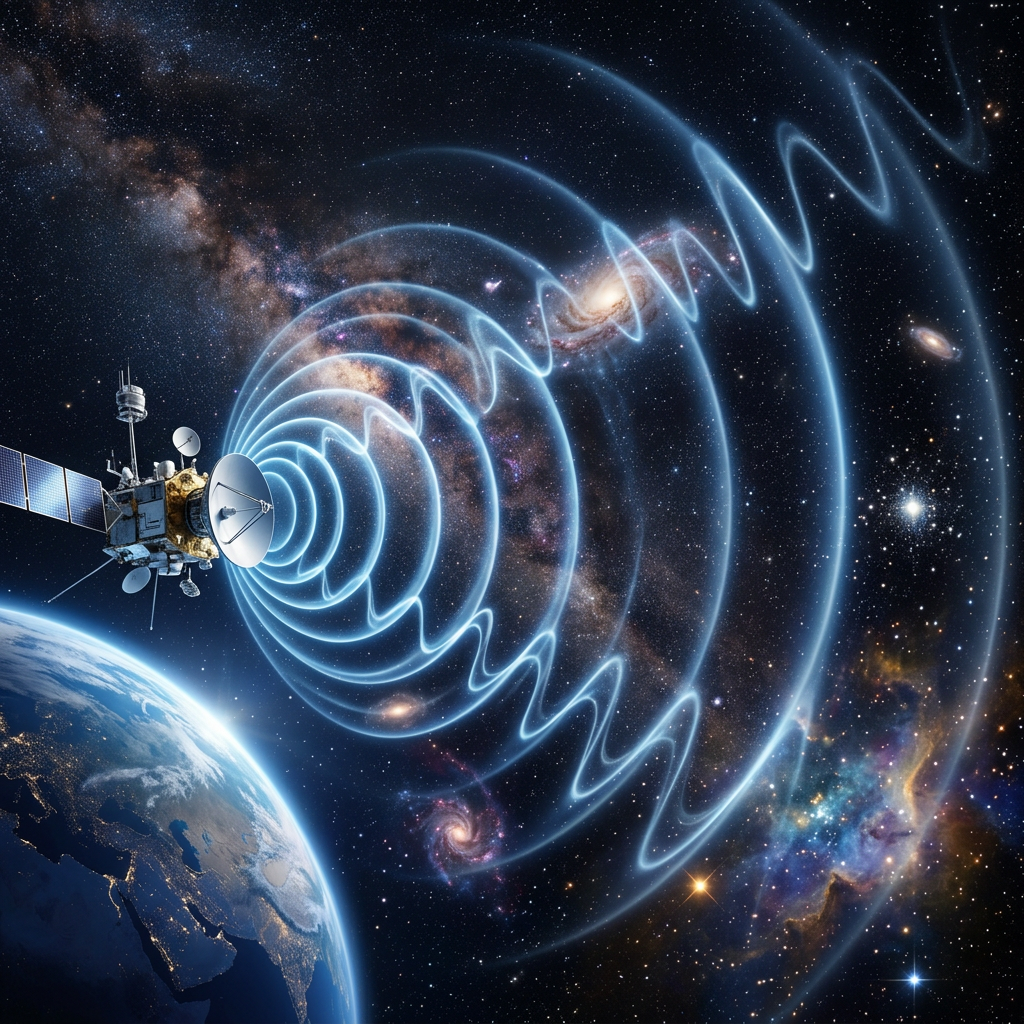
First Radio Signal Traced Directly to Exoplanet: Astronomers report the first radio emission directly localized to a planet outside our Solar System. Using South Africa’s MeerKAT radio telescope, researchers detected auroral radio waves from Beta Pictoris b, a young giant planet approximately 63 light-years from Earth. Earlier radio signals associated with exoplanet systems could not be conclusively separated from emission produced by their host stars. By comparing the radio observations with the planet’s precisely known orbit, the team found that the source followed Beta Pictoris b rather than its star. The signal implies a magnetic field of at least 1,250 gauss, providing what the researchers describe as the first direct magnetic-field measurement for an exoplanet. The result, currently reported as an arXiv preprint, could open an entirely new method for probing planetary interiors and magnetospheres—but awaits peer review. (Phys.org)
Cocaine Hijacks Brain Circuit for Flexible Behavior: Researchers have identified a neural circuit that normally helps animals switch among behaviors but becomes commandeered by cocaine to produce increasingly rigid repetition. Scientists at Hebrew University of Jerusalem used a deep-learning system called STEREO to track the natural behavior of mice after repeated cocaine exposure. By the fifth day, licking floors and walls consumed more than 60% of observed behavior. The researchers traced this narrowing repertoire to opposing pathways in the ventrolateral striatum. Activating the indirect pathway immediately interrupted repetitive behavior, while suppressing it prolonged repetition; manipulating the direct pathway produced largely opposite effects. Published in Current Biology, the findings suggest cocaine does not create an entirely new behavioral program but instead overwhelms neural machinery normally responsible for selecting appropriate actions. Similar circuitry could potentially illuminate other disorders characterized by behavioral rigidity. (Medical Xpress)
Lake Powell Falls to Record Low: Lake Powell has fallen to record-low levels following an exceptionally weak mountain snowpack and unusually warm conditions across the Colorado River Basin. Landsat 8 imagery showed the reservoir at 3,517.24 feet on September 10, below the previous record of 3,519.92 feet set in April 2023. The reservoir first crossed its previous record on August 15 and continued falling into September. Lake Mead also reached record lows during August. The Colorado River system supplies water and electricity to more than 40 million people and irrigates roughly five million acres of farmland. Lake Powell remains above its 3,490-foot minimum power-pool elevation, but federal water managers intervened earlier this year to help protect hydropower production. The satellite observations provide a stark measure of the continuing effects of drought and warming across the American Southwest. (NASA Science)

Leave a Reply