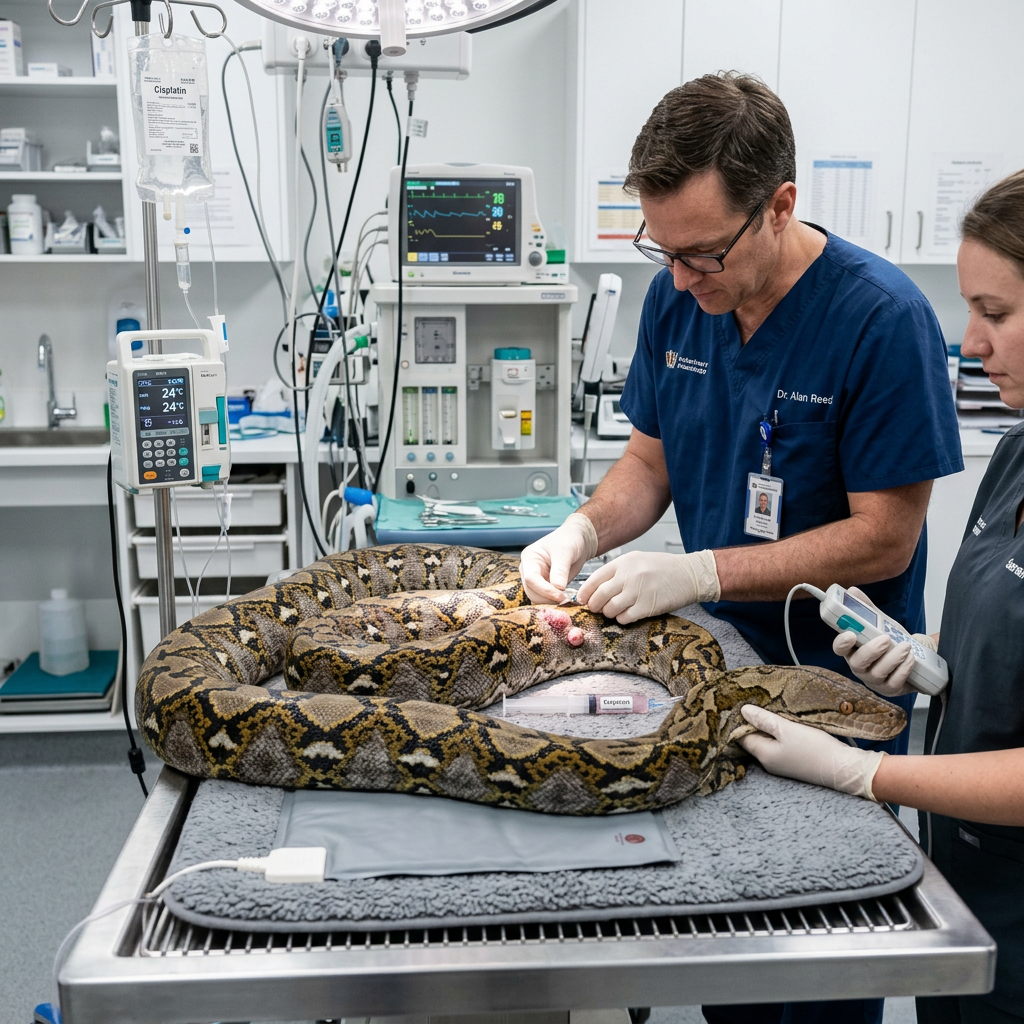
Python Receives Pioneering Cancer Treatment: A 23-year-old reticulated python at Chester Zoo has become what veterinarians believe is the first snake treated with electrochemotherapy, a cancer therapy more commonly used in humans and other animals. Jodie Foster, a 15-foot, 50-kilogram python, developed a malignant fibrosarcoma in her jaw that returned after surgery and began invading the bone. Veterinarians removed the tumor and diseased jaw tissue before administering bleomycin alongside carefully controlled electrical pulses. The pulses temporarily increase cancer-cell permeability, allowing the chemotherapy drug to penetrate more effectively. Months after the 90-minute procedure, Jodie is eating normally and showing no signs of recurrence. Researchers from Chester Zoo and the University of Liverpool plan to publish the procedure, potentially expanding treatment options for reptiles and informing broader veterinary cancer research. (The Guardian)
NASA Rescue Mission Fails to Save Swift Observatory: NASA has abandoned an unprecedented attempt to rescue the Neil Gehrels Swift Observatory after the spacecraft sent to raise its decaying orbit became uncontrollable. Swift, launched in 2004 to study gamma-ray bursts and other rapidly evolving cosmic events, has been losing altitude as heightened solar activity expands Earth’s atmosphere and increases orbital drag. Katalyst Space built the LINK rescue craft in roughly eight months, hoping to capture Swift and boost it into a safer orbit. But after LINK’s July 3 launch, failures in several reaction wheels caused the craft to spin. Weeks of attempts to stabilize it with thrusters proved unsuccessful. Without intervention, Swift will likely reenter Earth’s atmosphere later this year, ending a remarkably productive 22-year astronomical mission. (Science)
Hospital Patients Face Hours-Long Emergency Room Boarding: More than half of U.S. emergency department patients admitted for general medical care wait at least four hours for an inpatient bed, according to a JAMA study spanning 56 emergency departments in 17 health systems. Researchers analyzed more than 3 million adult emergency visits from June 2024 through May 2025, including 492,135 patients requiring admission. Of those, 53.6% waited four hours or longer for a bed, while 4.7% experienced delays of at least 12 hours without inpatient management and nearly 1% waited 24 hours or more. Older adults, Medicare recipients and more seriously ill patients faced longer waits. Researchers say the wide variation among hospitals suggests that organizational practices—not simply overcrowding—play a major role in dangerous boarding delays. (CIDRAP)

Transparent OLED Glasses Deliver Wearable Gamma Stimulation: Researchers at KAIST have developed transparent OLED glasses designed to deliver 40-hertz visual stimulation while allowing users to see normally through the lenses. Gamma-frequency stimulation has attracted attention as a possible noninvasive way to influence brain activity and potentially support cognition, particularly in early Alzheimer’s disease. The glasses achieved about 75% light transmission while successfully entraining gamma rhythms in human volunteers. EEG measurements indicated stronger connectivity between occipital and frontal brain regions during stimulation, while participants reported less visual discomfort than with conventional opaque flickering displays. The work remains an early demonstration rather than evidence that the glasses improve memory or treat dementia. Still, it points toward a practical wearable platform for testing whether repeated gamma entrainment can meaningfully alter cognitive function. (JOVE Visualizer)
Vitamin D Linked With Better Cognition: An Emory University study suggests high-dose vitamin D supplementation may be associated with better cognition in adults already showing mild cognitive impairment and sleep problems. Researchers examined 54 participants and found those reporting at least 5,000 IU of vitamin D daily scored more than 13% higher on the Montreal Cognitive Assessment than participants who did not take that amount. Lower doses were not associated with the same difference, and results were similar for vitamin D2 and D3. The finding is intriguing for cognitive-enhancement research because vitamin D affects neuronal function as well as sleep-wake regulation. However, this was a small observational study, not a randomized trial, so it cannot demonstrate that high-dose supplementation improves cognition. The researchers describe the results as preliminary and requiring controlled investigation. (Emory News)
Psilocybin Reveals Hidden Order Inside Brain Activity: The largest single-site psychedelic neuroimaging study to date challenges the idea that psilocybin simply makes brain activity more chaotic. Researchers studied 62 adults using fMRI and EEG while participants rested, listened to music, meditated and watched a movie before and after receiving psilocybin. Machine-learning analysis revealed that the drug reorganized neural activity into structured patterns that became unusually responsive to the person’s immediate environment. Brain networks normally separating internal and external information became more integrated, particularly among people reporting feelings of dissolving boundaries between themselves and their surroundings. Greater alignment between brain activity and context also predicted stronger changes in mindset the following day. The results suggest psychedelic effects may involve not indiscriminate neural disorder but a reorganization of cognitive processing around sensory and experiential context. (Nature)
Prenatal Fluoride Associated With Cognitive Differences: A large NIH-supported study has reported an association between prenatal fluoride exposure and children’s performance on tests of fluid cognition. Researchers linked public-water fluoride measurements during pregnancy with cognitive assessments from 2,514 children aged three to 17. When estimated fluoride concentrations approached or exceeded roughly 675 micrograms per liter—near the U.S. recommended fluoridation level of 700 micrograms—higher exposure was associated with lower scores measuring problem-solving, attention, memory and adaptation to new information. Each additional 500 micrograms per liter above that threshold corresponded to an average 3.36-point reduction. No association appeared for crystallized cognition, such as vocabulary and accumulated knowledge. Crucially, the observational study cannot establish causality, did not measure every source of fluoride exposure, and does not assess fluoridation’s well-established dental benefits. (EurekaAlert)
Gut Microbes Emerge As Cognitive Health Target: A new review in Frontiers in Molecular Neuroscience examines evidence that diet may influence cognitive aging partly through interactions among gut microbes, immune signaling and the brain. Fiber, polyphenols, prebiotics and probiotics can encourage microbial communities that generate short-chain fatty acids, support the intestinal barrier and regulate systemic inflammation. By contrast, diets rich in saturated fat and refined sugar are associated with dysbiosis, impaired gut-barrier function and chronic low-grade inflammation—processes potentially contributing to neuroinflammation and cognitive decline. The review makes the microbiome particularly interesting from a nootropics perspective because interventions could theoretically alter cognition indirectly through microbial metabolites rather than directly stimulating neurons. But the authors emphasize that much mechanistic evidence still comes from animals, while human studies remain heterogeneous and frequently observational. Personalized microbiome-based cognitive interventions therefore remain speculative. (Frontiers)
Childhood Screen Time Shows Unexpected Cognitive Association: An eight-year Finnish study complicates the assumption that more screen exposure necessarily harms children’s cognition. Researchers followed participants from childhood into adolescence, measuring physical activity and sedentary behavior and later testing learning, attention and working memory using the CogState battery. Surprisingly, greater accumulated screen time was associated with better cognitive processing in adolescence. The researchers stress that the result does not prove screens improve cognition. Instead, what children actually do on devices may be crucial: activities involving learning, problem-solving, creativity or active engagement could produce very different outcomes from passive consumption. The current analysis included 260 adolescents with an average age of 15.8 years. Researchers argue against treating screen time as a single behavioral category and call for intervention studies capable of distinguishing causation from correlation. (ScienceDaily)
AI Redesigns Antibodies To Fight Neurodegeneration: Researchers have used artificial intelligence to transform conventional antibodies into tiny molecules capable of functioning inside cells—a potentially important advance for Alzheimer’s, Parkinson’s, Huntington’s disease and motor neurone disease. Ordinary antibodies generally function outside cells, limiting their ability to attack disease-associated proteins accumulating internally. The University of Essex-led team discovered that electrical charge strongly influences whether antibody fragments remain stable within the cellular environment. Using that principle and AI-assisted protein redesign, they converted 672 antibodies into intracellular antibodies, or “intrabodies,” capable of targeting specific proteins. The molecules are being made freely available to researchers. This is not yet a cognitive-enhancement therapy or clinical treatment, but the platform could eventually permit unusually precise manipulation of proteins responsible for neuronal dysfunction, potentially opening new approaches to preserving cognition in neurodegenerative disease. (ScienceDaily)
Brain May Turn Experience Into Narrative: Neuroscience is increasingly showing that human memory does not preserve experience like a video recording. Instead, the brain appears to reorganize events into simplified narratives that make relationships, characters, causes and consequences easier to understand. Scientific American reviews research using movies and sophisticated brain-imaging analysis to investigate how neural systems segment continuous experience into meaningful events, track individuals across scenes and extract overarching meaning. These narrative representations can subsequently become the structure through which events are remembered. The work has important implications for cognition because it suggests memory enhancement cannot necessarily be reduced to increasing storage capacity. Improving comprehension, organization and meaning may be equally important. The emerging picture portrays memory as a constructive process in which the brain continuously edits complex sensory experience into manageable models that help humans understand and predict their world. (Scientific American)
Brain Waves May Perform Analog Computations: MIT neuroscientists are proposing that cognition and consciousness depend partly on analog computation performed by traveling electrical waves across the cortex. Their theory argues that conventional descriptions emphasizing fixed neural circuits and synaptic connections cannot fully explain how the brain rapidly assembles flexible networks for changing cognitive demands. Instead, slower alpha and beta waves may regulate faster gamma activity, determining when and where neuronal ensembles process information. Interactions among traveling waves could allow multiple calculations to occur simultaneously through spatial and temporal interference—something resembling analog rather than digital computing. The framework draws on evidence involving working memory, predictive processing and anesthesia, but remains a theory requiring direct experimental testing. Its relevance to neurotechnology is notable: because brain oscillations can potentially be manipulated noninvasively, understanding this wave-based organization could eventually suggest entirely new methods for modifying cognition. (Picower Institute)
Brain Blood Flow Is More Specialized Than Expected: A new Science study challenges the assumption that increases in neural activity generate a relatively uniform local blood-flow response. Experiments in mice showed instead that different sensory inputs recruit different types of cortical arterioles and produce distinct patterns of blood delivery across brain layers. Touch, painful stimulation, motor-sensory feedback and spontaneous neuronal activity produced differing vascular responses. Superficial arterioles became increasingly responsive as activity rose in shallow cortical layers, whereas deeper vessels integrated neural signals across a broader range of conditions. The findings matter for cognition research because neuronal performance depends heavily on precisely supplying active tissue with oxygen and metabolic fuel. They also complicate interpretation of techniques such as functional MRI, which infer neural activity partly from blood-flow changes. Understanding neurovascular coupling could eventually help researchers identify interventions that better maintain brain metabolism and cognitive performance. (Science)



Leave a Reply