Patient records from 189 clinics in Kenya, Uganda and Tanzania show new enrollment fell 59 percent and viral load testing dropped by a third in the five weeks after funding stopped.
When the United States froze foreign aid in January 2025, the damage to HIV programs in East Africa did not have to wait for the slow arithmetic of epidemiological models. It showed up in clinic registers within weeks.
New research led by scientists at the University of California, San Francisco, found that in the first five weeks after Washington withdrew funding for global HIV programs, the number of people newly enrolling in HIV care at clinics in Kenya, Uganda and Tanzania fell 59 percent, from 2,811 to 1,153, compared with the same stretch of 2024. Viral load testing, the routine blood test that tells clinicians whether a patient’s treatment is working, dropped 33 percent. The findings, presented July 28, 2026, at the International AIDS Society conference in Rio de Janeiro, are considered the first to use patient-level data to measure the immediate, real-world effects of the cuts.1,2
The picture they paint is of a system that bent rather than broke, held together largely by the people working inside it. “HIV programs within the East Africa IeDEA consortium managed to continue providing care and treatment during the funding pause, thanks to dedicated providers, many of whom worked without compensation,” said Hong-Ha M. Truong, PhD, MPH, a UCSF professor of medicine and the study’s lead author.2
Two decades of investment, paused overnight
For more than twenty years, the President’s Emergency Plan for AIDS Relief, or PEPFAR, has been the backbone of HIV care across much of sub-Saharan Africa. Launched by President George W. Bush in 2003 and carried out through agencies including the U.S. Agency for International Development and the Centers for Disease Control and Prevention, it remains the largest commitment any nation has made against a single disease. The program reports saving an estimated 26 million lives; in fiscal year 2024 alone it supported HIV testing for 83.8 million people and kept 20.6 million on treatment.3,4
On January 20, 2025, President Trump signed an executive order pausing most U.S. foreign assistance for 90 days pending review. Four days later, a State Department stop-work order extended the freeze to PEPFAR.5 A waiver for lifesaving treatment followed, but it arrived after clinics and partner organizations had already laid off staff, shuttered outreach programs and scaled back services. According to the press release, many prevention and support services remain restricted today.2
Counting the gap
To measure what happened on the ground, the UCSF team turned to the East Africa regional consortium of the International epidemiology Databases to Evaluate AIDS (IeDEA), an NIH-funded network that has tracked HIV care in the region for nearly two decades. Its nine member programs supplied 227,328 clinic encounters involving 102,990 patients at 189 clinics. The researchers compared the period from January 25 to February 28, 2025, with the same window in 2024.1,2
Viral load tests fell from 16,181 to 10,872. Among the tests that were performed, the share showing a suppressed virus (fewer than 400 copies per milliliter of blood) slipped from 91 percent to 88 percent. Patients already on treatment largely kept receiving it; the median gap between a scheduled visit and the actual visit did not change from one year to the next. The breakdown happened at the front door: the researchers describe a bottleneck that kept newly diagnosed people from enrolling in care at all.1
Staffing was the likely culprit. Speaking to the San Francisco Examiner, Truong explained that the pause left clinics short of the health workers needed both to run tests and to enroll people who had just been diagnosed.6 Kenya alone had more than 41,500 U.S.-supported health workers before the cuts, according to a UNAIDS situation report from April 2025.7
Who fell through the cracks
The declines were not evenly spread. Young people and men, groups that were already less likely to be engaged in HIV care, saw the steepest drops.2 New enrollments fell 64 percent among men compared with 56 percent among women. The age gap was wider still: enrollment dropped 69 percent among people under 25, versus 51 percent among those 25 and older. Viral load testing declined by similar amounts for women and men, 34 and 31 percent respectively, but fell 39 percent among patients under 25 compared with 32 percent among older patients. Both age differences were statistically significant.1
That pattern reflects how people typically enter HIV care in the region. Women, especially pregnant women, encounter the health system through antenatal visits, where HIV testing is routine. Men and adolescents rely more heavily on community testing campaigns, peer outreach and youth-friendly services, precisely the programs that were most exposed to the funding freeze. When those channels went dark, the people who depended on them had few other ways in.
Why the numbers matter
Both measures in the study carry consequences that ripple outward. Enrollment is the gateway to antiretroviral therapy. Someone who tests positive but never starts treatment remains at risk of illness and death, and can unknowingly pass the virus to partners. Viral load testing, meanwhile, is how clinicians catch treatment failure early, before drug resistance takes hold or a patient’s health deteriorates. People whose virus is fully suppressed do not transmit HIV sexually, which makes routine monitoring a pillar of prevention as well as care.
Until now, most estimates of the freeze’s toll came from models. Within weeks of the pause, researchers writing in the Journal of the International AIDS Society calculated that a 90-day interruption of treatment alone could cause more than 100,000 excess deaths over a year.5 A Lancet HIV modeling study by the Burnet Institute projected that, if cuts to PEPFAR and other donors went unmitigated, low- and middle-income countries could see between 4.43 million and 10.75 million additional infections and up to 2.93 million additional deaths by 2030, with Uganda among the countries most exposed.8 A separate analysis of seven African countries, including Kenya and Tanzania, estimated 60,000 to 74,000 excess HIV deaths from the 90-day freeze.9
The UCSF data offer something those projections could not: an early, direct measurement of real patients. Other evidence points the same way. A mid-2025 survey of clinics in the global IeDEA network found that about a third reported laboratory disruptions after January 2025, a figure that rose to 80 percent among East African respondents.10 UNAIDS later reported that use of PrEP, the preventive HIV medication, fell 38 percent in Uganda.11
What comes next
The State Department has defended the restructured program, saying PEPFAR is now more efficient and strategic while costing taxpayers less.12 Whether service levels recover, and whether the people who failed to enroll in early 2025 eventually found their way into care, are questions the current data cannot yet answer.
Truong and her colleagues are now investigating the longer-term effects of the funding disruption.2 Their first look suggests the clinics’ most immediate casualties were not the patients already in their files, but the ones who never made it through the door.
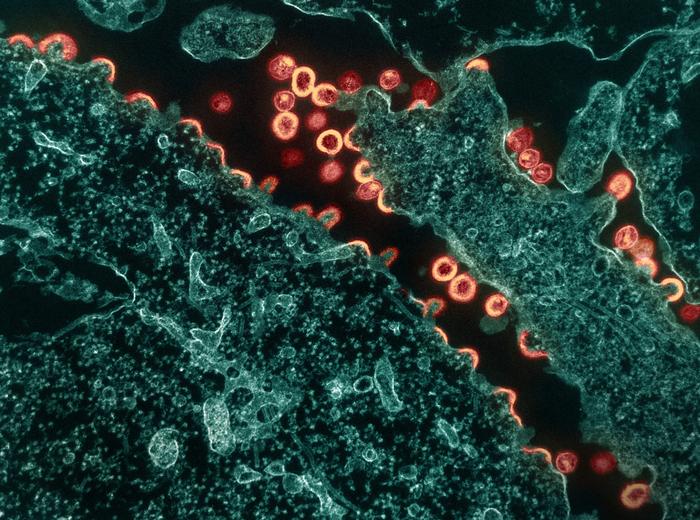
Featured image: Transmission electron micrograph of HIV-1 virus particles budding from an infected cell. (CREDIT: NIAID)
Endnotes
- Truong H-HM, Semeere A, Ylannoutsos CT, Musick B, Wools-Kaloustian K, Lewis-Kulzer J, Odhiambo F, Diero L, Kasozi C, Michael Mkwashapi D, Cohen CR. “Early impact of funding withdrawal on HIV care and treatment programs in East Africa.” Abstract OAC0204, AIDS 2026, the 26th International AIDS Conference, Rio de Janeiro, July 2026. https://programme.aids2026.org/Abstract/Abstract/?abstractid=10859 (abstract also published in the Journal of the International AIDS Society conference supplement: https://pmc.ncbi.nlm.nih.gov/articles/PMC13404270/)
- University of California, San Francisco. “How US HIV funding cuts quickly affected care in East Africa.” EurekAlert!, July 28, 2026. https://www.eurekalert.org/news-releases/1137953
- KFF. “The U.S. President’s Emergency Plan for AIDS Relief (PEPFAR).” Fact sheet. https://www.kff.org/global-health-policy/fact-sheet/the-u-s-presidents-emergency-plan-for-aids-relief-pepfar/
- HIV.gov. “PEPFAR.” https://www.hiv.gov/federal-response/pepfar-global-aids/pepfar
- Tram KH, Ratevosian J, Beyrer C. “By executive order: The likely deadly consequences associated with a 90-day pause in PEPFAR funding.” Journal of the International AIDS Society 28, no. 3 (2025): e26431. https://doi.org/10.1002/jia2.26431
- “UCSF study finds significant effect from HIV/AIDS global funding pause.” San Francisco Examiner, August 2026. https://www.sfexaminer.com/news/public-health/ucsf-study-finds-impact-of-hivaids-global-funding-pause/article_a645a92e-a4ea-4097-a8f1-72040b6f3e01.html
- UNAIDS. “Impact of US funding cuts on the global AIDS response: Weekly update, 8 April 2025.” https://www.unaids.org/sites/default/files/2025-04/20250408-USstop-sitrep.pdf
- ten Brink D, et al. “Impact of an international HIV funding crisis on HIV infections and mortality in low-income and middle-income countries: a modelling study.” The Lancet HIV 12, no. 5 (2025): e346–e354. https://doi.org/10.1016/S2352-3018(25)00074-8
- “PEPFAR funding cuts will lead to up to 74,000 excess HIV deaths in Africa by 2030, experts warn.” CIDRAP, July 2025 (reporting on a modeling study in eClinicalMedicine). https://www.cidrap.umn.edu/hivaids/pepfar-funding-cuts-will-lead-74000-excess-hiv-deaths-africa-2030-experts-warn
- “Impact of US government funding freezes on the HIV response: findings from a rapid survey in 32 countries.” Health Affairs Scholar 4, no. 2 (2026): qxag020. https://academic.oup.com/healthaffairsscholar/article/4/2/qxag020/8489381
- “International funding cuts disrupted global response to HIV, UN report says.” Al Jazeera, November 25, 2025. https://www.aljazeera.com/news/2025/11/25/international-funding-cuts-disrupted-global-response-to-hiv-un-report-says
- “Trump administration pushes back on claims that cuts to global HIV program have cost more lives.” Washington Examiner. https://www.washingtonexaminer.com/policy/foreign-policy/4536342/pepfar-hiv-aids-state-department/


Leave a Reply