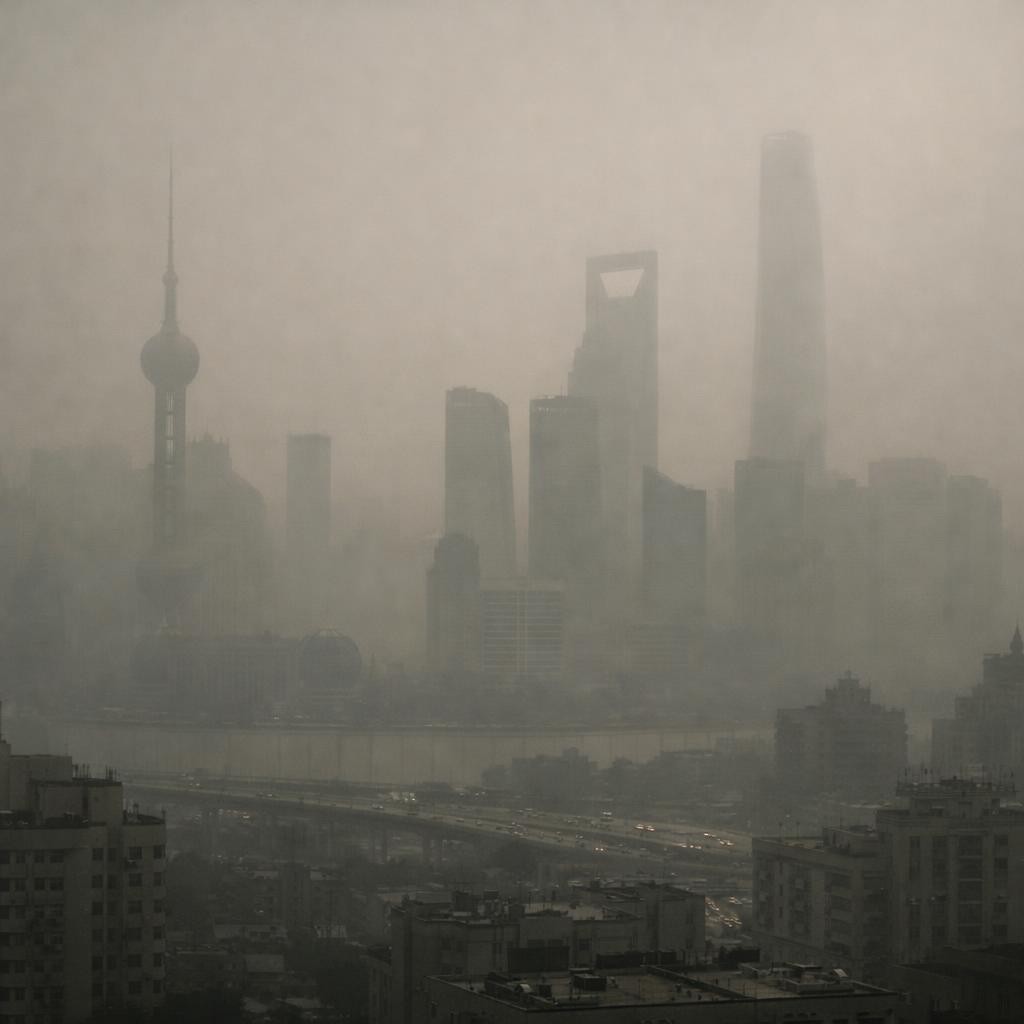
When a city issues an air-quality alert on a hot summer afternoon, most people picture tailpipes. A study published in Science Advances suggests the picture is out of date. In summer, a large share of the reactive pollutants rising off an urban area comes from things like hairspray, paint, solvents, cleaning products and the buildings people live in.
The research, by scientists at Colorado State University, the University of Minnesota and Purdue University, also finds that these emissions climb with temperature. That matters because the air-quality models cities and states rely on do not account for it.
“These sources are important but are not accurately included in current models,” said Delphine Farmer, a professor of chemistry at Colorado State who helped lead the study. She was referring to what atmospheric chemists call volatile chemical products, a category that takes in personal care products, paints, solvents, cleaners and building materials, all of which turned out to be major summertime emissions from the city.
Winter Belongs to Cars, Summer to Everything Else
The gases at issue are volatile organic compounds, carbon-containing chemicals that evaporate readily. They are usually discussed as an indoor air problem. Outdoors, they react in sunlight and contribute to the formation of ozone and fine particles.
The team took measurements over an urban part of Long Island, New York, in both summer and winter. The seasonal contrast was sharp. In winter, vehicle emissions accounted for most of the pollution. In summer, most of it came from other sources, chemical products and residences among them.
Dylan Millet, a professor of atmospheric chemistry at the University of Minnesota and a co-author, put the result in historical context. Vehicles have become much cleaner, he said, and as their contribution shrinks, urban sources that have received far less study carry more weight. Many of those sources release more as the temperature rises. That means they can be expected to increase during heat waves and as the climate warms.
Measuring What Leaves the Ground
What distinguishes the study is how the measurements were made. Most research on urban air records concentrations, meaning how much of a pollutant is present at a given spot. That tells you what is in the air, but not directly where it came from or how fast it is being produced.
The researchers instead mounted instruments on a cellular tower and used a technique called eddy covariance, which pairs rapid wind measurements with chemical measurements to calculate directly how quickly each compound is being emitted from the surface below. The method is seldom used in cities. Its measurement requirements are demanding, and the sampling has to be done well above the surrounding buildings.
Combined with machine learning tools, the approach let the team identify both the pollutants and their sources. Michael Vermeuel, an assistant professor at Purdue and the paper’s first author, said it captures what is actually coming off the urban surface and where it originates. Few urban field experiments have done that, he added, and the chemical fingerprint of the emissions changed substantially between summer and winter.
A Gap in the Models
The practical concern is forecasting and regulation. Air-quality agencies use models to predict bad-air days and to decide which sources to control. If those models leave out emissions that surge on precisely the hottest days, agencies are working without information they need, and strategies built around traffic may deliver less than expected.
The findings come from one urban area measured in two seasons, and the university’s summary of the work gives no specific emission figures or the share attributed to each source. How well the Long Island pattern holds for cities with different housing, climates and product use would need to be tested elsewhere. The implied next step is for modelers to build temperature-dependent emissions from consumer products and buildings into the tools that guide air-quality policy.
Endnotes
- Vermeuel, M., et al. (2026). “Surface temperatures drive strong seasonality in urban reactive carbon emissions.” Science Advances. https://doi.org/10.1126/sciadv.aef9622
- Colorado State University (October 7, 2026). “Summertime air pollutants often come from household products and buildings.” EurekAlert! https://www.eurekalert.org/news-releases/1146746



Leave a Reply