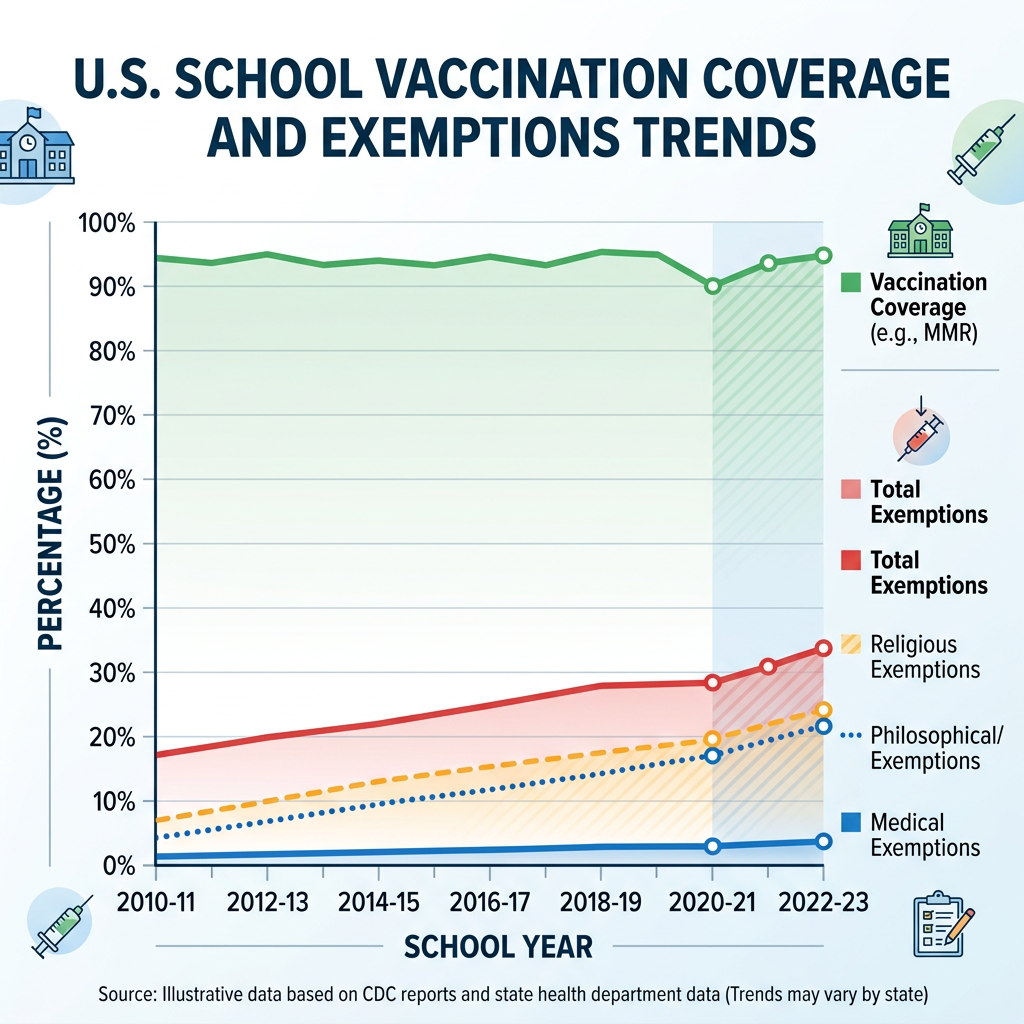
Childhood Vaccine Exemptions Rise as Measles Spreads: More U.S. children are entering school without routine vaccinations as nonmedical exemptions continue to rise. New CDC data show roughly 4% of kindergartners received an exemption for at least one vaccine during the 2025–26 school year, an 18% increase from the previous year and the largest annual jump in more than a decade. Rates vary sharply by state: nearly 13% of Utah kindergartners had religious or personal exemptions, while New York reported none. Overall vaccination coverage remains high at about 92%, but public health experts warn that local pockets of low immunization can fuel outbreaks. The concern is especially acute amid the nation’s worst measles year in recent history, including major outbreaks in under-vaccinated communities. Experts say rising exemptions threaten community immunity and vulnerable children. (New York Times)
Ebola Deaths in Congo Signal Hidden Transmission Chains: The Ebola outbreak in the Democratic Republic of the Congo is spreading faster than any previous Ebola epidemic, according to World Health Organization Director-General Tedros Adhanom Ghebreyesus. Speaking to the WHO’s emergency committee, Tedros warned that the outbreak remains far from controlled, with many patients dying at home or elsewhere in their communities rather than in treatment centers. Those deaths are particularly concerning because they suggest health officials are missing transmission chains and because contact with infected bodily fluids during caregiving or burial can spread the virus. The WHO first declared the outbreak a public health emergency of international concern in May. Funding also remains a challenge: the agency has raised about 60% of the $115 million it says is needed for the response. (cidrap.umn.edu)

Sugary Drinks Linked to Higher Gastric Cancer Risk: Daily consumption of sugar-sweetened beverages was associated with substantially higher gastric cancer risk in a long-running U.S. study. Mass General Brigham researchers analyzed 112,284 participants from the Nurses’ Health Study and Health Professionals Follow-Up Study, among whom 278 developed gastric cancer over decades of follow-up. People consuming at least one sugary beverage daily had a 2.45-fold higher risk than those drinking fewer than one per month; higher fructose intake was also associated with greater incidence. Artificially sweetened beverages showed no significant association. The researchers adjusted for numerous potential confounders, but emphasized that the observational design cannot establish causation. Limited information on H. pylori infection and the predominantly white study population were additional limitations. Results appeared in Gastro Hep Advances. (Medical Xpress)
Gut Bacteria May Turn Against Mucus Without Fiber: New research is complicating scientists’ understanding of how fiber, dietary protein and the gut microbiome interact. Researchers found that fiber can reduce bacterial degradation of the intestinal mucus lining, thereby decreasing production of potentially harmful phenol metabolites. They also identified digestion-resistant proteins, dubbed “Prifs,” that reach gut microbes and may promote production of more favorable metabolites associated with plant-based diets. Surprisingly, isotope-tracing experiments in mice, rats and human cells also showed that several indole and phenol compounds previously assumed to originate exclusively from microbes can be produced by mammalian metabolism itself. The work, published across PNAS and Nature Metabolism, suggests future dietary or probiotic therapies may need to distinguish carefully between compounds produced by microbes and those manufactured by the host. (ScienceDaily)
Ultra-Processed Foods Tied to Prostate Cancer Risk: Men consuming more ultra-processed food were more likely to report developing prostate cancer in a nationally representative U.S. analysis. Florida Atlantic University researchers examined 17,024 men participating in NHANES between 2003 and 2023, estimating the share of calories coming from ultra-processed foods using dietary recalls and the NOVA classification system. Compared with the lowest-consumption group, men in higher intake categories showed roughly 24% to 31% greater adjusted prostate cancer risks; the highest-intake group showed a 34% increase that did not reach statistical significance. The findings, published in The American Journal of Medicine, do not prove that processed foods cause cancer: dietary intake and cancer were self-reported, and unmeasured factors may contribute. Researchers called for larger prospective studies and randomized trials. (Florida Atlantic University)
Seafood Could Help Close Brazil’s Nutrition Gaps: Brazil’s enormous coastline could become a surprisingly powerful public-health resource. Researchers combined food-consumption data from more than 30,000 Brazilians with fisheries statistics and nutrient profiles to examine whether seafood could address widespread micronutrient deficiencies. Seafood currently provides only about 6% of Brazil’s protein intake, despite being nutrient dense and relatively environmentally efficient compared with many terrestrial animal foods. Modeling suggested increasing seafood to roughly 25% of protein intake could substantially reduce several nutritional shortfalls, including deficiencies involving vitamin A, calcium and magnesium. The researchers caution that simply expanding fishing would be unsustainable because many fisheries are already stressed. Instead, they advocate nutrient-conscious fisheries management, appropriate aquaculture expansion and protection of marine biodiversity. The study was published in Nature Food. (Miami News)
Vegetable Diversity Could Strengthen Diets and Farms: Nutrition policy should focus not merely on getting people to eat more vegetables, but on greatly expanding which vegetables are grown and consumed, researchers argue. A PNAS study identifies more than 1,480 edible vegetable species worldwide, many of them traditional or underused crops receiving comparatively little research, breeding or conservation attention. Examples include African spider plant, Asian bitter melon, Pacific slippery cabbage and edible pumpkin, sweet-potato and cowpea leaves. Such plants can provide important vitamins and minerals while carrying genetic traits that help crops withstand heat, drought, pests and disease. Researchers note that global vegetable intake remains roughly 40% below World Health Organization recommendations. They propose linking seed conservation, crop breeding, agricultural policy and public-health efforts so biodiversity reaches dinner plates rather than remaining solely in genebanks. (Phys.org)
Brain Protein May Help Restrain Fat Consumption: Researchers have identified a brain mechanism that may influence how strongly animals seek out high-fat foods—and it appears to operate differently in males and females. Osaka Metropolitan University scientists studied OPA1, a mitochondrial protein found in appetite-regulating MC4R neurons of the hypothalamus. Mice lacking OPA1 in those neurons ate more, gained additional weight with age and showed especially strong preferences for dietary fat when offered soybean oil. Female knockout mice were particularly affected. Researchers also found sex differences in responses to setmelanotide, an obesity drug acting through the MC4R pathway: appetite suppression was weaker in OPA1-deficient females. Published in The FASEB Journal, the mouse study does not demonstrate the same mechanism in humans but highlights neuronal energy metabolism as a potentially important component of obesity biology. (ScienceDaily)
AI App Aims to Measure Meals More Accurately: Emory University researchers have developed an AI-powered dietary assessment system designed to tackle one of nutrition science’s stubbornest problems: accurately determining what people actually eat. NutriCamp lets users record meals through photographs, voice or text, then identifies foods, estimates portions and calculates 65 nutrients and food components. Its database contains more than 5,600 foods and beverages and 23,000 portion descriptions. In testing involving complex real-world meals, the underlying NutriCamp framework reduced average estimation error for food weight and four key nutritional measures by 63%, outperforming several commercial dietary apps, food-recognition systems and GPT Vision. Dietitians also evaluated its estimates. Researchers envision the technology supporting epidemiological research and personalized clinical nutrition, although they say further validation across populations and medical conditions is necessary. (Medical Xpress)
Diet Apps Work Differently Depending on Social Feedback: Adding social persuasion to diet-tracking apps does not automatically make people eat better, according to research examining how different feedback mechanisms affect engagement. Investigators tested features including expert evaluation of meal photographs and peer-based observation. Photo-informed feedback from experts increased app use, slowed users’ tendency to disengage and improved meal recording. By contrast, allowing participants to observe other users’ food photographs reduced engagement and did not meaningfully change food choices. The results suggest digital nutrition tools may be more effective when social features provide authoritative, actionable guidance rather than simple comparison with peers. The study, published in the International Journal of Information Management, has implications for developers attempting to use behavioral science to promote healthier eating. It also illustrates how apparently similar “social” design features can produce strikingly different outcomes. (EurekAlert!)
Global Food Systems Are Missing Most 2030 Targets: The world is badly off course on nearly every major measure of food-system sustainability and nutrition, according to the 2026 Food Systems Countdown analysis. Researchers evaluated 197 countries across 44 indicators spanning diets and health, environmental impacts, livelihoods, governance and resilience. Of 30 indicators with defined targets, only mobile-phone subscriptions were projected to be met by most countries. For 22 indicators, fewer than one-third of countries are on pace to achieve their targets by 2030. Troubling trends include rising ultra-processed-food sales, agricultural water use, pesticide use and food-system emissions. Researchers found no country currently on track to meet the greenhouse-gas emissions target for food systems. The Nature Food analysis nevertheless identifies regional benchmarks and governance reforms that could provide more achievable pathways toward improvement by 2050. (Phys.org)
Community Health Centers Push Nutrition Into Primary Care: The National Association of Community Health Centers has launched a new Center for Nutrition and Health aimed at making food-based interventions a more routine part of primary healthcare. The initiative will help community health centers develop sustainable “Food for Health” programs for preventing and managing nutrition-related chronic conditions including diabetes, hypertension and cardiovascular disease. Such programs can include nutrition education, food distribution and “food pharmacy” approaches. One cited Miami-Dade program distributes food to 450–500 families each month and reaches roughly 40,000 people annually. The initiative also addresses practical obstacles that have prevented food-as-medicine programs from expanding, including reimbursement, infrastructure and fragmented partnerships. NACHC says a national assessment of community health centers’ nutrition capabilities and challenges, developed with Elevance Health Foundation, will be released this fall. (NACHC)




Leave a Reply