Scientists Discover a Genetic Eye Disease That Silently Destroys Night Vision
Researchers at the University of Pennsylvania and collaborating European institutions have identified a previously unrecognized inherited eye disease that gradually damages peripheral and night vision while preserving central eyesight for years. The condition, provisionally called EFEMP1-associated late-onset retinal degeneration, results from a specific mutation in the EFEMP1 gene. Examining three unrelated families, scientists discovered that affected individuals experienced unusually slow recovery when moving from bright environments into darkness. Remarkably, this abnormality could be detected before retinal cells showed visible structural damage. Published in JAMA Ophthalmology and reported November 22, the findings could help physicians identify the disorder before irreversible vision loss occurs. Researchers have not established how common the mutation is, and no specific treatment has been demonstrated. (ScienceDaily / Penn Medicine)
Alzheimer’s Research Identifies Protein That May Accelerate Brain Damage
Scientists at Sweden’s Lund University have discovered that a protein produced by the brain’s immune cells may actively contribute to Alzheimer’s disease rather than merely accompany it. The protein, galectin-3, binds to amyloid-beta plaques and changes how their protein fibers form. It also influences how microglia, the brain’s immune cells, process accumulated amyloid. In experiments involving mice with Alzheimer’s-like disease, removing galectin-3 produced smaller, more compact plaques, reduced damage to surrounding nerve endings and shifted microglia toward a more protective state. Human brain-tissue observations supported an association between galectin-3 and disease pathology. Published in Proceedings of the National Academy of Sciences and reported November 20, the research identifies a potential treatment target. A phase 2 antibody trial has received regulatory clearance, but patient benefits remain unproven. (Medical Xpress / Lund University)
Scientists Discover a Major Hidden Source of Nutrients Feeding the World’s Oceans
Researchers at the Hong Kong University of Science and Technology have discovered that organic nitrogen carried through the atmosphere supplies a substantially larger share of ocean nutrients than previously recognized. Analyzing 418 marine aerosol samples collected during 21 research cruises, including Arctic and Antarctic expeditions, scientists estimated that approximately 12.8 million tonnes of organic nitrogen enter the oceans annually. That represents roughly 27% of total atmospheric nitrogen deposition, rising to around half in some nitrogen-limited waters. Biomass burning, marine aerosols and atmospheric chemical reactions were major contributors. Published in Science and reported November 22, the findings could change how scientists model marine productivity, carbon cycling and climate. They also demonstrate how emissions originating on land can influence ecosystems thousands of kilometers away. (Phys.org / Hong Kong University of Science and Technology)
European and Japanese Spacecraft Successfully Enter Orbit Around Mercury
The European-Japanese BepiColombo mission has successfully entered orbit around Mercury after an eight-year journey through the inner solar system. Launched in 2018, the spacecraft traveled more than 10 billion kilometers, using gravitational encounters with Earth, Venus and Mercury to gradually adjust its trajectory. On November 21, a series of thruster firings slowed the spacecraft sufficiently for Mercury’s gravity to capture it. The mission’s two scientific orbiters, developed by the European Space Agency and Japan Aerospace Exploration Agency, are scheduled to separate in December and study the planet from different altitudes. Their instruments will investigate Mercury’s magnetic field, dense interior, surface geology and interaction with the solar wind. The mission marks humanity’s first return to Mercury since NASA’s MESSENGER spacecraft ended operations in 2015. (Associated Press / Phys.org)
Rare Rains Trigger Extraordinary Flowering Across Chile’s Atacama Desert
NASA satellite observations have documented an extraordinary flowering event across Chile’s Atacama Desert, one of Earth’s driest environments. Following unusually heavy winter rainfall and rare snowfall, dormant seeds germinated across large stretches of the normally barren landscape, producing dramatic purple, red, green and white vegetation. Scientists believe the 2026 flowering may be the most extensive observed during the satellite era. The rainfall coincided with strengthening El Niño conditions, which altered atmospheric circulation and helped steer storms toward northern Chile. Researchers used Landsat 8 and Landsat 9 imagery, supplemented by drone observations and field photography, to examine the blooms. Reported November 19, the event illustrates how desert ecosystems can respond rapidly to unusual climatic conditions and how satellite records help scientists distinguish exceptional events from recurring environmental cycles. (NASA Earth Observatory)
AI Detects Bladder Cancer Warning Signs Years Before Diagnosis
Researchers at the University of Plymouth have developed an artificial intelligence system capable of identifying subtle bladder cancer warning signs in electronic medical records years before conventional diagnosis. The team analyzed nearly 70,000 patient records spanning 25 years, examining more than 48,000 potential health indicators before identifying 38 particularly informative features. Their model, PRECISE-AGZ, correctly identified 85% of patients with bladder cancer and accurately classified 91% of those without the disease. It detected meaningful warning patterns at least 12 months before diagnosis, with some signals extending five years into patients’ medical histories. Reported November 21, the findings suggest AI could improve referrals and reduce unnecessary invasive examinations. However, further clinical validation is required before the technology can guide routine patient care. (ScienceDaily / University of Plymouth)
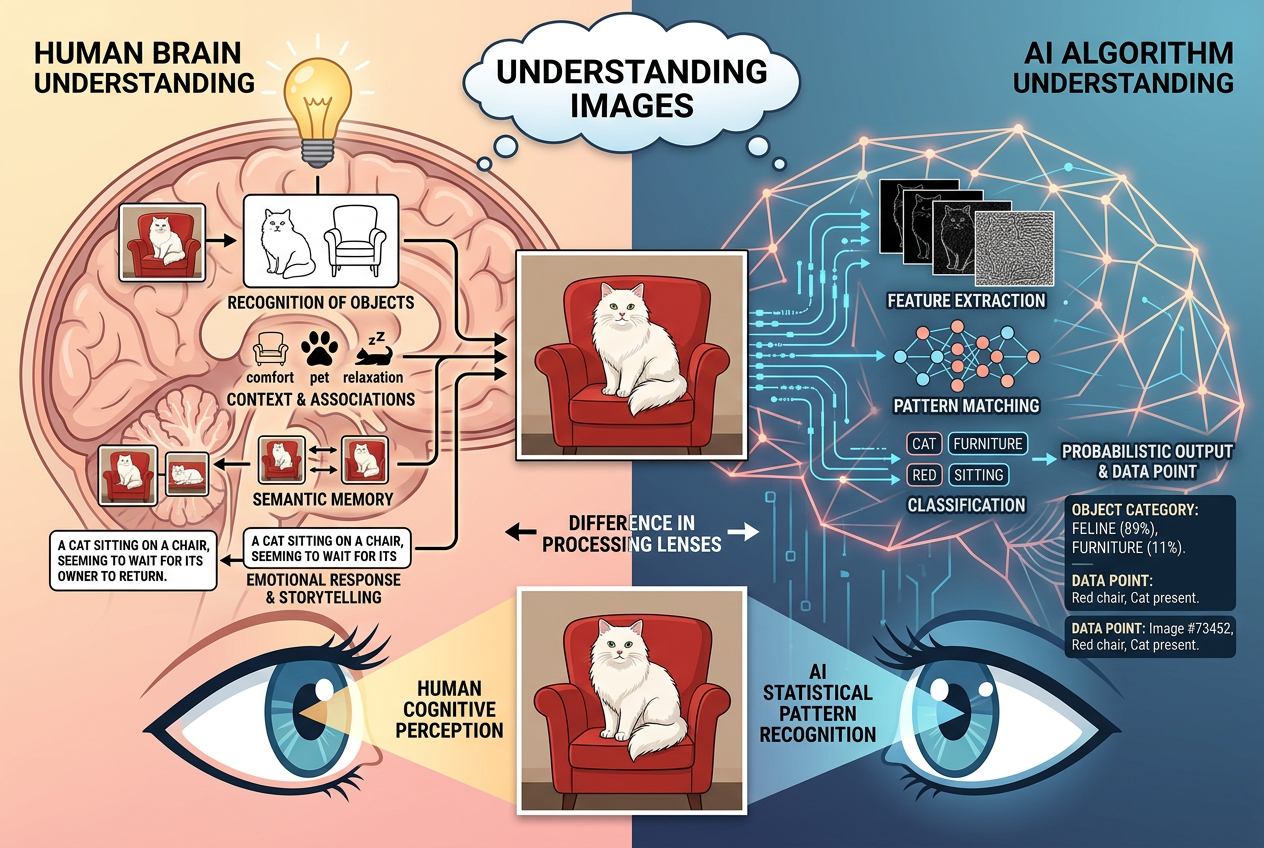
Scientists Discover That AI May Understand Images Differently From the Human Brain
Artificial intelligence systems commonly used to model human vision may rely on internal mechanisms that differ substantially from those employed by biological brains, according to researchers at York University. Scientists developed a technique called reverse predictivity testing, examining whether recorded neural activity could predict the internal representations of artificial neural networks. They tested models using 1,320 natural and synthetic photographs and 300 additional images depicting familiar objects in different visual styles. Although AI models successfully predicted certain patterns of brain activity, neural recordings often failed to predict the models’ internal features. Comparisons between biological brains did not show the same discrepancy. Reported November 21, the findings challenge assumptions that accurately reproducing neural responses means an AI system processes information like a brain. (ScienceDaily / York University)
Inner Ear Discovery Challenges a 65-Year-Old Theory of Hearing
An international research team has discovered that the mammalian inner ear processes low-frequency sounds in ways that challenge a foundational theory of hearing established during the 1960s. Traditional models describe the cochlea as a frequency map, with different locations responding to different sound frequencies. However, researchers examining guinea pig cochleae found that low-frequency vibrations produced nearly simultaneous responses across widely separated regions. Using optical coherence tomography and advanced noise-reduction techniques, the team detected synchronized movements that conventional measurements could overlook. Published in Science Advances and reported November 20, the findings suggest that the brain may distinguish certain sound frequencies without relying exclusively on spatial information. The discovery could eventually influence cochlear implant design, particularly for understanding speech amid background noise. (Medical Xpress / Oregon Health & Science University)
Scientists Discover Nearly 2,100 Species Living Inside North American Buildings
An international team of ecologists has assembled the largest survey to date of wildlife inhabiting homes and other indoor environments across the United States and Canada. Drawing on observations submitted through the citizen-science project Never Home Alone, researchers documented 23,782 records representing nearly 2,100 species. Participants photographed insects, spiders and other wild organisms inside buildings, while taxonomic experts helped verify identifications. Asian lady beetles were the most frequently recorded species, although the collection also included hundreds of spider species and even an alligator discovered in a garage. Published in Ecology and reported November 20, the research highlights how little scientists know about indoor ecosystems. The database could help investigators understand species distributions, biological pest control and how climate change influences wildlife sharing human environments. (Phys.org / North Carolina State University)
Mysterious Asteroid’s Strange Acceleration May Be Caused by Sunlight
Astronomers investigating an unusual object orbiting between Earth and Mars have proposed an explanation for its mysterious movements. The object, designated 1998 KY26, measures approximately 11 meters across and experiences small accelerations that gravity alone cannot explain. Researchers previously considered whether it might be a comet, but new calculations suggest its surface is too warm to retain the ice necessary for conventional cometary activity. Instead, scientists propose that sunlight itself may be responsible. Photons exert tiny amounts of pressure, while absorbed sunlight can generate additional forces as an object radiates heat through the Yarkovsky effect. A study published in Icarus on October 28 and covered by EarthSky on November 20 suggests these mechanisms could explain the object’s unusual trajectory without invoking comet-like outgassing. (EarthSky)


Leave a Reply