Demand for data keeps rising, driven by artificial intelligence, data centers, autonomous vehicles and satellite networks. Sending more information through the air with light runs into a fundamental problem: noise and atmospheric distortion scramble the signal. A team in Shanghai and Hangzhou has demonstrated a way to pack 154 bits into a single pulse of light and recover them intact after turbulence equivalent to 10 kilometers of travel.
The research, led by Guangyu Fan of the University of Shanghai for Science and Technology and Qiwen Zhan of Westlake University, is published in eLight.
Moving Data Away From the Noise
The limit on any communication channel is set by its bandwidth and its signal-to-noise ratio. Rather than simply boosting signal power, the team chose to move the information into a part of the spectrum where the dominant low-frequency technical noise is weaker. Their device, called a spatiotemporal topological comb or ST-Comb, encodes digital data in structures lasting femtoseconds to picoseconds, shifting it into a terahertz-scale spectral region.
Engineers already encode data in light’s wavelength, polarization and spatial patterns. More elaborate light fields, such as those with twisting phase structures known as optical vortices, offer far more possible states, but they are fragile. Turbulence and imperfect optics can split vortices and break pulses apart.
Spreading Information Across the Pulse
The ST-Comb splits an ultrafast pulse into a train of separately controllable sub-pulses, each assigned a programmable topological state. For every sub-pulse, the system independently sets amplitude, delay, twisting phase (topological charge), radial pattern and a phase property the team calls ST-CEP. Sub-pulses are spaced from about 100 femtoseconds to 10 picoseconds apart, within a train lasting roughly 5 to 50 picoseconds.
The key idea is to spread information across a global “fingerprint” of the whole pulse, combining its phase winding, radial structure, superpositions and spectral features, rather than relying on the fine local shape of the field. Experiments showed that as turbulence grew stronger, the local fidelity of the field dropped, but the global fingerprint stayed comparatively stable.
154 Bits and a Guide Star
In the proof of concept, 11 time slots each carried one of 14 predefined topological modes selected by a binary mask, giving 14 bits per slot and 154 bits per pulse. A leading Gaussian sub-pulse travels along as a reference “guide star” and carries no data. At the receiver, the signal is reconstructed, sliced in time, and decoded by a neural network called ST-Net, which classified 1,000 randomly generated test pulses with 100 percent accuracy.
The team tested a real 100-meter free-space link at the Sheshan Station of the Shanghai Astronomical Observatory, and used controlled phase screens to emulate turbulence equivalent to 100 meters, 1 kilometer and 10 kilometers. All datasets achieved 100 percent recognition.
Limits of the Demonstration
The 1- and 10-kilometer results come from emulated turbulence in the lab, not from physical links of that length; only the 100-meter path was tested outdoors. The announcement also gives no data rates, no bit error rates for the full link and no assessment of hardware complexity. The authors suggest future versions could integrate on-chip frequency combs, fast modulators and metasurfaces, and extend the approach to polarization-structured light, with possible uses in ultrafast waveform control and nonlinear optics as well as communication.
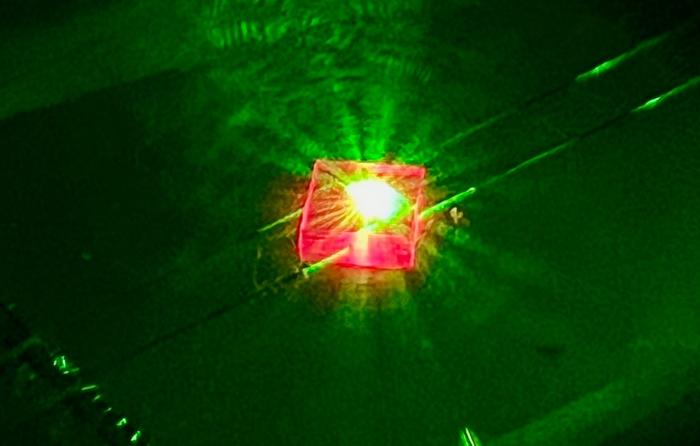
Featured image: A laser beam. Scientific Inquirer media library. (The press release image, showing the generation, encoding and self-referenced detection of the ST-Comb, is credited to Qiwen Zhan et al.)
Endnotes
- Fan, G., Zhan, Q., et al. “Spatiotemporal topological combs for robust high-dimensional information transmission.” eLight, 2026. DOI: 10.1186/s43593-026-00145-w.
- Light Publishing Center, Changchun Institute of Optics, Fine Mechanics and Physics, CAS. “Spatiotemporal topological combs enable robust high-dimensional optical encoding.” EurekAlert!, 2 November 2026. https://www.eurekalert.org/news-releases/1150322


Leave a Reply