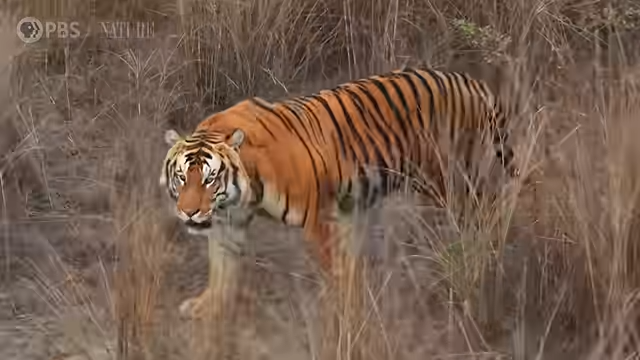
Tigers are among the world’s most recognizable animals, yet much of their private lives remains hidden. In Nature’s two-part documentary Tiger Island, a filmmaking team ventures into the forests of western Nepal, using drones, thermal cameras and local expertise to follow two mothers navigating the challenges of raising cubs. Along the way, they capture encounters that complicate the familiar image of tigers as solitary predators, including mothers apparently caring for each other’s young and an adult male sharing tender moments with cubs. Scientific Inquirer spoke with Nature executive producer Fred Kaufman about the contrasting stories of tigresses Goma and Mala, the care required to film without disturbing the animals, and what these observations might reveal about tiger family life.
Tigers have been filmed countless times. What convinced you that Tiger Island could show audiences something genuinely new?
We were really excited to find a location in Nepal which had not been covered in any great depth by film-makers before. It was a very promising location because of the incredible density of tigers, the presence of highly knowledgeable local experts, and the fact that we were able to gain permission to film the tigers by day and by night, both from the ground and the air. The combination of these three factors was what convinced us that we were onto something really special, and would be able to capture details of tiger behaviour that hadn’t been seen before.
Goma is an experienced mother, while Mala is raising cubs for the first time. How did following both mothers shape the story that ended up being told?
The nerve-wracking thing about this kind of filmmaking is that really you’re at the mercy of the animals. We knew we had a good chance of capturing some fascinating stories, but until we turned up at location we didn’t know what we were going to see. We knew in advance of the shoot, from our expert in-country guides, about Goma and Mala, so we knew we had two contrasting mothers to follow. And in the end we captured two stories, one about a confident, powerful, mature mother doing a remarkable job raising her cubs. And then also the story of an equally-determined but much less experienced mother who despite the odds, managed to keep one of her cubs alive in really difficult circumstances. We were really pleased that the stories were contrasting, but I must say we were so relieved that Mala’s story was one of triumph, in the end – even when things did look so bleak for her at one point.
The team filmed mothers appearing to care for each other’s cubs. Can you discuss the significance of this and just how much can be asserted confidently about the behavior?
We were genuinely perplexed when we were filming this behaviour! We located Goma at one point, and she had five cubs with her – even though we knew only two of them were her own. Then we saw another mother tiger nearby and realised that her cubs were missing – and were the ones hanging out with Goma. It was clear that there was some sort of babysitting behaviour going on. We had big cat scientist Dan O’Neill on our crew, he’s currently working on his PhD, and has co-authored a paper based on our footage, and his observations of the alloparental care he directly witnessed. The paper is currently in the peer review stage, so we’re hopeful that we’ll have helped contribute to the scientific literature around tiger behaviour.
Drones and thermal cameras let the team follow behavior that would otherwise be difficult to see. How did those tools change the film, and what precautions helped keep the crew from disturbing the tigers?
Tigers are such well-camouflaged, secretive creatures that we knew that if we were to uncover new behaviours we needed to film them in untraditional ways – and that meant using drones and night-vision cameras. We’ve been filming animals all over the world using these tools for a number of years now, and we have some simple protocols we follow to ensure we’re not disturbing them. The night vision camera is a great asset because you can spot animals from an incredibly long distance, it has a very long zoom lens, and it can show the presence of creatures even through dense bush. We could position ourselves several hundred feet from the tigers and sit and wait, and sometimes they would actually come towards the crew – they seemed a lot bolder at night. Generally if a creature is approaching the camera and behaving naturally, then that’s a very strong indication that they are comfortable with your presence. Our drone fleet was composed entirely of small, lightweight, quiet drones, equipped with long zoom lenses. We could position the drones over a hundred feet away from the tigers and still capture very striking imagery. On a drone shoot we’ll start on Day One with the drones a long distance away, so they’re pretty much inaudible and invisible to most creatures. And then if we’re seeing natural behaviour, that distance can be slowly reduced over a number of hours or sometimes even over a number of days. We found that with the tigers at this location, they really did not seem to be disturbed by the drones at all, and we ended up being able to fly relatively close to them. They seldom even glanced at the drones, and they continued to exhibit entirely natural behaviour whilst being filmed from the air: playing, hunting, sleeping, etc. It was it was kind of a perfect shoot in the sense that the main tools we had taken to do the job proved to be very compatible with the animals we were filming!
Scenes of mothers, fathers and cubs together offer a different view of tiger family life. After working on this film, what do you hope viewers will reconsider about these animals?
I think that the private lives of tigers have so seldom been filmed that I wonder if it’s less about having our viewers reconsider what they think they know about tigers, and more about having our viewers enlarge their knowledge of what tigers actually get up to all day! Of course, we don’t know whether the behaviours we saw are unique to Tiger Island, or are more widespread across other tiger populations, but I hope we’ve opened people’s eyes to the fact that tigers seem to have more involved family lives than we thought. With regards to female tigers specifically, they do seem to be much more tolerant of each other, to the extent that they look after one another’s cubs. And with regards to male tigers, they aren’t always the brutal cub-killing machines they’re sometimes portrayed as: those tender moments we captured between Bandheil (an adult male tiger), and Goma’s cubs were quite remarkable.




Leave a Reply