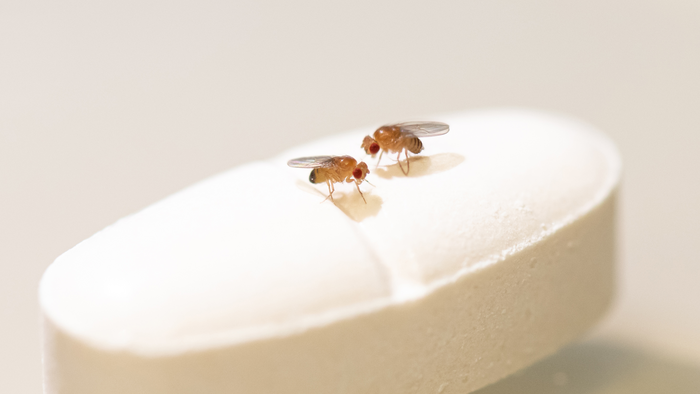
Catch a whiff of apple cider vinegar, and a fruit fly will turn and head toward it. Take the smell away, and something interesting happens: the fly keeps going in the same direction for several more seconds, as though it is holding the goal in mind. That brief persistence is a simple form of working memory, the ability to hold information temporarily so it can guide what you do next. It is the same capacity people use to remember a phone number long enough to dial it or to keep track of where they parked.
Researchers at NYU Langone Health have now traced how the fly’s brain pulls this off. Their study, published in Nature, describes a circuit in which two types of neurons divide the job, one holding the content of the memory and the other controlling when it is written and released. The arrangement, they report, lets the fly switch quickly between keeping track of its own heading and locking onto a specific target.
Two Cell Types, One Goal
The team, led by Katherine Nagel, an associate professor of neuroscience at NYU Grossman School of Medicine, recorded electrical activity in the flies’ brains while the insects tracked the vinegar odor and continued after it disappeared. Two neuron types, known as PFG and hΔK, showed closely matched patterns of activity during the behavior, suggesting they were working together to steer the fly.
Both cell types sit in the central complex, a region of the insect brain that functions as a navigation center. Work over the past decade has shown that neurons there form an internal compass, a ring of activity that tracks which way the fly is facing much as a needle tracks north.
To understand how PFG and hΔK interact, the researchers turned to the fruit fly connectome, the complete wiring diagram of every neuron and synapse in the fly brain. The map allowed them to see exactly how the two populations connect to each other and to the rest of the navigation system, and to build a model of the circuit with co-investigator Bard Ermentrout of the University of Pittsburgh.
A Split Attractor
Neuroscientists have long proposed that working memory relies on “attractor” networks, circuits whose activity settles into a stable pattern and stays there even after the original input is gone, much as a marble rests at the bottom of a bowl. The NYU team found a variation on that idea, which they call a split attractor network.
In this design, PFG neurons hold the content of the memory, in this case the direction of the goal. The hΔK neurons control its timing. Between them sits a communication block that acts as a gate. When the gate opens, a new goal can be written in quickly. When it closes, the memory is protected and can persist on its own. That separation lets the fly shift between simply tracking where it is facing and committing to a particular destination.
Nagel said scientists have long assumed an arrangement like this powers working memory, but direct evidence for how such circuits operate has been hard to obtain. Pinning down what specific networks do, she noted, is one of the frontiers of the field.
From Flies to People
A fruit fly’s brain holds roughly 140,000 neurons, compared with about 86 billion in a human brain. That simplicity is precisely what makes it useful. Researchers can map every connection, record from identified cells and test models in ways that are not yet possible in mammals.
“The fly has an amazing track record for revealing how human biology works,” Nagel said. Studies in Drosophila have helped uncover the genetics of development, the molecular basis of circadian rhythms and the mechanics of learning, many of which turned out to be shared with humans.
Whether a split attractor operates in the mammalian brain remains an open question. Working memory in people is thought to involve the prefrontal cortex and other regions whose circuits are vastly more complex. But the fly study offers a concrete, testable design, a way of separating what is remembered from when it is updated, that researchers can now look for elsewhere. Nagel said she hopes the work provides insight into processes such as working memory more broadly.
The study’s co-authors are Aaron J. Lanz, Nicholas D. Kathman and Emily Hao. The research was supported by the National Institutes of Health and the National Science Foundation.
Endnotes
- Nagel, K. (senior author) et al. (2026). A split attractor design for rapidly writing a navigational goal. Nature. https://doi.org/10.1038/s41586-026-11144-9
- NYU Langone Health / NYU Grossman School of Medicine (October 7, 2026). “Fruit fly study reveals mechanics of working memory.” EurekAlert! https://www.eurekalert.org/news-releases/1146889

Leave a Reply