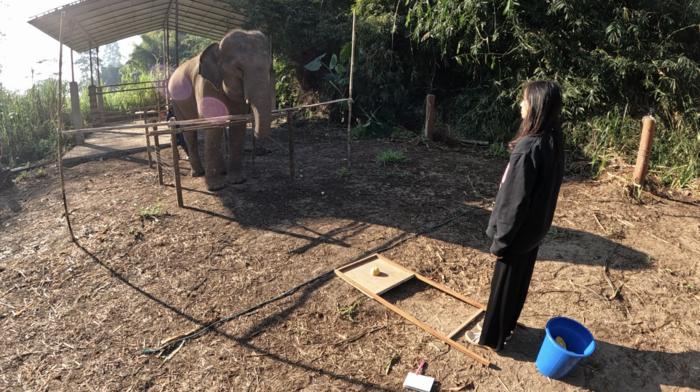
About 700,000 years ago, on the banks of what is now the Jordan River in northern Israel, a straight-tusked elephant died near a place where early humans were making stone tools. One of its molars survived, buried alongside handaxes and cleavers. Researchers have now used that single tooth, together with pollen and other evidence, to reconstruct the landscape those humans lived in. What they found was a well-watered refuge of woodlands, grasslands, marshes and rivers.
The study, published in Quaternary Science Reviews, was led by Hannah Farrell, a doctoral candidate at the University of Haifa, working with Prof. Gonen Sharon of Tel-Hai University, who directs excavations at the site. Collaborators include Cheryl A. Makarewicz and Nimrod Marom of the University of Haifa and Minji Jin and Dafna Langgut of Tel Aviv University.
A Famous Site, a New Excavation
The tooth comes from Gesher Benot Ya’aqov, the “Daughters of Jacob Bridge,” in the Jordan Rift Valley just south of the Hula Valley. The area is one of the most important early human sites outside Africa. Earlier work there produced some of the oldest evidence of controlled fire use and a rich record of Acheulian technology, the long-lived toolmaking tradition associated with Homo erectus and its relatives and known for its teardrop-shaped handaxes.
The new material comes from an area called North Bridge Acheulian (GBY-NBA). There, excavators recovered a well-preserved molar of Palaeoloxodon antiquus, the straight-tusked elephant, in the same layers as basalt handaxes and cleavers. Palaeoloxodon was among the largest land mammals of the Pleistocene, considerably bigger than living African elephants, and it ranged across Europe and western Asia.
What a Tooth Remembers
Elephant molars are unusually informative. They are huge, they form over years, and they record both what an animal ate and the environment it lived in. The team combined several methods to read that record. CT scanning and 3D reconstruction allowed them to study the tooth’s internal structure without damaging it. Microscopic analysis of wear on the chewing surface revealed the texture of the elephant’s diet. Isotope geochemistry captured chemical signatures of the plants it consumed and the water it drank.
Carbon isotope values from the tooth point to a consistently well-watered environment rather than a dry, seasonally stressed one. Pollen recovered from the site’s sediments supports that picture, showing abundant wetland plants including reeds, sedges, willow and tamarisk. Together, the evidence describes a mosaic landscape of woodland, open grassland, marsh and shallow water.
A Refuge on the Corridor
That setting matters because of where it sits. The Levant forms a narrow land bridge between Africa and Eurasia, known as the Levantine Corridor, and nearly every early human population moving out of Africa by land would have passed through it. The authors describe the Hula Valley as a stable ecological refuge along that route, a place where reliable water and food could support both people and large animals even as climate shifted elsewhere.
Sharon said the availability of water, plants and animals “shaped where humans and wildlife could survive.” The work, he noted, is ultimately about understanding how people and animals responded to environmental change hundreds of thousands of years ago.
The close association between the elephant and the tools also raises questions about how early humans used such animals. Elephant remains appear at a number of Acheulian sites, and archaeologists continue to debate how often early humans hunted these giants versus scavenging carcasses. The study does not settle that question, but it places the tools and the animal in the same rich, watery landscape.
Why It Matters
Reconstructing ancient environments is essential to understanding human evolution, because the landscapes early people moved through determined what resources they could use and where they could survive. A single site can only reveal so much, and the evidence here comes largely from one tooth and its surrounding sediments. Still, the convergence of several independent lines of evidence, from wear patterns to isotopes to pollen, strengthens the case that the Hula Valley offered a rare stability during a period of environmental change.
For researchers tracing how humans spread out of Africa, that stability may help explain why this corner of the Levant was occupied repeatedly over such long stretches of time.
Featured image credit: KyotoU / Hoi-Lam Jim
Endnotes
- Farrell, H. et al. (2026). Elephant dental remains from the Acheulian site at North Bridge Acheulian–Gesher Benot Ya’aqov: hominin behavior and environmental implications. Quaternary Science Reviews. https://doi.org/10.1016/j.quascirev.2026.110277
- Tel-Hai University of Kiryat Shmona in the Galilee (October 7, 2026). “700,000-year-old elephant tooth reveals a lost ecosystem shared by early humans in the Levant.” EurekAlert! https://www.eurekalert.org/news-releases/1146912

Leave a Reply