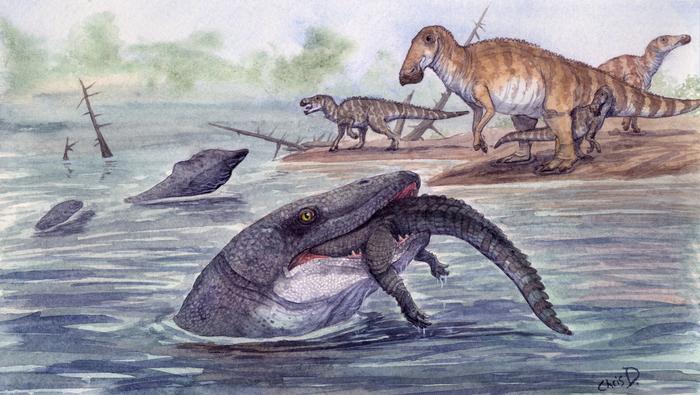
Some 70 million years ago, while tyrannosaurs ruled North America’s floodplains, the oceans belonged to mosasaurs. These marine reptiles, distant relatives of today’s monitor lizards and snakes, grew to the size of a city bus and sat at the top of Late Cretaceous food webs. Paleontologists have long known they were formidable. What has been harder to pin down is how they hunted.
A study led by Rutgers University, published in Current Biology, suggests that not all mosasaurs hunted the same way. By reconstructing the bodies of four mosasaur species and applying basic physics to their tails, the researchers found that some were built for explosive, ambush-style lunges while others were better suited to cruising open water in pursuit of prey. The team describes it as the first attempt to quantify burst swimming in a marine reptile from the age of dinosaurs.
One Stroke of the Tail
Lead author Kiersten Formoso, an assistant professor in the Department of Ecology, Evolution, and Natural Resources at Rutgers, and her colleagues began with fossil skeletons. From those, they rebuilt the overall body shapes of four genera: Platecarpus, Tylosaurus, Mosasaurus and Plotosaurus. They then asked a narrow but revealing question. Starting from rest, how fast could each animal accelerate with a single sweep of its tail?
That kind of “slam start” matters for predators that rely on surprise. A pike lurking in weeds or a barracuda hanging motionless near a reef wins its meals in the first fraction of a second. The tail does the work, shoving against the water to launch the body forward before prey can react.
The models showed a clear split. Platecarpus and Tylosaurus produced faster lunges for their body size than Mosasaurus and Plotosaurus, with Platecarpus coming out on top relative to its size. A large Tylosaurus, the team estimates, could reach roughly 15 miles per hour from a single tail stroke. That is a brief burst, not a cruising speed, but it is the kind of acceleration that turns an unsuspecting fish or turtle into a meal.
Where the Power Came From
The advantage traced mainly to anatomy behind the hips. The ambush specialists had a longer, more flexible section of tail, which let them generate more thrust in that first push. Plotosaurus, by contrast, carried a stiffer tail shaped for efficiency over distance. “Its tail was built for sustained, tuna-like swimming rather than sudden bursts,” Formoso said.
That comparison to tuna is apt. Modern fishes show the same trade-off. Fast-starting ambush hunters tend to have flexible bodies and broad tails, while open-ocean cruisers such as tuna and mackerel have stiff bodies and narrow, crescent-shaped tail fins that minimize drag over long swims. The Rutgers analysis suggests mosasaurs evolved along a similar spectrum, sorting themselves into different ecological roles rather than competing for exactly the same prey in exactly the same way.
The researchers stress that the cruisers were not sluggish. Plotosaurus simply excelled at something different: covering ground efficiently and chasing prey through open water rather than waiting to strike.
A Giant From New Jersey
The team also modeled exceptionally large individuals, including a Mosasaurus based on a fossil held by the New Jersey State Museum in Trenton. New Jersey has a long association with mosasaurs; its Cretaceous marine deposits have yielded remains of the animals since the 19th century, and the state’s fossil record has helped shape what scientists know about the group.
Modeling giants is important because size changes the physics. Larger animals have more muscle to drive the tail, but they also have far more mass to get moving. Understanding how those factors balance out helps clarify whether the biggest mosasaurs could still ambush prey or had to rely on other strategies.
Reading Behavior From Bones
Behavior rarely fossilizes, so paleontologists usually infer it indirectly from teeth, stomach contents, bite marks or the environments where fossils are found. The Rutgers approach adds another tool. Because the laws governing how a body moves through water have not changed in 70 million years, a well-reconstructed skeleton can be treated as a machine whose performance can be estimated.
That approach has limits. The models depend on reconstructions of soft tissue, including muscle mass and the shape of the tail fluke, that are not preserved directly in most fossils. Estimates of speed are therefore best read as comparisons between species rather than precise measurements. Still, the consistent difference between the ambushers and the cruisers points to real variety in how these predators made a living.
The findings add to a growing picture of mosasaurs as a diverse group rather than a single kind of sea monster. Some crushed shellfish, some hunted large prey, and now some appear to have specialized in the sudden rush from hiding while others ran their quarry down in open water. The study was funded by the U.S. National Science Foundation, the Geological Society of America and the Paleontological Society.
Featured image credit: Christopher DiPiazza
Endnotes
- Formoso, K. et al. (2026). Mosasaur tail morphology reveals burst swimming performance and ecological diversity. Current Biology. https://doi.org/10.1016/j.cub.2026.09.036
- Rutgers University (October 7, 2026). “Some of those ancient sea predators were built for surprise attacks.” EurekAlert! https://www.eurekalert.org/news-releases/1146904



Leave a Reply