Mammals are defined by milk. Every one of us began life suckling, using a coordinated set of muscles and bones that lets an infant draw in milk and swallow it while still breathing. That system is so basic to mammalian life that it is easy to assume it arrived with the first true mammals. A newly described fossil from China suggests the key anatomy was in place much earlier, in an otter-sized predator that swam the lakes and rivers of the Middle Jurassic.
The animal, named Megacauda sungei, lived about 165 million years ago in what is now Xiayingzi, Inner Mongolia. It is described in Nature by an international team from Shenyang Normal University, the University of Chicago, the University of Bonn, Shandong University of Science and Technology and Ohio University. The species name honors Prof. Sun Ge, honorary director of the Paleontological Museum of Liaoning.
A Small Top Predator
Megacauda was a docodont, a member of an extinct group of mammaliaforms, the close relatives of true mammals that diversified during the age of dinosaurs. It measured about half a meter from nose to tail and weighed roughly two kilograms. That is small by modern standards, but large for a Jurassic mammal relative, and the researchers argue it was a top predator in its freshwater setting.
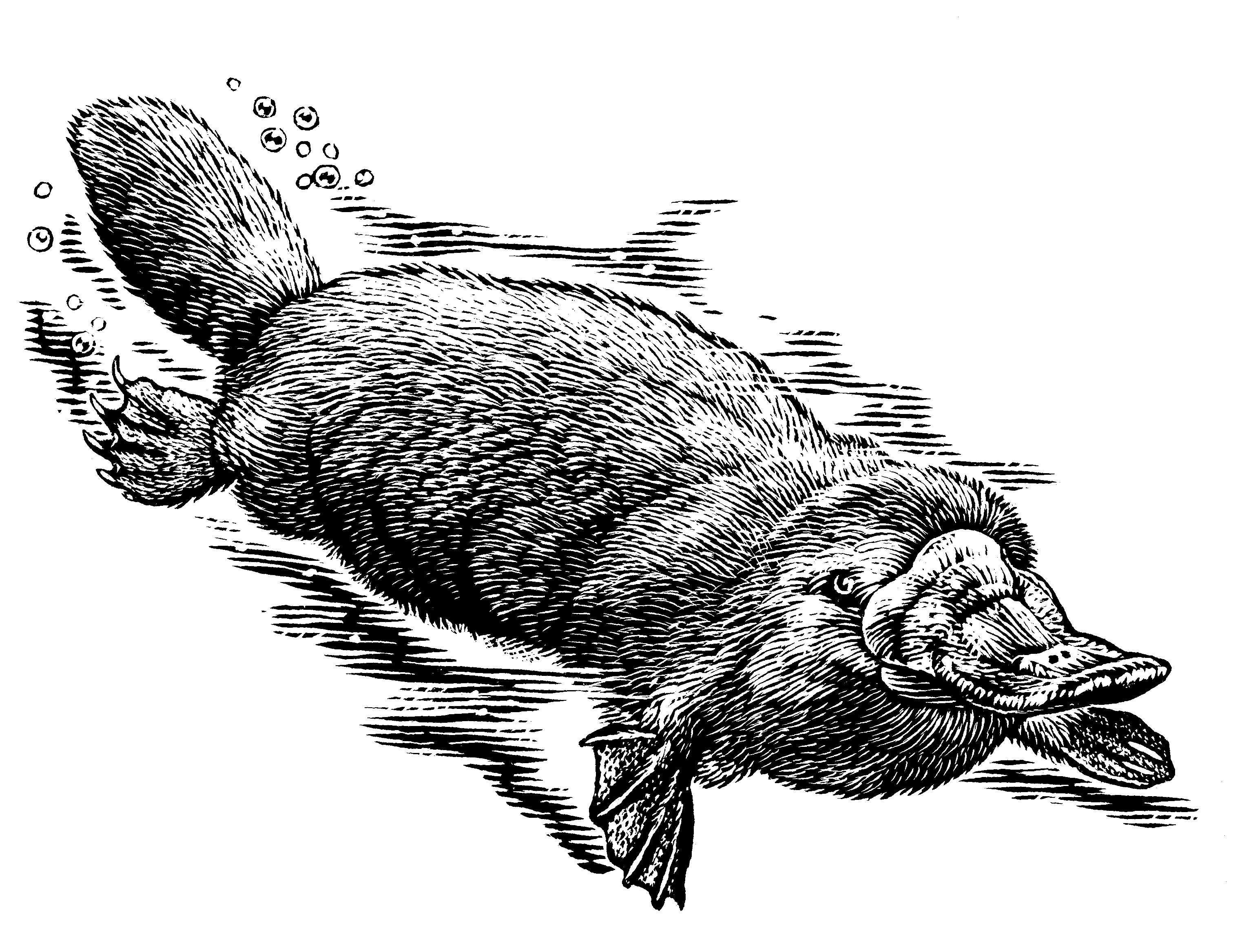
Micro-CT imaging revealed a strange combination of features borrowed, in appearance, from very different living animals. It had seal-like cheek teeth whose backward-curving cusps would have helped grip slippery prey such as fish. Its pelvis resembled a platypus’s, and its long tail resembled an otter’s. Three-dimensional reconstructions suggest it swam by paddling with its front limbs, steering with its hind limbs and undulating its tail.
It is not the first Jurassic mammal relative to take to the water. Castorocauda, a beaver-like docodont described in 2006 from rocks of similar age in China, also showed adaptations for swimming. Megacauda strengthens the case that early mammal relatives were far more ecologically varied than the old image of tiny, shrew-like insect-eaters hiding from dinosaurs.
Hooks in the Roof of the Mouth
The more surprising discovery lay in the skull and throat. On the palate, the researchers found a pair of small bony hooks closely resembling structures in living therian mammals, the group that includes marsupials and placentals. In modern mammals, these hooks anchor the soft palate and the muscles used in suckling and swallowing.
The soft palate separates the mouth from the pharynx, which allows a mammal to swallow and breathe at the same time. Thomas Martin of the University of Bonn contrasted this with crocodiles, which must lift their heads and use gravity to get food down. In mammals, the ability to suckle efficiently gave young a reliable, energy-rich food supply. “It was this adaptation that made brain development, eventually leading to humans, possible,” Martin said.
Megacauda also preserved specialized hyoid bones, the small bones in the throat that support the tongue. Their shape suggests an early version of the muscle system modern mammals use to move milk and food back toward the esophagus.
Rewriting the Sequence
The fossil also complicates the evolutionary story. The modern-style hooks sat alongside more primitive bony ridges on the palate. Scientists had generally assumed that the hooks evolved directly from those ridges, but finding both in the same animal suggests the two structures had separate histories.
The team also proposes a new explanation for monotremes, the egg-laying platypuses and echidnas. Monotremes nurse their young, but they lack nipples and feed milk in an unusual way. The authors suggest monotremes lost parts of the ancestral suckling apparatus and developed a different method of taking in milk, rather than retaining a primitive version of it.
Zhe-Xi Luo of the University of Chicago, the study’s senior author, said the fossil captures an important stage in mammalian evolution, showing that “many of these innovations emerged well before the rise of modern mammals.” Peishu Li of Ohio University’s Heritage College of Osteopathic Medicine, a co-author, described the age of dinosaurs as a period of extraordinary innovation among early mammals and their relatives.
As with any single fossil, the interpretation rests on one well-preserved individual, and soft tissues such as muscles must be inferred from bone. But the bony hooks and hyoids are hard anatomy, and their presence 165 million years ago pushes the origins of one of mammals’ defining traits deep into the Jurassic.
Endnotes
- Li, Y., Li, P., Neander, A. I., Zhang, H., Zhou, C.-F., Martin, T. & Luo, Z.-X. (2026). A Jurassic mammaliaform swimmer and transformation of the mammalian pharynx. Nature. https://doi.org/10.1038/s41586-026-11107-0
- University of Bonn (October 7, 2026). “‘Top predator’ from the Jurassic measures just half a meter.” EurekAlert! https://www.eurekalert.org/news-releases/1146635
- Ohio University (October 7, 2026). “Ancient origins of mammalian suckling and swallowing uncovered.” EurekAlert! https://www.eurekalert.org/news-releases/1146915


Leave a Reply