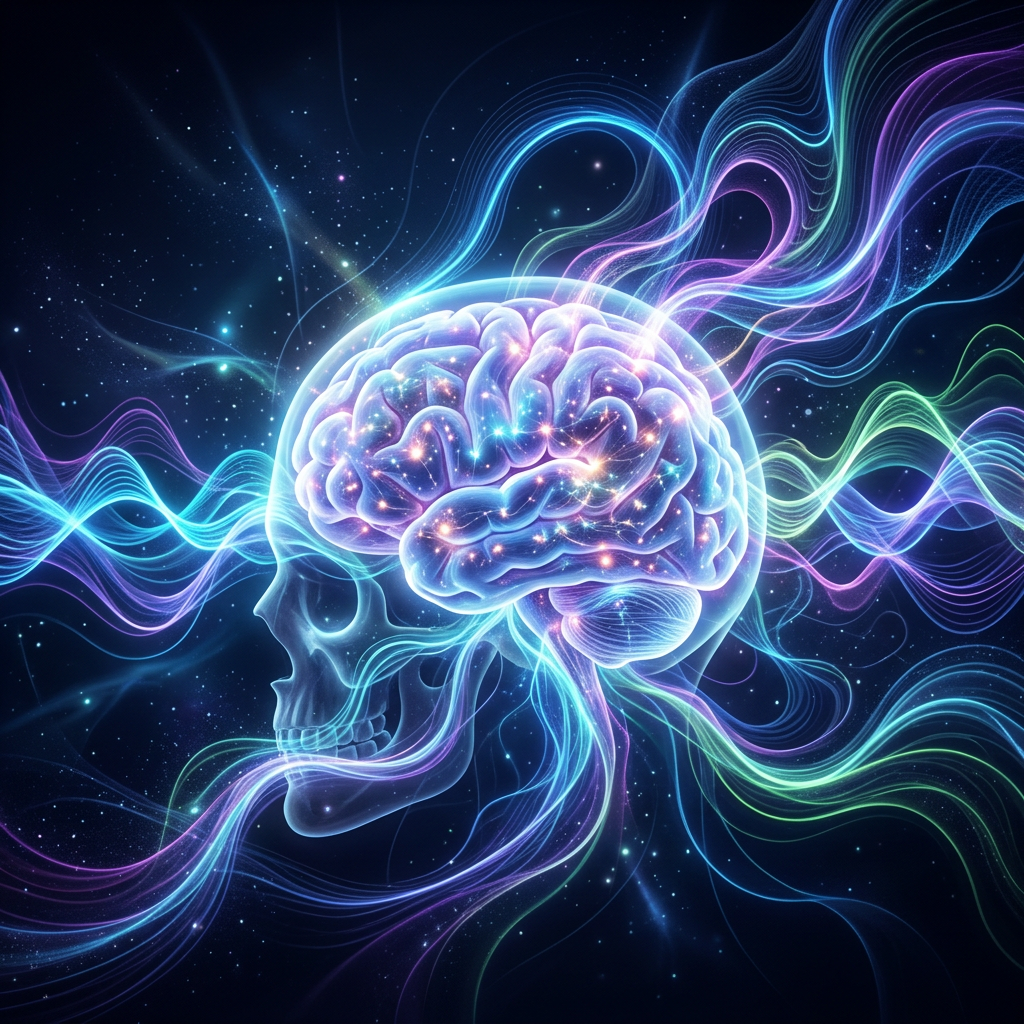
Brain Waves May Be the Machinery of Consciousness: A new theory from Massachusetts Institute of Technology proposes that traveling brain waves perform analog computations that allow the brain to rapidly coordinate thought—and perhaps generate unified conscious experience. Rather than viewing cognition solely as information moving through fixed neural circuits, Earl Miller and colleagues argue that oscillating electrical fields dynamically select and organize overlapping populations of neurons. Slower alpha and beta waves carrying goals and memories can regulate faster gamma activity representing sensory information, while interacting waves could perform parallel analog calculations. Evidence from anesthesia is particularly intriguing: drugs with very different molecular targets similarly disrupt large-scale wave organization when consciousness disappears. Published in The Journal of Neuroscience, the proposal remains a theory. Miller says the crucial next step is experimentally detecting signatures showing that the predicted analog computations actually occur. (MIT News)
Probiotic Mix Cuts Severe Gut Disease in Preemies: Routine use of a three-strain probiotic was associated with a substantially lower risk of necrotizing enterocolitis, or NEC, in very premature infants treated at two Dutch neonatal intensive care units. Researchers compared 1,413 infants before and after implementation of a probiotic containing Bifidobacterium infantis, Bifidobacterium lactis and Streptococcus thermophilus. NEC incidence fell from 11.9% to 5.3%, corresponding to a 51% lower adjusted risk. The potentially fatal condition involves disruption of the infant gut microbiome, inflammation and intestinal injury. Overall mortality was unchanged, however, while non-NEC mortality was higher among probiotic recipients, and one case of probiotic-associated sepsis occurred. Researchers said the findings support probiotic effectiveness but also underscore the need for careful safety evaluation in extremely preterm infants. (cidrap.umn.edu)
Dark Matter Detector Records a Mysterious Particle: The world’s largest dark-matter detector has recorded a tantalizing event that resembles what physicists have spent decades searching for: a weakly interacting massive particle, or WIMP. The LUX-ZEPLIN experiment uses 10 tonnes of liquid xenon nearly a mile underground in South Dakota to detect the tiny flashes and electrical signals produced when particles strike xenon atoms. Researchers reported one unusually energetic interaction whose characteristics are consistent with some WIMP models. One event, however, is nowhere near enough to claim a discovery; unknown backgrounds or conventional particles could still explain it. Scientists will need substantially more data before determining whether the signal is genuine. If eventually confirmed, it would provide the first direct detection of dark matter, the invisible substance thought to constitute most matter in the universe. (Science)

Genome Rewrite Exposes Limits of Biological AI: Researchers have performed an extraordinarily comprehensive genetics experiment by systematically changing essentially every DNA letter in a viral genome—and discovered that leading AI models struggle to predict the consequences. The experiment generated a vast map showing how individual mutations affect viral fitness, revealing many effects that existing biological assumptions and computational models miss. Researchers then challenged advanced AI systems trained to predict genetic function. Although the models captured some broad patterns, their performance deteriorated substantially when confronted with mutations and biological relationships outside familiar training distributions. The results demonstrate both the power of massively parallel genome editing and a fundamental weakness in current biological AI: pattern recognition does not necessarily translate into mechanistic understanding. Such comprehensive mutation maps could ultimately improve models used to predict disease-causing variants, engineer proteins and design synthetic organisms. (Nature)
Tick Allergy Could Have an Antibody Treatment: National Institutes of Health scientists have discovered rare antibodies that might eventually provide a treatment for alpha-gal syndrome, the unusual tick-associated allergy that can make people react to red meat and other mammalian products. The antibodies emerged unexpectedly from malaria research and bind alpha-gal, the carbohydrate responsible for triggering the allergic response. In laboratory experiments, they effectively acted as molecular shields, preventing allergic antibodies from attaching to alpha-gal allergens. That raises the possibility of developing therapies that neutralize the trigger before it provokes an immune reaction. Alpha-gal syndrome cases are increasing in the United States and elsewhere as tick ranges shift, yet patients currently have no specific treatment beyond avoiding triggering foods and products. The findings, published in the Journal of Clinical Investigation, remain preclinical and require further testing. (National Institutes of Health)
Wearable AI Could Replace Arterial Lines: Wearable sensors combined with artificial intelligence have produced continuous blood-pressure measurements approaching those obtained from invasive arterial catheters. Johns Hopkins researchers developed MOSAIC, which places one sensor on the chest and another on a finger. The devices measure electrical cardiac activity and blood flow, while a deep-learning model converts those signals into a continuous blood-pressure waveform. In an initial study involving 28 intensive-care patients, MOSAIC closely tracked measurements from arterial lines—the current gold standard for continuous monitoring. Those catheters are highly accurate but require inserting a tube directly into an artery, creating risks of infection, bleeding and clotting while restricting mobility. Researchers are now testing MOSAIC in a larger ICU cohort. Eventually, continuous noninvasive monitoring might extend beyond hospitals to people with hypertension, functioning somewhat like continuous glucose monitors used in diabetes. (Whiting School of Engineering)
Microbial Molecule May Drive Lung Fibrosis: A protein fragment produced by bacteria living in the human microbiome may directly contribute to pulmonary fibrosis. Researchers at the University of Illinois Urbana-Champaign and Mie University investigated corisin, a bacterial peptide previously associated with lung scarring. Their experiments indicate that corisin enters cells and disrupts mitochondrial protein-quality-control mechanisms, triggering cell death and fibrosis. Importantly, blocking the molecule with an antibody reduced tissue damage in experimental models, suggesting corisin is not merely correlated with disease but may actively drive it. Previous work showed that corisin produced by gut bacteria can reach the lungs through the bloodstream; the researchers are now examining whether respiratory bacteria can produce it locally as well. Because fibrosis contributes to disease across the lungs, liver, kidneys, heart and other organs, the mechanism could have implications beyond pulmonary fibrosis. (Illinois News Bureau)
Marine Heat Waves Threaten Children’s Health: Ocean warming may be harming human health through pathways extending far beyond direct exposure to heat. Researchers studying coastal communities in low- and middle-income countries found that children exposed to marine heat waves were more likely to experience poorer health outcomes. Exceptionally warm ocean temperatures can damage fisheries, alter marine ecosystems and reduce the availability or affordability of seafood, potentially affecting nutrition in communities that depend heavily on the sea. They can also disrupt household income and local food systems. The study highlights an underappreciated dimension of climate change: warming oceans can affect people indirectly through ecological and economic systems connecting marine environments to human well-being. Children may be particularly vulnerable because nutritional disruptions during development can have lasting consequences. The researchers argue that climate-health planning should therefore consider ocean conditions alongside terrestrial heat and extreme weather. (Phys.org)
Saqqara Tomb Preserves Old Kingdom Ritual World: Archaeologists at Saqqara have uncovered an intact roughly 4,000-year-old tomb belonging to Sekhentio-Ptah, a powerful Old Kingdom official who held titles including Royal Chamberlain, Overseer of All the Works of the King and Keeper of the Secrets of Royal Decrees. The tomb in the Bubasteion Necropolis contains a funerary chapel and inscribed false door, along with an unusually complete group of alabaster ritual objects still positioned where ancient mourners left them. Researchers say that context could help reconstruct Old Kingdom funerary ceremonies more precisely than artifacts removed from their original locations. Nearby interconnected burial shafts yielded human remains, three sealed stone sarcophagi, pottery, painted funerary cartonnage, a wooden falcon and more than 100 faience ushabti figurines, documenting centuries of subsequent use of the necropolis. (Archaeology Magazine)
Particle Hunt Uncovers Two Exotic Structures: An experiment searching for one exotic particle has unexpectedly uncovered evidence for two previously unknown structures that may belong to the puzzling family of “XYZ” hadrons. Researchers at Thomas Jefferson National Accelerator Facility fired high-energy photons at protons and examined the particles produced in the collisions. Instead of finding only the state they were targeting, the data revealed two structures containing at least two strange quarks whose internal arrangements remain uncertain. Ordinary hadrons come primarily as three-quark baryons or quark-antiquark mesons, but discoveries over the past two decades have revealed tetraquarks, pentaquarks and other configurations that challenge this simple classification. Determining whether the new signals represent genuine particles, molecular-like combinations of hadrons or other phenomena could help physicists understand how the strong nuclear force assembles quarks and gluons into matter. (ScienceDaily)
Roman Telescope Deploys Its Space Hardware: Nancy Grace Roman Space Telescope has successfully deployed two critical pieces of hardware following its August 30 launch: a high-gain antenna and a visor-like sunshade. Roman will eventually transmit more data than any previous NASA astrophysics mission, using its 5.6-foot-wide carbon-composite antenna to send information across roughly one million miles at rates reaching 500 megabits per second. Its deployable aperture cover blocks unwanted light from entering the telescope, helping maintain the extraordinarily precise observations needed for surveys of galaxies, dark energy and exoplanets. NASA has also successfully powered on Roman’s Coronagraph Instrument, designed to suppress starlight so astronomers can observe planets and dusty disks around nearby stars. The telescope now enters a roughly three-month commissioning period, with its first public images expected in early 2027. (NASA Science)

Leave a Reply