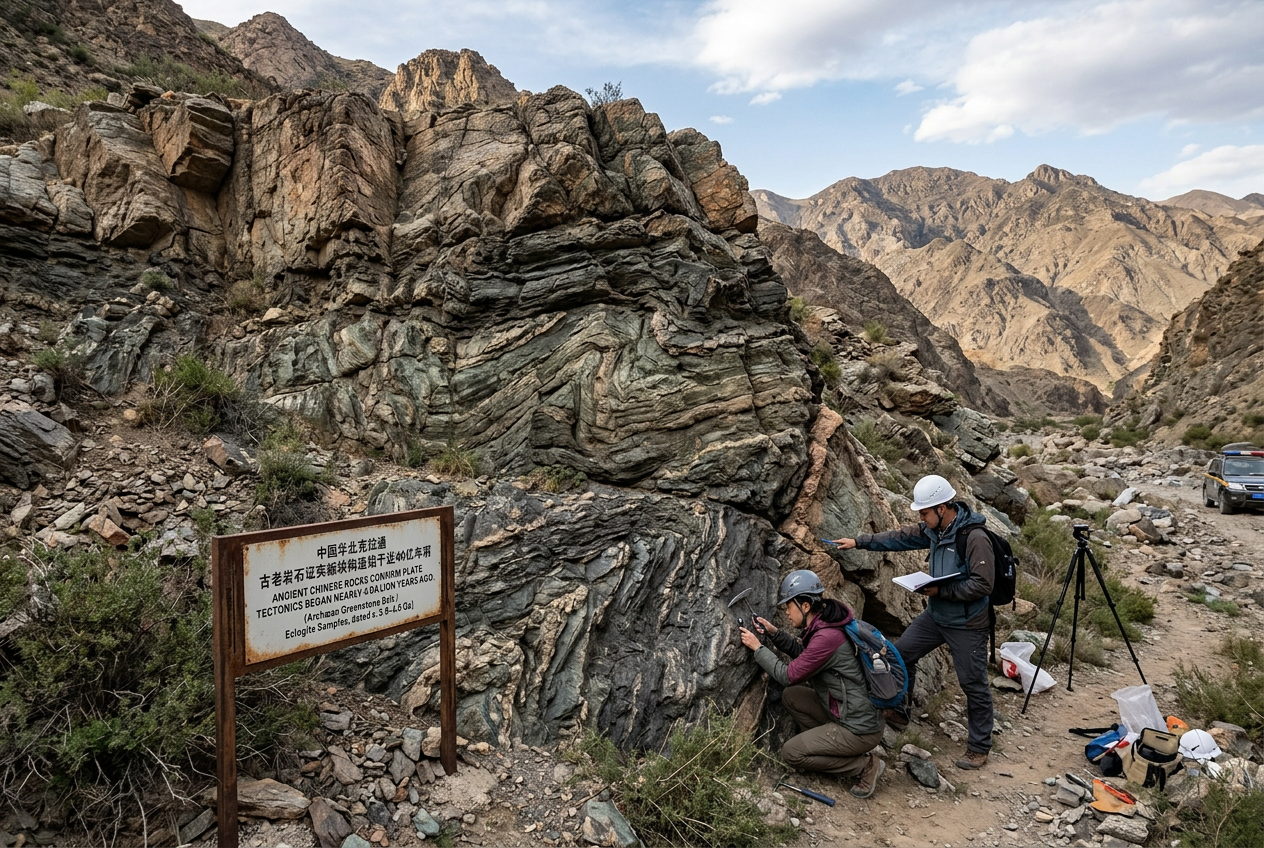
Ancient Chinese Rocks Suggest Plate Tectonics Began Nearly 4 Billion Years Ago
Geologists have discovered some of Earth’s oldest known rocks in northern China, providing new evidence that processes resembling modern plate tectonics may have operated nearly four billion years ago. Researchers studying the Shimen Complex in Hebei province dated three rock samples to approximately 3.95 billion years using uranium-lead measurements in zircon crystals. Oxygen and hafnium isotope analyses suggest that the rocks originated from material exposed to water near Earth’s surface before being transported more than 50 kilometers underground, where intense heat and pressure caused partial melting. Published in Nature and reported November 14, the findings support the possibility of an early subduction event. Additional isotope evidence suggests that Earth’s crust was already differentiating from its mantle more than 4.3 billion years ago. (Phys.org)
Viral Infections May Leave Lasting Immune Damage That Vaccines Prevent
Scientists at Pompeu Fabra University in Barcelona have discovered that recovering from an acute viral infection does not necessarily mean the immune system has returned to normal. Experiments in mice revealed that infections could leave persistent structural damage in the spleen, including fibrosis and disruptions to the organization of immune cells. These changes interfered with T-cell activation and weakened the animals’ responses to subsequent immune challenges, even after the original virus had been eliminated. Remarkably, mice vaccinated before infection avoided both the spleen abnormalities and the lingering immune dysfunction. Published in Cell Death & Disease and reported November 13, the findings suggest that vaccination may provide benefits beyond preventing immediate illness. However, researchers caution that the results come from mice and have not been demonstrated in humans. (ScienceDaily)
Yale Study Finds Diet, Exercise and Certain Drugs Can Change Biological Aging Markers
Researchers at Yale University have found that some medications and lifestyle interventions can measurably reduce biological aging markers, while popular anti-aging supplements show little consistent benefit. Analyzing 51 clinical studies, scientists compared more than 110 DNA methylation biomarkers, including 16 major epigenetic clocks that estimate biological age from chemical changes to DNA. Combining regular exercise with healthy diets, including Mediterranean-style eating patterns, was associated with reductions in epigenetic age. Certain prescription medications, including metformin, semaglutide and anti-TNF therapies, also produced measurable changes. By contrast, over-the-counter supplements generally failed to demonstrate comparable effects. Published in Nature Medicine and reported November 13, the findings could improve evaluation of anti-aging interventions. Crucially, lowering an epigenetic age estimate does not establish that a treatment extends lifespan or prevents disease. (ScienceDaily)
Mysterious Radio Signal Reveals Dead Star Orbiting a Sunlike Companion
Astronomers have identified an unusual stellar system that emits powerful radio pulses approximately every 7.9 minutes, providing new clues about a mysterious class of objects known as long-period radio transients. Using Australia’s Murchison Widefield Array, researchers discovered that the pulses appear during six-hour windows separated by approximately 26 hours of silence. Follow-up observations with South Africa’s MeerKAT telescope and Hawaii’s Keck Observatory traced the signal to a system containing a star similar to our Sun. Timing measurements suggest its unseen companion is a white dwarf approximately two-thirds the Sun’s mass, orbiting every 32 hours. Published in Nature Astronomy and reported November 14, the discovery identifies the first suspected white dwarf radio pulsar paired with a Sunlike star. Such systems could illuminate stellar evolution and the origins of certain supernovae. (The Conversation / Phys.org)
Ancient Peruvian Society Remained Surprisingly Peaceful Despite Climate Disasters
Archaeologists investigating ancient societies along Peru’s northern coast have found that catastrophic climate events did not necessarily produce widespread interpersonal violence. Researchers examined skeletal remains from the Lambayeque Valley, where mass ritual sacrifices have previously been associated with devastating El Niño flooding. Despite evidence of environmental upheaval, only 25 individuals, approximately 1.6% of the sample, displayed skeletal signs of interpersonal violence. Another 77 individuals, approximately 5.1%, showed evidence of accidental trauma. Neither category was significantly associated with periods of ecological instability. Published in Frontiers in Environmental Archaeology and reported November 9, the findings challenge assumptions that resource scarcity inevitably leads to violent social breakdown. However, the researchers acknowledge that skeletal evidence cannot reveal every violent encounter, and broad archaeological dating may conceal shorter periods of conflict. (Frontiers / Phys.org)
Scientists Create Massive Atlas of 21 Million Human Brain Cells
An international team of neuroscientists has produced an unprecedented cellular atlas of the basal ganglia, a collection of deep-brain structures involved in movement, motivation, decision-making and emotion. The research, published across more than two dozen studies, examines approximately 21 million human brain cells alongside millions of cells from mice, macaques and marmosets. Scientists mapped cell types, gene activity, molecular regulation and anatomical locations, identifying previously unrecognized cellular populations and genetic patterns associated with neurological and psychiatric disorders. One newly characterized cell type may be relevant to schizophrenia and bipolar disorder, while other findings illuminate autism-related genetic activity and aging. Reported November 12, the atlas could eventually help researchers develop treatments targeting specific cells implicated in Parkinson’s disease, Huntington’s disease and other conditions. Clinical applications remain years away. (Reuters)
Webb Telescope Discovers Two Giant Black Holes From the Universe’s Infancy
Astronomers using the James Webb Space Telescope and Gemini North have discovered the earliest and most compact pair of quasars yet observed. Named Nāpōwawāʻenakaulua, the system existed approximately 900 million years after the Big Bang, during the universe’s Cosmic Dawn. Its two supermassive black holes contain an estimated 1.5 billion and 400 million solar masses and are separated by only 18,100 light-years. Their enormous sizes so early in cosmic history challenge existing explanations of how black holes grow through gas accretion and galactic mergers. The discovery emerged from Webb’s Aether survey, which has identified approximately 200 early-universe quasars. Published in The Astrophysical Journal Letters and reported November 13, the findings provide a rare opportunity to investigate how the first massive galaxies and black holes developed together. (Space.com)
Genetic Investigation Reconstructs Deadly Hantavirus Outbreak Aboard Cruise Ship
Scientists have used viral genome sequencing to reconstruct a deadly hantavirus outbreak aboard the expedition ship MV Hondius, revealing both the power and limitations of genomic epidemiology. The outbreak involved 13 infections and three deaths, with approximately 650 contacts quarantined. Researchers analyzed viral genomes from 10 infected individuals and found nearly identical sequences, supporting a single introduction followed by limited person-to-person transmission. The Andes hantavirus strain is unusual because it can spread between humans. Investigators also discovered that eight apparent mutations were sequencing errors, highlighting the dangers of relying on hastily processed genetic data. Published in Science and reported November 12, the research suggests the outbreak may have originated from an infected traveler, although investigators could not determine precisely where the virus was acquired. (Le Monde)
Satellite Study Finds World’s Mangrove Forests Are Recovering After Decades of Loss
A global satellite analysis has revealed an encouraging reversal in the fortunes of mangrove forests, ecosystems that protect coastlines, support fisheries and store substantial amounts of carbon. Researchers examined Landsat imagery collected between 1984 and 2023, documenting nearly 3,000 square kilometers of mangrove losses before 2010, followed by almost 2,000 square kilometers of expansion. Approximately two-thirds of the recovery resulted from mangroves colonizing new coastal areas, while the remainder involved restoration and regrowth. Particularly notable gains occurred in Southeast Asia, northern Australia and South America. In Myanmar, abandoned agricultural land and coastal sediment accumulation helped mangroves return. Published in Science and highlighted by NASA on November 13, the findings suggest conservation measures and natural regeneration can reverse environmental damage, although deforestation remains a serious threat. (NASA Earth Observatory)
Worldwide Microsoft Outage Exposes Risks of Dependence on Major Technology Providers
A major Microsoft service disruption has exposed how heavily businesses, governments and essential services depend on a small number of technology companies. The outage affected users in more than 70 countries, disrupting Outlook, OneDrive, Copilot and other Microsoft services. Financial institutions, government agencies, schools and healthcare organizations experienced interruptions, with some services remaining unreliable into Friday. Microsoft attributed the disruption to a technical problem introduced during a network-capacity upgrade rather than a cyberattack. Recovery efforts continued as delayed messages and service queues gradually returned toward normal. Reported November 13, the incident renewed concerns about concentrated digital infrastructure and the vulnerability of organizations that rely on interconnected cloud platforms. Technology specialists emphasized the importance of independent backup systems and continuity planning to reduce the consequences of future failures. (Financial Times)


Leave a Reply