
Neurons get most of the attention, but they do not work alone. They depend on glial cells for support and nourishment, and among the most important of these are astrocytes, star-shaped cells that supply nutrients, help regulate blood flow and keep brain tissue healthy. For a long time, neuroscientists assumed that when an adult brain loses its astrocytes, it cannot fully replace them.
Researchers at the University of Zurich now report that the assumption is wrong, at least in mice. In a study published in Nature Neuroscience, they describe a specialized group of astrocytes that gathers at the edge of damaged tissue and rebuilds the lost cells by an unexpected route. The cells divide, and then send the newly formed nuclei of their daughter cells across long distances into the injured zone.
Bruno Weber, who heads the research team at the university’s Institute of Pharmacology and Toxicology, said the findings reveal a previously unknown capacity of the adult brain to repair itself and point to new ways of supporting recovery when astrocytes are lost.
Watching a Lesion Close
Astrocytes can be destroyed by injury. They can also be destroyed by the immune system. In neuromyelitis optica spectrum disorder, an autoimmune disease, antibodies attack and kill these cells specifically.
To see what happens afterward, co-lead authors Marina Herwerth and Matthias Wyss used two-photon microscopy, a technique that allows researchers to image living brain tissue, to observe the brains of mice in real time over several weeks. Alongside the imaging, the team mapped which genes were switched on in different regions of the brain. Together the two approaches let them pick out the particular astrocytes doing the repair work.
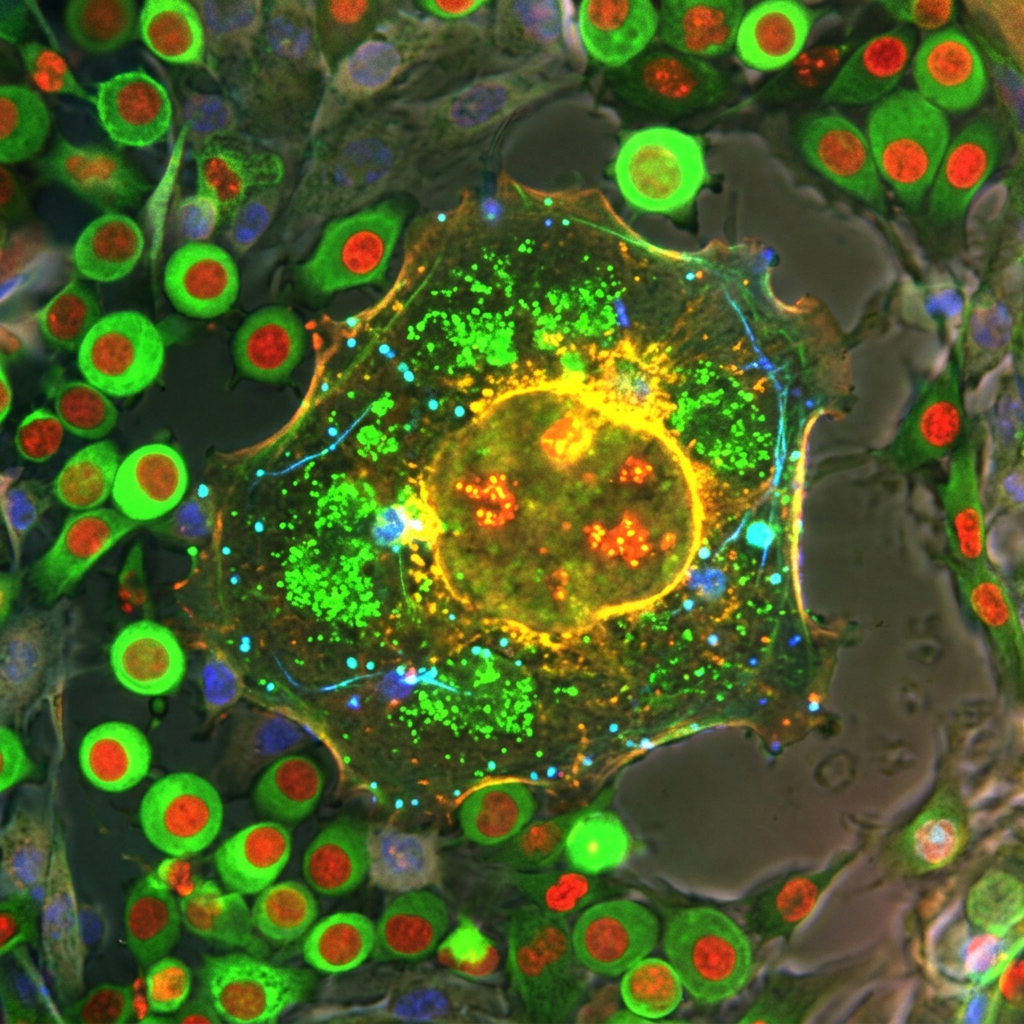
An image released with the study shows a lesion just under half a millimeter across. At its rim, the regenerative astrocytes extend long cellular processes that seal the defect. Newly formed nuclei travel along those extensions toward the damaged area, while ordinary, unaltered astrocytes surround the site.
Nuclei on the Move
Cell division on its own would not be surprising. What stands out is the delivery. Instead of whole new cells crawling into the gap, the regenerative astrocytes reach into it first and then ship in the nuclei, which help repopulate the area and reconnect the cells to one another. In Weber’s phrase, they “knit the astrocyte network back together.”
That network matters as much as the cell count. Astrocytes do not function as isolated units. They tile the brain and communicate with their neighbors, so restoring the connections between them is part of restoring what they do for the neurons in their care.
From Observation to Intervention
The authors say the discovery adds to the understanding of how the brain organizes and regenerates itself after certain kinds of damage. The practical hope is that the process could be encouraged. If these mechanisms can be selectively activated, they could support more effective repair, restore astrocyte networks and improve recovery from some brain disorders.
The study offers some leads. The team identified numerous genes and signaling pathways that are switched on temporarily while the repair is under way. Weber said these could serve as starting points for future work on influencing regeneration after disease or injury.
For now those applications are prospective. The evidence comes from a mouse model, the lesions studied were small and focal, and no human studies or therapies are described. Whether human astrocytes mount the same response, and whether it would be enough to matter after a stroke, a head injury or a sustained autoimmune attack, are open questions. The university’s announcement does not give sample sizes or other quantitative details beyond the size of the lesion shown.
Endnotes
- “Focal astrocyte loss reveals nuclear translocation during lesion repopulation.” (July 23, 2026). Nature Neuroscience. Co-lead authors Marina Herwerth and Matthias Wyss. https://doi.org/10.1038/s41593-026-02354-5
- University of Zurich (August 10, 2026). “Brain possesses greater self-repair capacity than previously assumed.” EurekAlert! https://www.eurekalert.org/news-releases/1139114

Leave a Reply