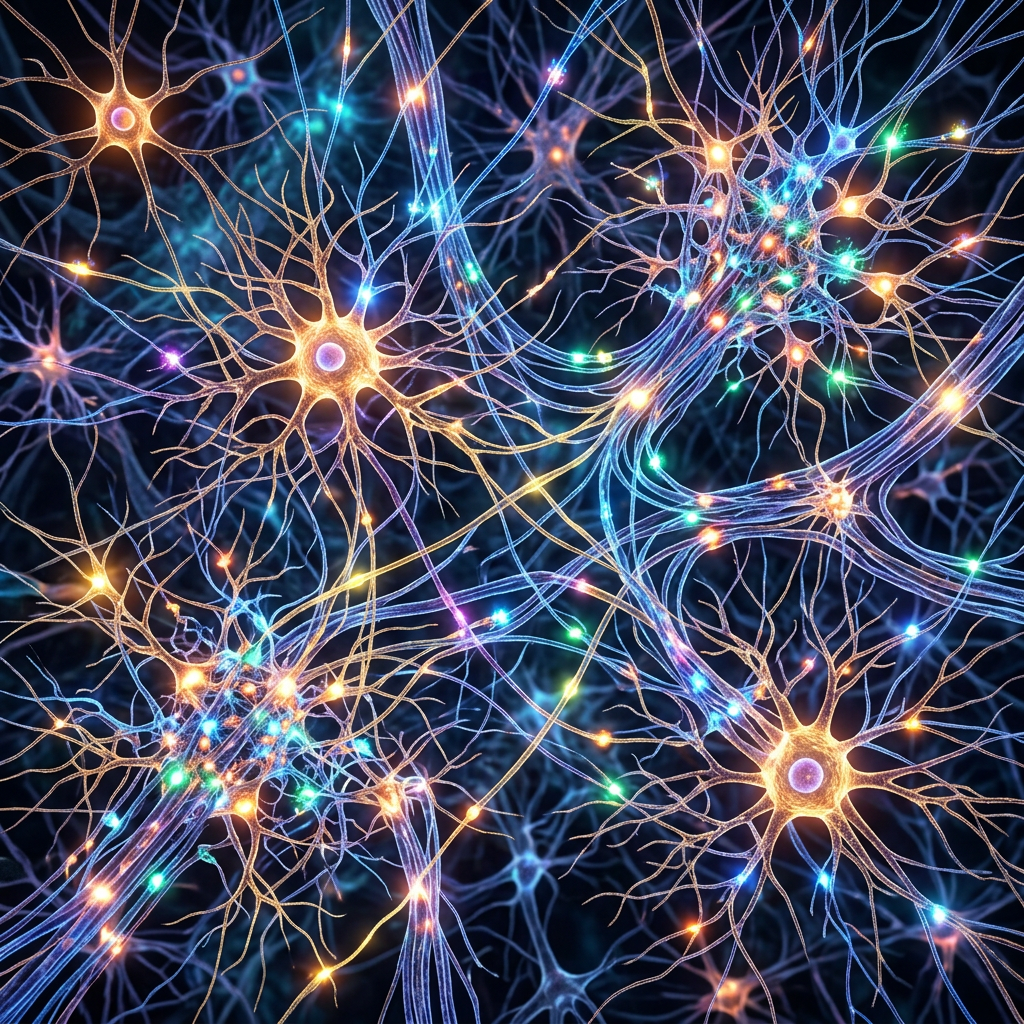
Anyone who has taken up a language or a musical instrument knows the pattern. Progress comes quickly at first. Then, at some point, it flattens, and further hours of practice seem to buy very little. Learners tend to blame their own effort or talent. Research from the University of Maryland suggests part of the explanation may lie in the physical material that surrounds brain cells.
In a study published in August in the Proceedings of the National Academy of Sciences, Maryland biologists report that the extracellular matrix, a scaffold-like structure enveloping neurons, helps control when the brain is able to change during learning. Working with gerbils trained on a sound-based perceptual task, they found that the matrix in the auditory cortex loosens within hours of a practice session and rebuilds itself within about a day. As the animals mastered the skill, that cycle faded and eventually stopped.
“This tells us that the brain isn’t just passively storing what you learn,” said Melissa Caras, an assistant professor of biology at Maryland and the study’s senior author. In her account, the brain is also regulating when learning should stop, so that skills already gained are protected from being overwritten.
From Rigid Barrier to Moving Part
For decades, neuroscientists regarded the adult extracellular matrix as something close to a fixture. Its job, in that view, was to stabilize the brain’s wiring once development was complete, at the price of making new learning harder with age. The idea is often used to explain why young children absorb languages so readily. Their matrix is immature and pliable, and it firms up as they grow.
Part of that scaffold takes the form of perineuronal nets, mesh-like coatings that wrap around particular neurons and hold their connections steady. In the gerbil auditory cortex these nets surround a class of cells known as parvalbumin-expressing neurons.
The picture of a static matrix owed something to how it had been studied. Earlier experiments sampled the structure only occasionally, at intervals of days or weeks, and concluded that it rebuilt slowly. Caras’s team looked at much shorter intervals and found something else: a structure that shifts in rhythm with training.
The timing appears to be the point. Because the matrix loosens and resets on roughly the same schedule as daily practice, each session gets its own window in which circuits can be adjusted. The gains from one day then settle overnight and become the starting point for the next.
Too Loose Is No Better
If a loosened matrix permits learning, it might seem that dissolving it altogether would speed things up. The experiments showed the opposite. When the researchers used an enzyme to break the matrix down, the animals learned more slowly, and the greater the disruption, the greater the impairment.
Breaking it down after a skill had been mastered was also costly. Performance slipped, though it did not collapse. Caras compared the effect to falling from top marks to a B-minus: the skill erodes without being lost entirely.
Taken together, the results indicate that the same structure is needed both to acquire a skill and to keep it. A learning plateau, Caras proposes, may mark the moment when the relevant brain regions shift from a state that is ready to learn to a more stable one, with the matrix locking the gains in place.
Reopening the Window
The researchers stress that the work is at an early stage and a long way from application in people. It was done in animals and in one region of the brain. Still, they see a possible use in hearing rehabilitation. People newly fitted with cochlear implants must train their brains to interpret an unfamiliar kind of signal, and they may be more receptive to that training early on than long-term users are. A safe way to briefly reopen the learning window, Caras suggested, could help.
Getting there will require knowing much more about the mechanism. The team plans to identify the molecules that trigger the matrix to loosen and rebuild, to record brain activity during the period when it is open, and to examine its role in hearing loss and related disorders. The long-term goal is to open the matrix temporarily and on demand, without paying the price that wholesale disruption exacted in the experiments.
The research was supported by institutional start-up funds from the University of Maryland.
Endnotes
- “Experience-dependent modulation of extracellular matrix integrity supports perceptual skill learning and memory.” (2026). Proceedings of the National Academy of Sciences. https://doi.org/10.1073/pnas.2601801123
- University of Maryland (August 6, 2026). “Scientists discover a brain cycle that may explain why learning eventually stalls.” EurekAlert! https://www.eurekalert.org/news-releases/1139119



Leave a Reply