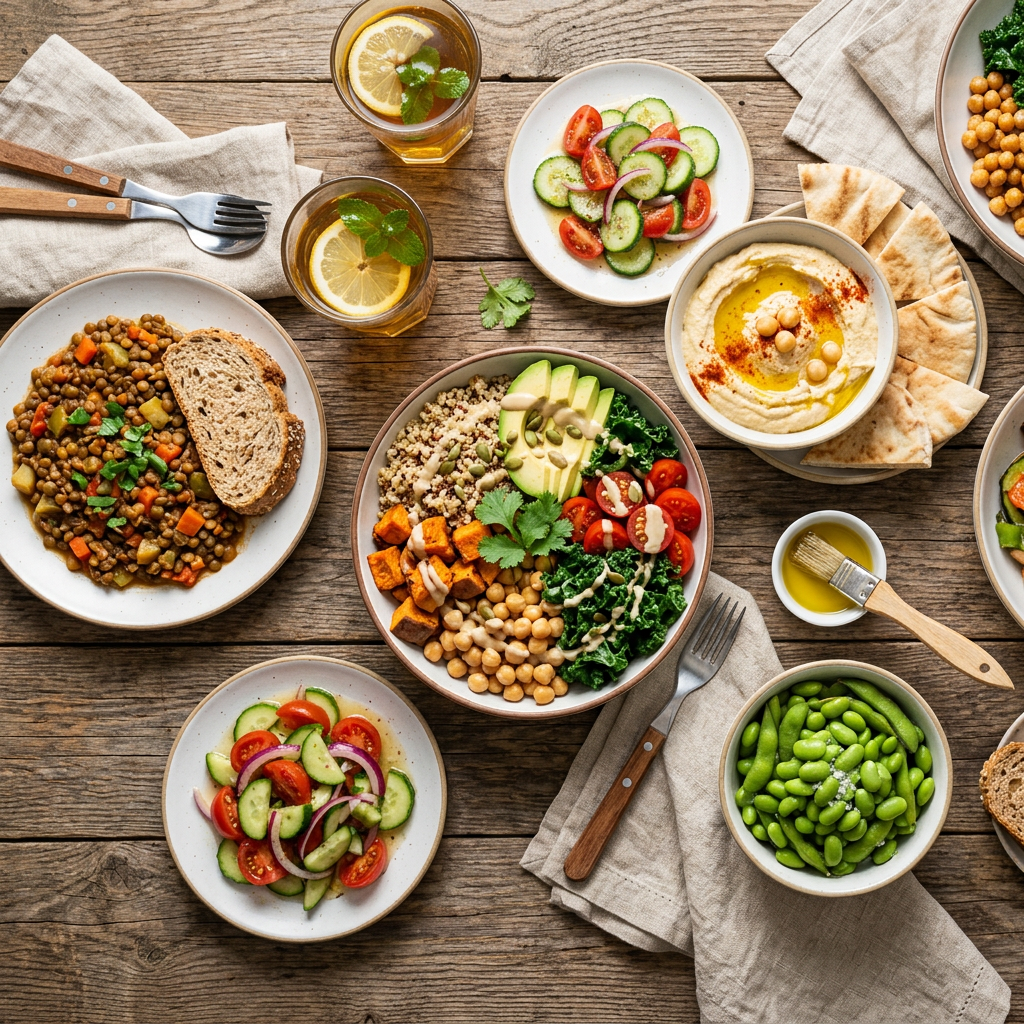
Most weight-loss advice comes down to an instruction that is easy to give and hard to follow: eat less. An analysis published in August in JAMA Network Open points to a different lever. In a 16-week randomized trial, adults who switched to a low-fat vegan diet went on eating about the same weight of food as before. What changed was how many calories that food contained.
The measure at the center of the study is dietary energy density, the number of kilocalories in each gram of food a person eats. The researchers calculated it by dividing each participant’s total daily calories by the total daily weight of their food. Over the course of the trial, energy density fell by roughly 30 percent among participants on the vegan diet and did not change in the control group.
“You don’t have to eat less,” said Hana Kahleova, director of clinical research at the Physicians Committee for Responsible Medicine and the study’s lead author. People can eat more food, feel full and still lose weight, she said, by choosing foods that are naturally lower in energy density.
Same Plate, Fewer Calories
The trial enrolled adults with overweight and assigned them at random to one of two groups. One followed a low-fat vegan diet built on fruits, vegetables, grains and legumes. The other made no changes to what they ate. Neither group was given a calorie limit. The vegan diet was ad libitum, meaning participants could eat as much as they wanted.
The total weight of food consumed did not change significantly in either group. Energy intake fell in both, but more in the vegan group, where the announcement of the results reports a figure of about 357 kilocalories a day. And the participants whose energy density dropped the most tended to lose the most weight, a relationship that held even after the researchers accounted for changes in calorie intake.
The explanation offered is a matter of substitution. The vegan diet removed meat, dairy and eggs, which pack many calories into a small volume, and sharply increased foods at the other end of the scale, vegetables and legumes in particular. Those foods are rich in water and fibre, so a large portion delivers comparatively little energy.
Why Volume Matters
Energy density is not a new idea in nutrition research. Controlled feeding studies have shown that when the energy density of a meal is lowered while its volume is held constant, people report feeling fuller and eat less afterward. Appetite, in other words, responds in part to how much food arrives, not only to how many calories it carries.
Kahleova argued that this is what makes the approach workable. The result, she said, came from the choice of foods and not from willpower or smaller portions, and a 30 percent reduction in energy density would be difficult to achieve through portion control alone. When foods are lower in energy density, natural appetite signals work in a person’s favor: people eat until they are satisfied and end up taking in fewer calories. She described that as a sustainable approach to managing weight and a realistic strategy for clinicians, who can help patients change what they eat instead of telling them to eat less.
Reading the Result
Several points bear on how much weight the finding can carry. The paper is a secondary analysis, meaning it re-examines data from a trial designed around other questions. The announcement does not state how many people took part, how much weight they lost, or what the absolute energy density values were before and after. The link between falling energy density and weight loss is an association observed within the trial.
The comparison was also with people who changed nothing about their diets. The trial therefore cannot say whether a low-fat vegan diet does better than other eating patterns that lower energy density, such as diets that simply add vegetables and legumes while keeping some animal foods.
Finally, the Physicians Committee for Responsible Medicine, which conducted the research, is a nonprofit founded in 1985 that promotes preventive medicine and is a long-standing advocate of plant-based eating. That does not invalidate a randomized trial, but it is context readers should have.
Endnotes
- Kahleova, H., et al. (2026). “Vegan Diets and Dietary Energy Density: A Secondary Analysis of a Randomized Clinical Trial.” JAMA Network Open. https://doi.org/10.1001/jamanetworkopen.2026.27483
- Physicians Committee for Responsible Medicine (August 6, 2026). “Low-fat vegan diet cuts dietary energy density by nearly a third, helping explain weight loss, new study finds.” EurekAlert! https://www.eurekalert.org/news-releases/1139158
Leave a Reply