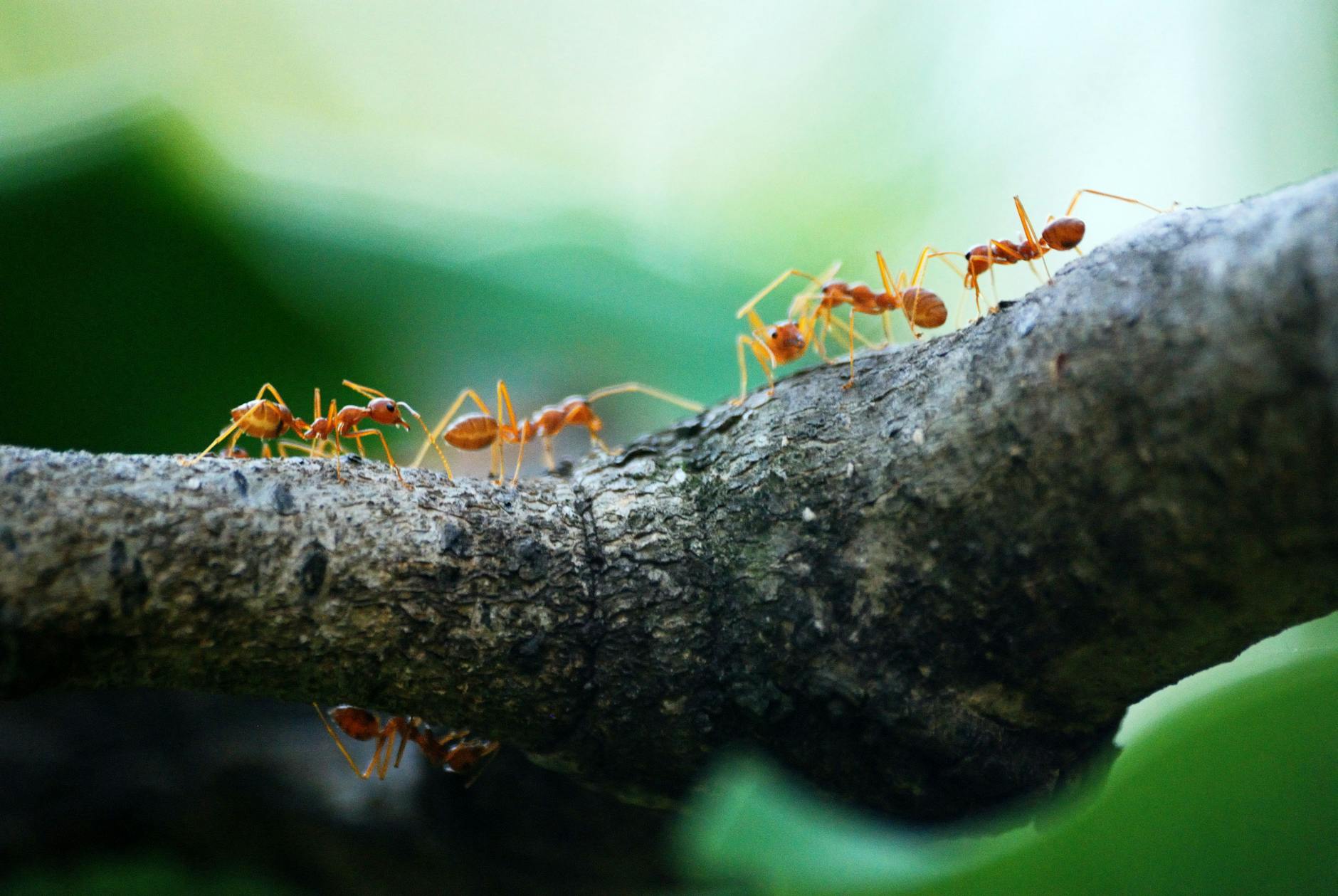
Watch an ant nest for long enough and it can seem to breathe. For a stretch the colony is quiet, its workers motionless. Then, with no apparent signal, the nest stirs, ants begin moving almost in unison, and a few moments later stillness returns. The cycle repeats.
Biologists first documented these synchronized bursts of activity more than 30 years ago, and they have remained a curiosity ever since, in part because they look so much like collective behavior in systems that have nothing to do with insects: neurons firing together, fireflies flashing in step, oscillating chemical reactions.
A team of engineers and biologists from New York University and the New Jersey Institute of Technology has now proposed a mathematical account of how the bursts arise. Their study, published in August in PRX Life, traces the rhythm to a tug between two tendencies: how readily one active ant rouses its nestmates, and how completely the colony settles back to rest before the next wave begins.
Bursts, said Michael Napoli, a doctoral researcher in mechanical and aerospace engineering at NYU and the study’s lead author, “emerge as a balance between the responsiveness of the colony” to the first ant that stirs and its capacity to switch off fully before the next round.
Three States and a Virtual Nest
The researchers built a computational model that draws on decades of observations of how ants move, combined with existing theories of how social insects activate one another. In it, each simulated ant occupies one of three states. It can be active, inactive, or refractory, a temporary condition in which it cannot be roused again. Active ants wander through a virtual nest, and when they encounter inactive ones they can set them moving.
Run with the right settings, the simulated colony undergoes what physicists call a phase transition. Like water turning to ice at a particular temperature, the nest shifts abruptly from one kind of collective behavior to another, in this case from scattered, unsynchronized movement to coordinated pulses.
The First Mover
The simulations point to a striking feature of how a burst begins. It does not require many ants to coordinate at the outset. A single individual is often enough. The authors call this ant the first mover. Once active, it stimulates others, which stimulate still others, and the activity cascades through the colony in the manner of falling dominoes or a rumor crossing a social network.
The cascade works because of speed. The team describes ants as operating in a high-speed interaction regime, in which information crosses the nest much faster than a burst lasts. Workers are constantly making and breaking contact with one another as they move, and that churn carries the signal efficiently.
Maurizio Porfiri, the NYU engineer who is the study’s senior author, argued that synchrony depends less on how many interactions take place than on how quickly information travels through a network whose members are themselves in motion. Because individual ants traverse the nest faster than the burst unfolds, he noted, a new behavior passes through the colony almost instantly.
Sheep, Neurons and Robots
Simon Garnier, a professor of biological sciences at NJIT and a coauthor, said cascades set off by a single leader appear in other systems as well, from sheep that abruptly bunch together to neurons that fire in coordinated patterns. The group hopes the ant model will help identify general principles of collective behavior that hold across such cases.
There is an engineering interest too. Swarms of robots are designed to operate through local interactions among neighbors, with no central controller issuing commands. Understanding how one agent can trigger coordinated action across a group could inform the design of such systems for warehouse logistics, environmental monitoring and disaster response.
The authors are frank about what the model leaves out. It treats all workers as alike, although real ants differ from one another, and it ignores the complicated architecture of real nests. Whether actual colonies sit near the synchronization threshold the model predicts is a question for future experiments, as is whether changing a colony’s density or its patterns of movement alters the bursts in the ways the mathematics suggests.
If the picture holds, a colony that appears to act as one may be doing something simpler. One ant moves first, and the rest follow quickly. The research was supported by the U.S. National Science Foundation.
Endnotes
- Napoli, M., et al. (2026). “Nest-Level Phase Transition Drives Synchronized Activity Bursts in Ant Colonies.” PRX Life. https://doi.org/10.1103/ghnl-p5c1
- NYU Tandon School of Engineering (August 6, 2026). “Ready, set, march: Researchers use math to explain sudden activity bursts in ants.” EurekAlert! https://www.eurekalert.org/news-releases/1139190
Featured image: Photo by Poranimm Athithawatthee on Pexels.com.

Leave a Reply