Jonathan was already fully grown when he arrived on the island of St Helena about 144 years ago, a gift from the Seychelles. He has lived ever since in the grounds of Plantation House, the residence of the island’s governor. He is estimated to have hatched in 1832, which would make him 194 years old, the oldest living giant tortoise and the oldest known living land animal.
Researchers have now examined his genome and its chemical regulation for clues to how any animal lasts that long. Their study, published in Science Advances, attributes his longevity to two things: a favorable set of genes, and a striking absence of the molecular wear that normally builds up with age.
“Nature has already solved the puzzle of aging in remarkable ways,” said Stephen Clark, the study’s senior author and the founder of Kallel, a U.S. longevity non-profit whose researchers led the work. Jonathan’s genome, he said, offers a model of cellular resilience.
Good Genes
Jonathan is an Aldabra giant tortoise, Aldabrachelys gigantea. In his DNA the team identified 287 distinct gene variants that appear to dampen the ordinary processes of ageing. The variants touch on functions that recur throughout research on longevity: the repair of damaged DNA, the control of inflammation, the regulation of insulin and the suppression of cancer.
Each of those makes intuitive sense. A cell that mends its DNA efficiently accumulates fewer mutations. An animal that keeps inflammation in check avoids the slow tissue damage it causes. And a large, long-lived creature has many cells dividing over many years, so strong defenses against cancer are close to a requirement.
Switches That Did Not Drift
The second finding concerns the epigenome, the layer of chemical marks on DNA that act as switches, turning genes on and off without altering the underlying sequence. In most animals studied, these marks shift with age. The changes accumulate, gene activity becomes less well regulated, and that drift is thought to contribute to physical decline.
The researchers compared Jonathan’s epigenome with those of younger giant tortoises of the same species. The switches governing DNA repair and metabolism turned out to be largely the same in the 194-year-old as in his juniors. The study is described as the first epigenomic investigation of a giant tortoise.
Justin Gerlach of Peterhouse, University of Cambridge, who took part in the research, said the regulators of energy production and DNA repair have stayed remarkably stable in Jonathan across nearly two centuries. Gerlach has studied the ecology and conservation of giant tortoises for several decades, but this was his first investigation of their unusual lifespans. He called it a privilege to work with so old an animal, and said it felt more like collaborating with the tortoise than studying him.
One Tortoise, and a Long Road to Medicine
Gerlach believes the giant tortoises of the Galápagos and the Seychelles have a great deal to reveal about ageing. They are also the last survivors of groups of animals that once dominated many island ecosystems, which gives the research a conservation dimension as well as a biomedical one.
Clark’s ambitions run to human health. Ageing is the largest risk factor for most chronic diseases, he noted, and he said the goal is to turn these evolutionary insights quickly into affordable treatments for ordinary people, with philanthropic support helping to make longevity medicine widely accessible.
That is an aspiration, and the distance between it and the present study is considerable. The work centers on a single extraordinary individual. The university’s announcement does not say how many younger tortoises he was compared with, or how the 287 variants were shown to matter. Finding variants in genes related to DNA repair is not the same as demonstrating that they extend life, and nothing in a tortoise’s genome translates directly into a therapy for people. Jonathan’s age is itself an estimate, since no one recorded his hatching. The research was funded by the Voland Fund.
Endnotes
- “Epigenetic insights into extreme longevity in the world’s oldest terrestrial animal, Jonathan.” (October 7, 2026). Science Advances. https://doi.org/10.1126/sciadv.adw8887
- University of Cambridge (October 7, 2026). “Genetic analysis of the world’s oldest land animal reveals secret of living 194 years.” EurekAlert! https://www.eurekalert.org/news-releases/1146346
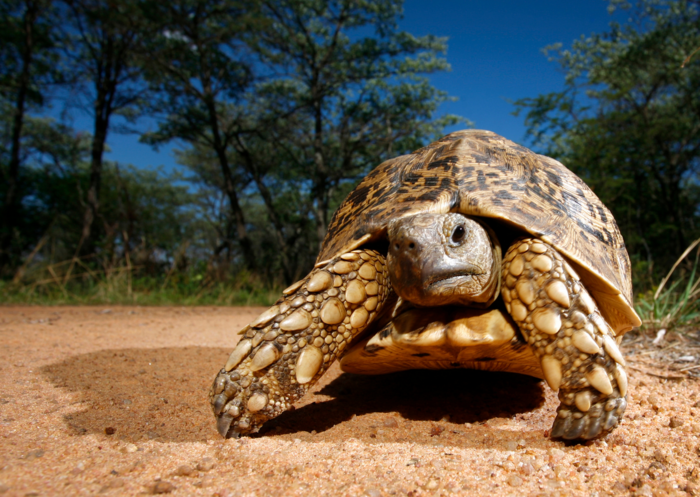
Featured image: A leopard tortoise (file photo). It does not show Jonathan or his species.



Leave a Reply