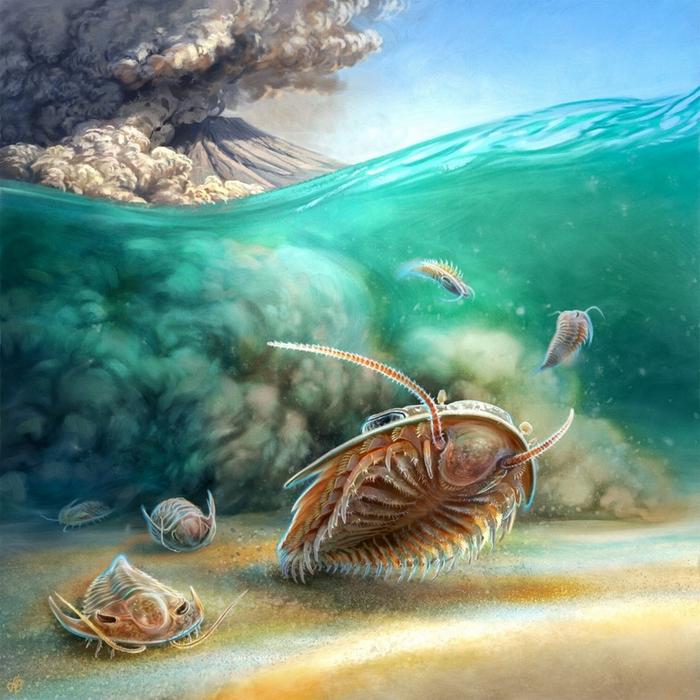
The Cambrian seas were dangerous places, and trilobites were frequent targets. Many fossil trilobites bear healed bite marks, evidence of attacks they survived. Yet such scars are surprisingly rare in most trilobite populations. A new study using living horseshoe crabs suggests the fossil record may be hiding most of the damage.
The work, by researchers from Chang’an University, Northwest University and the Guangxi Institute of Oceanology in China, is published in Continent & Life Evolution.
An Arms Race in Shells
Predation is thought to have driven an evolutionary arms race during the Ediacaran and Cambrian periods, fueling a dramatic rise in animals with mineralized skeletons. Trilobites, with their hard exoskeletons, are often cited as a product of that race. Numerous bite-type injuries have been documented on their shells, but in most populations evidence of non-lethal predator damage is scarce.
To understand why, the team turned to the horseshoe crab, a living arthropod that, like trilobites, has a hard outer skeleton it must shed to grow.
How a Horseshoe Crab Heals
In laboratory experiments, the researchers amputated parts of horseshoe crabs and followed their recovery. The crab’s blood, called hemolymph, clotted quickly, sealing the wound, stopping bleeding and keeping out microbes. A thin new cuticle then formed on the inside of the damaged shell, fitting the wound and covering it without altering the outline of the injury.
Real repair took longer. Regrowing an appendage or fully mending the shell required molting. Only after the animal shed its old exoskeleton could the original wound outline be covered or reshaped. How well tissue recovered depended on both where the injury was and how severe it was, a pattern the authors say also appears in fossil trilobites.
A Hidden Majority
With that sequence in mind, the team re-examined 409 abnormal trilobite specimens described in earlier studies. Sharp-edged injuries, of the kind a fresh wound would leave, turned out to be very rare. Among trilobites with clearly identifiable scars, 95 percent had molted at least once after being hurt.
The implication, the authors argue, is that most sharp-edged injuries were never recognized, because without the telltale reshaping that follows a molt they look just like breakage that happened after death. That hidden group would include successful predation, fatal injuries and damage suffered by adults, none of which would show post-injury molting. As a result, the fossil record of healed wounds may substantially underestimate how often trilobites were attacked.
The authors acknowledge they cannot yet correct for this recognition bias, and they propose comparative injury experiments on other living arthropods to better understand how trilobites were damaged and repaired.
Featured image: Artistic reconstruction of two trilobite species an instant before burial by volcanic ash 510 million years ago. Credit: Prof. A. El Albani, Univ. Poitiers. (The press release image, a reconstruction of a Cambrian predator–prey scene with injured trilobites and a schematic of trilobite wound repair, is credited to Xiao-Yong Yao and colleagues.)
Endnotes
- Yao, X., Han, J., Chen, R., Cheng, M., Liu, H., et al. “Healing and regeneration in horseshoe crab, with possible application to trilobite injuries.” Continent & Life Evolution, 22 October 2026. DOI: 10.55092/cle20260013.
- ELSP. “Healing and regeneration in horseshoe crab, with possible application in trilobite injuries.” EurekAlert!, 2 November 2026. https://www.eurekalert.org/news-releases/1150317


Leave a Reply