Ever since a quarry worker split open a slab of Bavarian limestone in 1861 and found a feathered skeleton inside, Archaeopteryx has carried more symbolic weight than any animal its size has a right to. It arrived two years after Darwin’s On the Origin of Species, a near-perfect transitional form that seemed to say birds came from reptiles. But one basic question has never been settled: how did the creature actually get off the ground?
A team at the University of Southampton thinks it finally has a workable answer, and it starts with the feet. Using computer models built on the mechanics of living birds, the researchers conclude that Archaeopteryx most likely launched itself with a series of two or three powerful hops, flapping in between, rather than with the single explosive jump that modern birds favor. The work appears in Developmental Biology.
A Bird That Was Not Quite a Bird
Roughly 150 million years old, Archaeopteryx sits on the blurry boundary between non-avian dinosaurs and true birds. “Archaeopteryx is the first real bird,” said Dr Neil Gostling, a palaeobiologist at Southampton. “It was covered in feathers and possessed wings, but also retained a number of distinctly dinosaur features, such as a long bony tail, claws on separate fingers, and teeth in a beakless jaw.”
That mix of traits is what makes it so valuable to evolutionary biologists, and so awkward as a flier. “It wasn’t a particularly well developed ‘bird’ compared to those we know today,” Gostling said.
The central problem is in the chest and shoulders. Modern birds anchor their enormous flight muscles to a keeled breastbone, a bony ridge that works a bit like the keel of a ship. Archaeopteryx had no such keel, and its shoulder joint could not raise the wing high above the back the way a pigeon or sparrow can. Without those features, a powerful wing-driven launch looks unlikely. Over the decades, researchers have proposed alternatives, from flapping while running uphill to climbing trees or cliffs and gliding down. Those scenarios are hard to test, and none has won universal agreement.
“We know Archaeopteryx couldn’t rely on its wings to take off — with no keeled sternum, and a shoulder that couldn’t lift the wing above the back — so we asked what its legs could contribute,” said Professor Markus Heller, a biomechanics specialist at Southampton.
Learning From Gulls, Crows and Finches
Fossils cannot be filmed taking off, so the team turned to animals that can. They built a computer model of takeoff mechanics informed by observations of living birds, including gulls, magpies, crows and finches, and then fitted that model to the anatomy of Archaeopteryx. By estimating the turning forces, or joint moments, at the hip, knee and ankle, along with how much work the leg muscles could plausibly generate, they calculated how quickly the animal could accelerate from a standstill.
Living birds offered a strong hint about where to look. “All birds push with their legs when they take-off,” Gostling said. “In fact up to 90 percent of the force required to get off the ground comes from the legs and then the wings take over.”
Part of the study builds on earlier observations by the late Dr Colin Palmer, a Southampton researcher who is listed among the paper’s authors.
Hop, Hop and Away
The numbers came out in favor of a multi-step launch. According to Dr Erik Meilak, a former PhD researcher at Southampton, the model showed that “a mid-sized, 400g Archaeopteryx could have achieved a sustainable flight speed of seven metres per second with three bipedal leaps, or with two bipedal leaps with a downward flap between jumps.”
Seven meters per second works out to about 25 kilometers per hour, the minimum speed the animal would need to stay aloft once its wings took over. A single leap could not get it there. Two or three, the model suggests, could.
Gostling described the likely sequence in plain terms. “Archaeopteryx would have either taken off with a leap, leap, leap and then lots of flapping, or a leap, a flap, another leap and more flapping,” he said.
Heller put the finding more bluntly. “It turns out that is where take-off is won: the legs generate the force, and the wings take over afterwards.”
An Ancient Habit Hiding in Plain Sight
One appealing feature of the hypothesis is that the behavior has not disappeared. Anyone who has watched a crow lumber off a sidewalk has seen something like it. “Although today’s birds can take-off with just one leap, we still see many, such as crows, magpies and seagulls, also using the multiple hop technique,” Gostling said.
The choice, he explained, seems to depend on circumstance. Modern birds “use one leap if startled, stressed or threatened,” he said, but behave “like their ancestors – two or three or more if they are saving energy.” In that reading, the single explosive jump is an emergency upgrade made possible by the powerful chest muscles of modern birds, while the hop-and-flap routine is the older, more economical default.
That framing matters for the broader debate about the origins of flight. Arguments have long split between a “ground-up” view, in which flight evolved from running and leaping animals, and a “trees-down” view, in which it began with gliding. A leg-powered, multi-hop takeoff fits comfortably with an animal that spent at least some of its time on the ground and used its hind limbs to do the heavy lifting while its wings were still a work in progress.
What the Model Can and Cannot Tell Us
The conclusions rest on modeling and comparison with living species rather than on direct evidence from fossils, which preserve bones but not muscle performance. The 400-gram body mass is an estimate for a mid-sized individual, and the press release does not report uncertainty ranges or how sensitive the results are to changes in assumed muscle strength. Different body sizes or muscle parameters could shift the number of hops required.
Still, the study offers something the field has often lacked: a takeoff mechanism that is physically workable for an animal with Archaeopteryx‘s particular, compromised anatomy, and one that echoes behavior still visible in birds today. The research team also included Dr Pauline Provini of the Muséum National d’Histoire Naturelle in Paris.
More than 160 years after its discovery, the animal that helped make the case for evolution may finally have shown how it left the ground: not with a single heroic bound, but with a few determined hops.
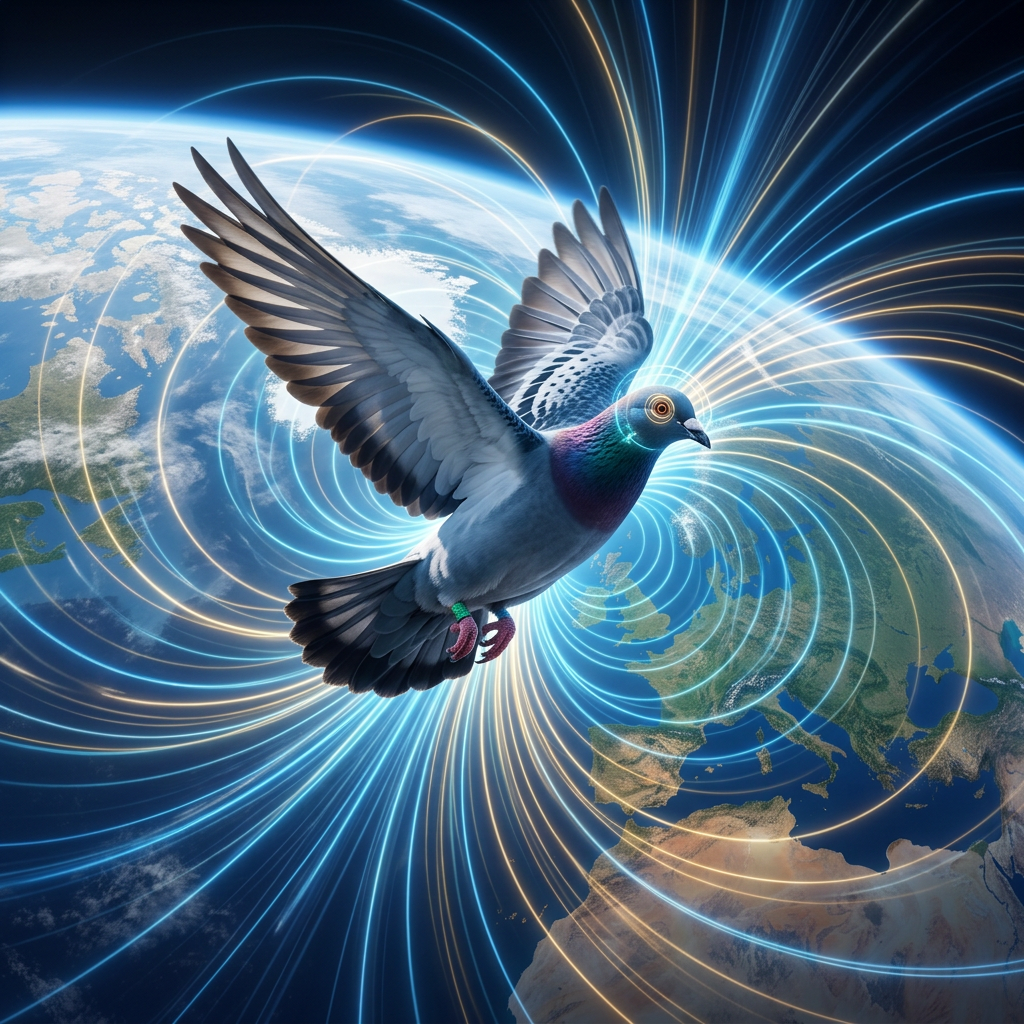
Featured image: A pigeon in flight, visualized against Earth’s magnetic field. Scientific Inquirer media library. (The press release illustration of Archaeopteryx is credited to Mark Witton.)
Endnotes
- Meilak, E., Gostling, N., Palmer, C., Heller, M., and Provini, P. “Hop, hop and away: On the take-off of Archaeopteryx using a multiple leaping mechanism.” Developmental Biology, 5 August 2026. DOI: 10.1016/j.ydbio.2026.07.018.
- University of Southampton. “New evidence to help solve how earliest birds took flight.” EurekAlert!, 12 August 2026. https://www.eurekalert.org/news-releases/1139801


Leave a Reply