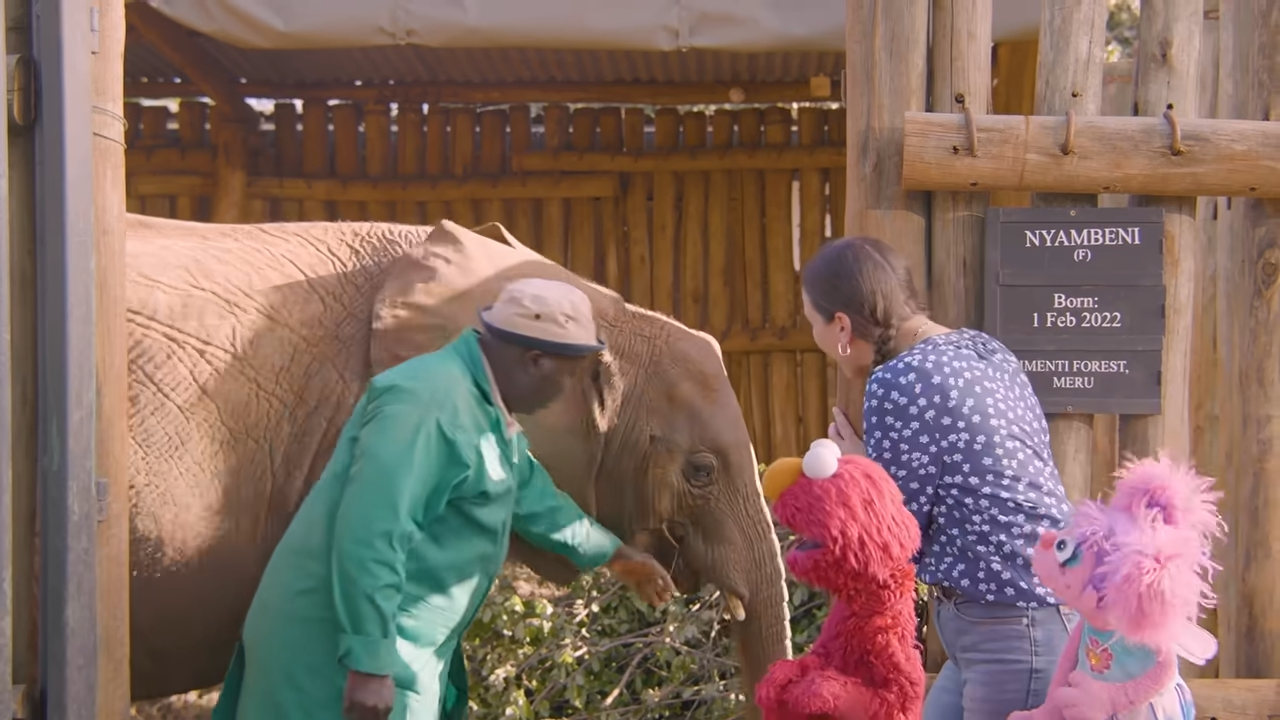
What happens when the beloved characters of Sesame Street venture into the wild world of PBS’s Nature? The result is Sesame Street and the Great Elephant Adventure, a special episode celebrating Nature‘s 45th season that takes Elmo, Abby Cadabby, and Nina on an African safari. Their journey begins at Kenya’s Sheldrick Wildlife Trust, where they meet an orphaned elephant and discover the importance of wildlife conservation, animal families, and allowing wild creatures to remain wild. Blending Sesame Street‘s trademark warmth and humor with Nature‘s commitment to natural history storytelling, the unlikely collaboration offers something for children and adults alike. Scientific Inquirer spoke with Nature executive producer Fred Kaufman about the surprising origins of the partnership, the challenges of bringing Muppets into the African bush, and the lessons he hopes audiences will take away from the adventure.
Marc Landas: Nature has been on the air for 45 seasons, and you’ve been involved with the series for quite some time. What made this the right moment for a crossover partnership with Sesame Street?
Fred Kaufman: I think it was a glorious accident, in a way. It was never really planned. The story behind it is that the president of our company, Neil Shapiro, who recently retired, had been at an event with the CEO of Sesame Workshop. Out of that meeting came the question: Is there something we could do together? Executive producers and content people at WNET were asked whether they were doing anything, or could develop something, with Sesame Workshop. It could have been anything—nature, news, culture, music. Anything.
My initial reaction was that this was the complete opposite of what we do. We don’t produce children’s programming. They’re a scripted, studio-based show, and we’re a natural history documentary series. I thought there really wasn’t anything we could do together. Nothing came to mind.
At the same time, however, we were considering a donor safari trip to Africa, something we’d done previously with some of our donors. We were discussing possible dates when, at some point, the idea of taking the Muppets on safari began to seem incredibly interesting and attractive. The elevator pitch was simply: Take the Sesame Street Muppets on safari in Africa.
Everybody immediately understood it. That’s always great when you can explain an idea in one sentence and nobody asks, “Well, what do you mean?”
As you mentioned, we’re in our 45th season. We’re an established brand, which gives us the opportunity to take chances and experiment a little. I loved the idea of crossing over with another beloved PBS brand. Is there anything more beloved than Sesame Street? I thought it could work.
One concern, though, was whether it would appeal to an adult audience. That was something we discussed with Sesame Workshop. We wanted to preserve the charm of the characters and allow Elmo to be Elmo, but how could we also make something that adults would enjoy watching? Those discussions helped shape the editorial approach and content of the show.
Marc Landas: How did the idea evolve into an elephant-centered story?
Fred Kaufman: The original plan was to do a broader safari, traveling to different places each day and experiencing the African bush in different settings and circumstances. The Sheldrick Nursery was always going to be the centerpiece of the show.
It was Jessica, the writer, who came up with the idea of having the Sesame Street Muppets adopt an elephant online through Sheldrick and then travel to Kenya to meet her. The hook would be that Elmo wanted to bring the elephant home with him. That story arc really came from Sesame Workshop and the writer.
Marc Landas: You mentioned that one of your concerns was making the special appealing to adults as well as children. How did you bridge that gap?
Fred Kaufman: When we were talking with Sesame Workshop, I said, “This can’t be counting stripes on a zebra.” We needed to explore themes similar to those we would normally cover on Nature. We’re talking about orphaned elephants. Why are they orphaned? How are they cared for? What does their future look like?
Then there’s the experience of going into the bush and taking a proper safari. What animals will we see? Why are some solitary while others live in groups? There are nocturnal animals and the sounds you hear at night, which can be frightening until someone explains what’s making them.
These are all themes we explore on Nature. But when you script them for a younger audience, they can also resonate with adults because the explanations are very much like those an adult would give to a child. As an adult watching, you might think, “Yes, that’s exactly what I would say to my child if they asked that question.”
You bring the material to a level that’s relatable. It’s a little anthropomorphic, but it works within the context of telling a story and engaging the viewer.
Marc Landas: Elmo ultimately comes to understand that caring for an animal can mean letting it live independently in the wild. Children often encounter animals primarily as pets or in zoos. Why was that particular lesson about conservation important for you to communicate to children?
Fred Kaufman: I think everybody ultimately needs to understand that the show, in a sense, is about belonging. Elmo and Abby belong on Sesame Street, and elephants belong in the wild.
As a young viewer, you might think it would be wonderful to have a baby elephant in your backyard or as a pet. The same might be true of other wild animals that children find fascinating. But these animals belong in particular environments. They’re wild animals, and they need to live in the wild.
That’s especially true of elephants, which are incredibly social animals. They need family around them. They’re not solitary animals. They’re surrounded by mothers, brothers, sisters, aunts and uncles. They live in groups that look after one another.
It’s an important lesson for everyone: understanding that these animals need to be wild and that they depend on their social groups. We wanted viewers to come away with a better understanding of how animals actually live in nature.
Marc Landas: One aspect I particularly appreciated was that Elmo and Abby experience Kenyan people and culture, rather than simply encountering animals on safari. How important was it to make Kenya more than an exotic backdrop and instead present it as a real place with its own communities, knowledge and relationship with wildlife?
Fred Kaufman: From the beginning, particularly from Sesame Workshop’s perspective, the idea was that going to Kenya should involve more than simply focusing on animals. It needed to be about the culture and the people as well.
That was certainly true when it came to the keepers at Sheldrick. Those elephants are so calm and relaxed because the keepers around them are calm and relaxed. The keepers are fascinating people, and through them, you get a different perspective on life in Kenya. We wanted to communicate that.
There’s so much we can learn by trying to understand different cultures. That’s something Sesame Street has always emphasized in its programming. It was natural to hear from Kenyan people, learn about their experiences and understand what their lives are like. We felt that would add texture to the special and expand the story beyond the elephants and other wildlife.
Marc Landas: Children today grow up hearing about climate change, endangered species and habitat loss. These subjects can be frightening and sometimes leave young people feeling powerless. How did you approach introducing those issues to younger viewers?
Fred Kaufman: We didn’t spend a great deal of time on them, but the underlying issue is that some of these elephants are orphaned because of habitat loss. Elephant herds may move onto farmland, where they can be shot at or injured. As a result, some young elephants become orphans and need to be rescued. They’re brought to Sheldrick and similar facilities, where they’re nurtured and ultimately returned to the wild.
But habitat loss and climate change are very deep, complicated subjects. We touched on them, but even with regular episodes of Nature, there are topics we can only introduce. They really require viewers to go out and do some additional research on their own.
Sometimes an issue is simply too complicated to explore in a truly meaningful way within the time available. Viewers need to go online, look things up and read more about it. So we addressed those issues, but they’re part of a much larger and more complicated conversation.
Marc Landas: I enjoyed the special quite a bit, even as an adult. Do you see Nature and Sesame Street collaborating on another project in the future? Is this an experiment you might want to repeat?
Fred Kaufman: I’d love to. It was a great experience for me. Producing television is never really fun. It’s always stressful. Particularly with natural history documentaries, whatever footage you get, you’re always thinking, “Could we have gotten that better? Could the light have been better?” You’re constantly challenging yourself.
But working with Sesame Workshop, these characters and the brilliant writing, there were moments of sheer fun with Elmo and Abby. I remember the actress who played Nasarian, the lodge mother. On the first day of shooting, we were filming a morning safari drive with everyone in the vehicle. She called her mother on her cell phone, and she was in tears because she was working with the Sesame Street Muppets.
How special is that? You’re sitting in a safari vehicle with Elmo and Abby. That’s not something that happens every day. There were some genuinely emotional moments. These characters can say things that you simply couldn’t say in narration, or that an adult wouldn’t express in quite the same way. But when they say something with such innocence and sincerity, it really hits home. It can be incredibly poignant. I really loved that aspect of the experience.
We all had a wonderful time, although we had no idea whether we might fall flat on our faces. We didn’t know how the elephants would react to these furry monsters. We were also filming on the edge of the rainy season. If we’d been rained out for even a day, we would have had a serious problem.
We were taking a gamble. Nobody had done anything quite this ambitious before. But it all worked out, and I’d love to do something else with them.
We’ll have to see, though. Funding is a major consideration. This special was much more expensive than what we normally produce for Nature. It’s almost like shooting a feature film. You have a crew of about 100 people, and the production is extremely complicated and involved. Still, we had a wonderful time, and I would love to collaborate again.



Leave a Reply