Plants cannot walk, so they have evolved countless ways to get their seeds somewhere else. Some ride the wind, some hitch rides on fur, and many are packaged in fruit for birds and mammals to eat and later deposit. For a group of odd, ghostly parasitic plants in Japan’s tropical forests, however, the identity of the courier turned out to be a surprise.
Kobe University botanist Suetsugu Kenji has found that land hermit crabs disperse the seeds of the parasitic plant Balanophora fungosa, both by carrying fruits stuck to their bodies and by passing seeds through their guts. The study, published in Ecology, is described as the first empirical evidence that hermit crabs can act as both external and internal seed dispersers.
Plants Without Green
Members of the family Balanophoraceae are strange even by plant standards. They lack chlorophyll and do not photosynthesize, instead drawing nutrients from the roots of host plants. They grow in the shaded, windless understory of forests, and each plant produces up to a million tiny seeds, each wrapped in a small, dry fruit.
With seeds so tiny and numerous, it might seem obvious how they spread. “Many people assumed that they simply fall by gravity and are carried away by the wind,” Suetsugu said. But in still, sheltered forest understories, wind is in short supply.
In earlier work, Suetsugu found that invertebrates, including ants, crickets and cockroaches, disperse the fruits of related plants. The pattern appeared to depend on how firmly the fruits were attached: those that clung tightly attracted insects with stronger mandibles, while those that detached easily were picked up by smaller invertebrates.
Expecting Ants
Balanophora fungosa seemed to fit that pattern neatly. The plant has dull colors, a yeasty scent and fruits that come off easily, so Suetsugu suspected ants were the main dispersers. He tested the idea in a coastal forest on a tropical Japanese island near Okinawa.
He covered plants with nets fine enough to let ants through but coarse enough to block larger animals. If ants were doing the work, fruits should still disappear. Instead, fruit removal stopped. Something bigger was responsible.
Caught on Camera
Time-lapse cameras revealed the culprit: the land hermit crab Coenobita brevimanus. The crabs used their pincers to scrape fruits off the plants, sometimes stripping a plant’s entire fruit set in a single night.
Eating fruit is not the same as dispersing seeds, so Suetsugu looked for evidence that the crabs actually moved seeds to new places. He found it in two forms. Some fruits stuck to the crabs’ bodies, and crabs carrying them were seen several meters from the plants. In addition, some seeds survived the trip through the crabs’ digestive tracts.
Because land hermit crabs can travel up to 100 meters, they are likely to be effective dispersers, potentially carrying seeds well beyond the parent plant. The crabs also appeared to seek the plants out deliberately. They were seen near mature plants but not immature ones, suggesting they are drawn by the scent of ripe fruit.
Rethinking Scavengers
The finding casts hermit crabs in an unfamiliar role. “These animals have usually been regarded as omnivores, scavengers or seed predators,” Suetsugu said. Seed predators destroy seeds rather than helping plants spread, so evidence that crabs can move viable seeds changes how ecologists might view their place in coastal forests.
The study also highlights a broader blind spot in research on seed dispersal. “Large vertebrates have received most of the attention, but small-bodied invertebrates are often overlooked,” Suetsugu said. Birds, bats and mammals dominate the literature, while crabs, insects and other small animals may be doing more work than scientists have realized.
Suetsugu suspects the phenomenon may not be limited to one plant on one island. In the study, he writes that the crabs’ “abundance in coastal forests and omnivorous feeding habits suggest that this may represent a more general pattern.”
Open Questions
The press release leaves several details unreported, including the number of plants and cameras involved, how many hours of footage were analyzed, how many crabs were observed and what proportion of seeds survived digestion. Whether seeds carried by crabs actually germinate and establish new plants, which ultimately determines how important the crabs are, also remains to be shown. And although the paper’s title mentions cockroaches, the release describes new findings only for crabs.
Still, the study adds an unexpected character to the story of how plants travel. On a tropical island, a parasitic plant with no green leaves appears to rely on a scuttling crustacean to plant its next generation.
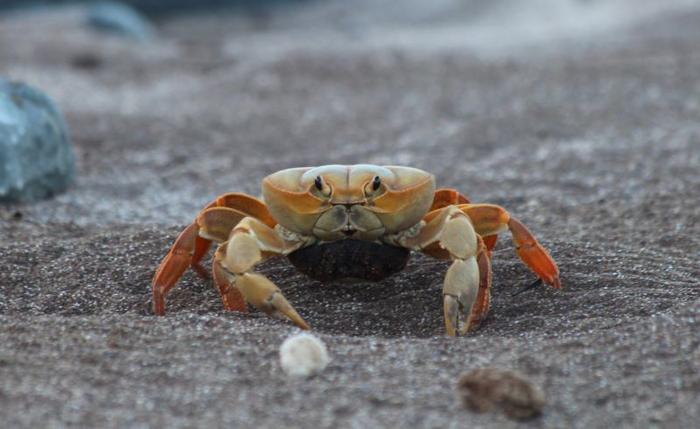
Featured image: A crab. Scientific Inquirer media library. (The press release photo of Coenobita brevimanus scraping fruits off Balanophora fungosa is credited to Suetsugu Kenji.)
Endnotes
- Suetsugu, K., et al. “Unexpected allies: Land hermit crabs and cockroaches contribute to seed dispersal in a non-photosynthetic plant.” Ecology, 11 August 2026. DOI: 10.1002/ecy.70462.
- Kobe University. “Who are the secret gardeners of a parasitic plant?” EurekAlert!, 11 August 2026. https://www.eurekalert.org/news-releases/1139248


Leave a Reply