Elephants are among the most social animals on Earth. Female Asian elephants live in fluid networks of companions, sometimes splitting into small groups and coming back together, sharing knowledge about where to find food and water and helping one another raise calves. Those relationships are not a luxury. For elephants, they are a survival strategy.
A 12-year study published in Science suggests that those networks can unravel, and do so suddenly. Tracking more than 440 wild female Asian elephants in Sri Lanka’s Udawalawe National Park, researchers from UC San Diego found that gradual losses from the population preceded an abrupt shift: the elephants’ large, densely connected communities broke apart into smaller, more isolated groups.
“We see individual elephants leaving and possibly dying at accelerating rates,” said lead author Anastasia Madsen, a postdoctoral researcher in the laboratory of Shermin de Silva, an associate professor in UC San Diego’s Department of Ecology, Behavior and Evolution.
Watching a Society Over Time
Long-term observation is what made the finding possible. By identifying and following individual females over more than a decade, the team could track who associated with whom and how those connections changed as animals disappeared from the population and, more rarely, new ones joined it.
Several factors likely contributed to the population’s decline, according to the researchers: deaths, elephants permanently leaving the area, and fewer new individuals joining. Other possible pressures include poaching, deaths from conflict with people, disrupted habitat connections, and reduced food as conditions change across the 119-square-mile park and its surroundings.
A Social Tipping Point
The most striking result is the shape of the change. The losses accumulated gradually, but the social structure did not erode gradually in response. Instead, as the population shrank, it crossed a critical threshold and shifted from large, well-connected communities to smaller, less-connected groups.
That kind of sudden reorganization is characteristic of systems with tipping points, where small changes have little visible effect until a threshold is crossed, after which the system flips to a different state. And once flipped, such systems can be hard to restore.
“Once we move past the tipping point, it’s much harder to go back to previous states,” Madsen said. The researchers warn that the fragmentation now seen at Udawalawe may be difficult to reverse.
Why Isolation Matters
For elephants, losing companions means losing more than company. Elephants rely on their social groups to forage, to share information and to raise their young. Older females, in particular, carry knowledge about the landscape, such as where water can be found in a drought, that younger animals learn by following them. Calves benefit from the care of multiple adults.
When networks fragment, that shared knowledge and support may become harder to access. Smaller, isolated groups may be less able to find resources or protect their young, potentially feeding back into further population decline.
Conserving elephants, then, may require more than keeping individual animals alive. “We need to be able to replace the relationships that are lost over time,” de Silva said.
Social Patterns as an Early Warning
The study also points to a practical tool for conservationists. Because gradual turnover and rising isolation came before the sudden fragmentation, monitoring social structure could offer an early warning that a population is approaching a threshold, before the change becomes visible in simple head counts.
“We are gaining more evidence that studying social patterns is an important tool,” Madsen said.
The research comes from a single population in one protected area, and it is observational, so it identifies patterns and likely contributors rather than proving which factor drove the decline. The release does not quantify how much each pressure contributed. Still, the findings carry a message that may apply to other social species: populations can appear stable until, quite suddenly, the web of relationships that holds them together gives way.
The work was funded by the U.S. Fish and Wildlife Service, the U.S. National Science Foundation, the University of Pennsylvania, UC San Diego and Trunks & Leaves Inc., a conservation nonprofit founded by de Silva.
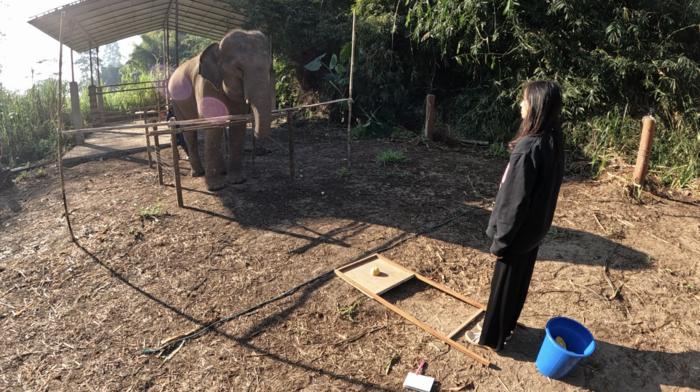
Featured image: An elephant. Credit: KyotoU / Hoi-Lam Jim. (The press release photo of elephants at Udawalawe National Park is credited to the Udawalawe Elephant Research Project, CC BY-ND.)
Endnotes
- Madsen, A., et al. “Increased demographic turnover and isolation precede social fragmentation in Asian elephants.” Science, 12 November 2026. DOI: 10.1126/science.aef6714.
- University of California San Diego. “Elephants found to be increasingly isolated, leading to fractured social networks.” EurekAlert!, 12 November 2026. https://www.eurekalert.org/news-releases/1150948



Leave a Reply