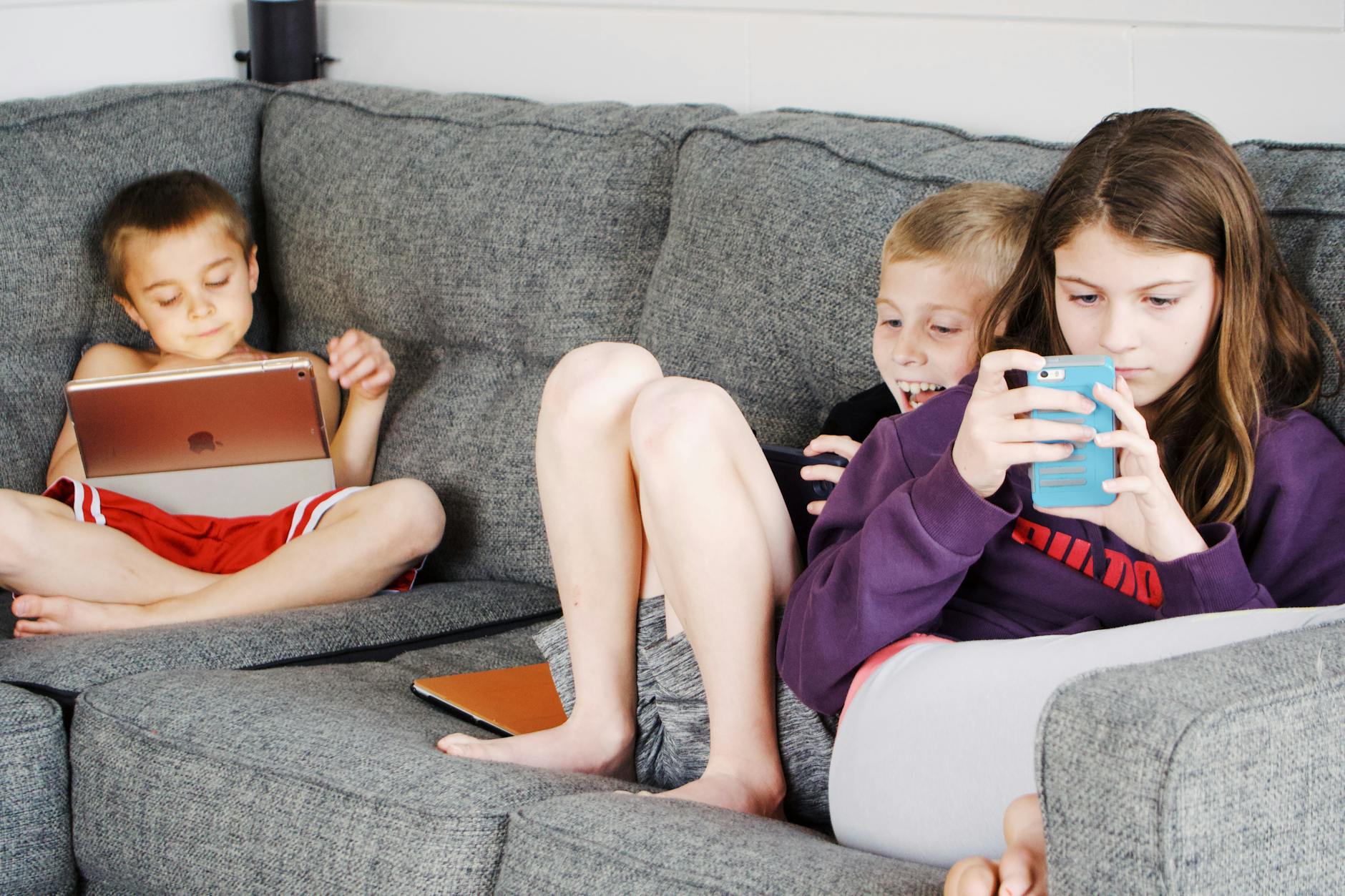
FIU researchers asked what shapes how families manage screens, and found the answer had more to do with the caregiver’s state than with the child’s.
Advice about children and screens is almost entirely addressed to the decision: how long, what content, which rules. A study in Family Relations from Florida International University asks a prior question — what determines whether a parent is in a position to make that decision well — and finds that the parent’s own stress is a substantial part of the answer.
The survey covered 822 caregivers across the United States with children aged four to eight. Parents under higher stress were more likely to use screens to calm or occupy their children, and less likely to enforce consistent screen-time limits.
The lead author is Enid Moreira, a psychology doctoral student at FIU, with Shayl Griffith, an assistant professor in FIU’s Department of Counseling, Recreation and School Psychology, as senior author. The work was conducted at FIU’s Center for Children and Families.
Two different stresses, two different effects
The study separates the strain into components, and they act on different parts of parenting.
Parents experiencing emotional distress were less likely to enforce consistent limits. Parents who felt overwhelmed specifically by their child’s behaviour were more likely to reach for a screen to manage a difficult moment.
That split is more informative than a single stress measure would be. Consistency is a demand on sustained attention — noticing that the agreed time has passed, absorbing the protest that follows, holding the line when it would be easier not to — and a depleted parent has less of that to spend. Handing over a tablet during a tantrum is a different act, one that solves an immediate problem at an immediate cost of nothing.
“What stood out was the importance of caregivers’ own stress in decisions about how screen media is used by their children,” Moreira said. “This is important because it points to the need to support caregivers as much as children.”
The direction the arrow runs
This is a survey administered once, which leaves the causal question open in a way that matters for what anyone should do about it.
Stress may erode a parent’s capacity to enforce limits. Equally, a child whose behaviour is difficult — and who is therefore handed a screen more often — generates the stress, which would make the stress a consequence rather than a cause. The study’s own finding that feeling overwhelmed by a child’s behaviour predicts screen use points at a loop more than at a direction.
A third possibility covers both: circumstances that produce parental stress, such as financial pressure, long or irregular working hours, single parenting or inadequate childcare, also produce the conditions in which a screen is the only available option. On that reading, stress and screen use are both downstream of something a parenting intervention cannot reach.
The measures are also self-reported on both sides. Parents estimated their own stress and their own screen practices, and a parent who is struggling may report both more candidly or less so than one who is not — which can inflate or deflate the association without any underlying relationship changing.
The release reports no statistics beyond the sample size: no effect sizes, no proportions, no indication of how strong any of these associations were. Eight hundred and twenty-two caregivers is a solid sample, and whether the relationships it found are substantial or marginal is not something a reader can tell.
The researchers’ conclusion
What the team draws from it is a redirection rather than a prescription, and it is the part that fits the data best.
“When caregivers have the resources they need, they are better able to set consistent boundaries and engage with their children in ways that promote healthy development,” Griffith said.
If screen practices track caregiver capacity, then advice that assumes capacity will fail in exactly the households where it is most needed. Telling an overwhelmed parent to be more consistent identifies the gap without supplying anything to close it, whereas reducing the stress addresses the input.
The researchers also suggest that improving the quality of children’s screen use may matter as much as stricter rules — and are careful to say that screen use during a hard moment is not inherently harmful, and that parents can make such moments more intentional.
“In the same way we think about nutrition, we can think about digital content as something that can be more or less healthy,” Moreira said.
The analogy has limits worth noting, since nutritional quality rests on a large body of outcome research and the equivalent for digital content is much thinner. But the practical point stands independently: a parent who cannot reduce screen time can still influence what is on the screen, and that is an option available under exactly the conditions the study describes.
A note on how to read it
One misreading should be headed off, because this is a literature that generates guilt efficiently.
The study did not find that stressed parents are doing something harmful. It found that stress predicts particular screen-management strategies, and it measured no outcome in any child — no behaviour, no development, no wellbeing. Whether the practices it identifies matter for children is a separate question this design cannot address.
Read as the authors frame it, the finding is about support rather than blame: the households where screen rules are least consistent are the ones under most strain, which makes it a resourcing problem presenting as a discipline problem.
The article was published on 26 May 2026. The research was supported by the National Academy of Education through a National Academy of Education/Spencer Foundational Postdoctoral Fellowship awarded to the senior author; the release’s conflict-of-interest statement describes only that funding.
Notes
- Moreira, E., Griffith, S. “Parenting in the digital age: How parenting stress shapes screen media parenting strategies.” Family Relations, 2026. DOI: 10.1111/fare.70186.
- Florida International University. “When parents are stressed, kids get more screen time, FIU study finds.” EurekAlert!, 6 August 2026. https://www.eurekalert.org/news-releases/1139229.
Photo by Jessica Lewis on Pexels.com




Leave a Reply