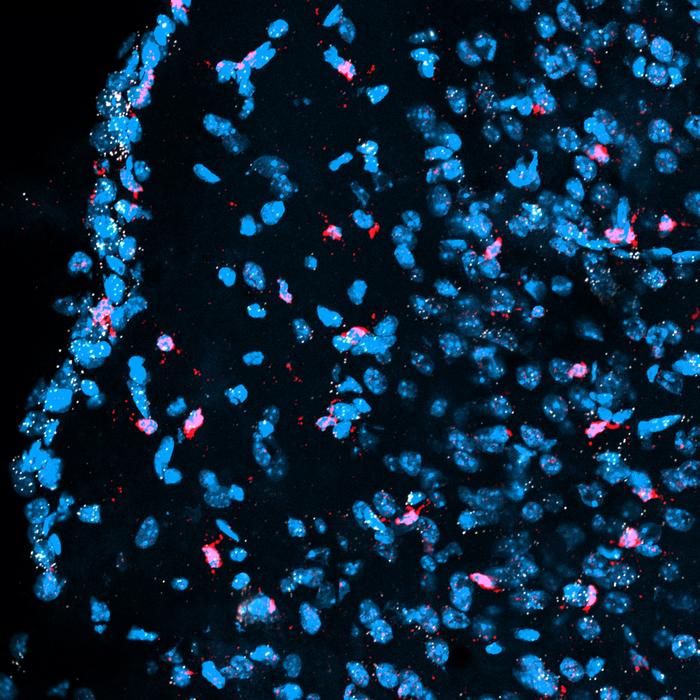
A Colorado team found HSV-1 infection drove microglia into interferon-dominated states and turned down the genes behind their everyday housekeeping, in the brain regions where the virus turned up.
Herpes simplex virus type 1 infects more than 60 per cent of people and stays for life, usually doing nothing more than producing an occasional cold sore. It establishes latency in nerve cells, reactivating when the immune system is distracted, and for most carriers that is the whole story.
A study in PLOS Pathogens from the University of Colorado Anschutz looks at what the virus does to the brain’s own immune cells, and finds the answer is more than inflammation.
“Microglia act as both the brain’s security system and its maintenance crew,” said Christy Niemeyer, an assistant professor of neurology at CU Anschutz and the study’s senior author. “When HSV-1 enters the brain, these cells shift into emergency defense mode. While this helps fight the virus, it may also compromise their ability to perform the everyday functions, even after the virus is gone.”
The brain’s maintenance crew
That dual job description is the key to the finding. Microglia are the resident immune cells of the central nervous system, and their defensive role is only part of what they do.
In a healthy brain they are constantly busy with upkeep: extending processes to survey their territory, pruning unused synapses, clearing cellular debris and dead cells, and supporting the neurons around them. This is not idling between emergencies — synaptic pruning shapes circuits during development and continues through adult life, and debris clearance is what keeps the tissue from accumulating damage.
A cell that does both jobs has to choose. The study found infection produced distinct microglial populations dominated by interferon signalling, while genes tied to the normal protective and maintenance functions became less active.
Interferons are the body’s primary antiviral alarm, and an interferon-dominated state is the appropriate response to a virus. The cost is what gets set aside to mount it.
Where the virus was, and what changed
The changes were concentrated in the brain regions where the virus was detected, which the authors read as localised areas of heightened immune activity rather than a brain-wide response.
Regional specificity matters for interpretation. A diffuse inflammatory state could be a systemic reaction to being unwell; changes that track the virus’s distribution point to local cells responding to local infection. HSV-1 reaching the brain through the nasal route, as the study’s title indicates, would be expected to produce exactly this kind of patchy distribution, following the olfactory pathway inward rather than arriving everywhere at once.
The team also found chromatin changes — alterations to the packaging of DNA that affect how easily genes can be switched on or off.
That is the detail that makes the study’s central question worth asking. A shift in which genes a cell is expressing can reverse as soon as the stimulus goes away. A change in chromatin is a change in what the cell is set up to do, and such changes can outlast the signal that produced them.
“What makes these findings particularly interesting is that the virus isn’t simply triggering inflammation,” Niemeyer said. “It’s changing the molecular programs that control how these immune cells function. An important question is whether these changes persist after infection.”
That question is not answered here. Whether the altered state outlasts the infection is explicitly identified as the planned next step, and until it is done the word in the headline — stuck — is a hypothesis rather than a finding.
The Alzheimer’s question, handled carefully
The microglial changes resemble patterns seen in response to other factors linked to Alzheimer’s disease, which is the connection that gives this work its wider interest and also its greatest potential to be overstated.
“Interestingly, the way that HSV-1 finely tunes the immune response in microglia, resemble patterns found in response to other factors that drive Alzheimer’s disease,” said Kimberley Bruce, an associate professor of medicine and co-senior author. “Although we have not established that HSV-1 causes Alzheimer’s, it highlights the immune programming of microglia as a common factor linking infection, aging and genetic risk factors.”
The disclaimer is the authors’ own and deserves to be repeated rather than buried. This study does not show that the cold sore virus causes dementia. It shows that infection pushes microglia into a state that looks like states associated with other Alzheimer’s risk factors — a convergence at the level of cellular response, not a demonstrated causal chain.
The framing Bruce offers is the more useful one in any case. Alzheimer’s risk involves genetics, age and, increasingly in the evidence, immune function, and several of the strongest genetic risk variants turn out to be expressed in microglia. If different risk factors converge on the same altered microglial programme, then that programme is the thing to study, whatever drives it in a given person.
There is a longstanding and contested literature linking HSV-1 to dementia risk, with epidemiological associations and some trial interest in antivirals, none of it settled. Work of this kind contributes a possible mechanism without resolving the question.
What the release leaves out
The study reports no numerical results in the release — no counts of cells or animals, no magnitudes, no measures of how much gene expression shifted. The findings are given as directions only.
More significantly, the release does not state what was infected. The paper’s title describes intranasal HSV-1 infection and region-specific microglial remodelling, which is the design of an animal experiment, but the release never names the model system. For a result about the human brain’s vulnerability to a near-ubiquitous human virus, that omission is not a small one: whether these are mouse microglia or human cells in culture changes what the finding can be extrapolated to.
“Understanding how a common virus changes the brain’s immune environment may help us identify why some individuals become more vulnerable to neurodegeneration,” Niemeyer said. That is a fair statement of the ambition. The work in hand is a characterisation of a cellular state, and the questions that would make it consequential — does it persist, does it occur in people, does it matter for outcomes — are all still open.
The study’s other listed authors are Seth Frietze, Cameron Lunn, Dean Oldham, Joseph R. Boyd, Andrew N. Bubak, Amalia Bustillos Saucedo, Maria A. Nagel and Diego Restrepo. The release does not state the study’s funding sources.
Notes
- “Intranasal HSV-1 infection drives region-specific interferon-dominant microglial remodeling.” PLOS Pathogens, 2026. DOI: 10.1371/journal.ppat.1014684.
- University of Colorado Anschutz Medical Campus. “Common cold sore virus may reprogram the brain’s immune defenses.” EurekAlert!, 19 October 2026. https://www.eurekalert.org/news-releases/1148363.
Credit: Ostrem et al., 2024



Leave a Reply