Earth has spent most of its history without large polar ice sheets. The present day, with ice capping Antarctica and Greenland, is an unusual “icehouse” state, and only a handful of comparable intervals exist in the geological record. That rarity makes it hard to know how an icehouse planet responds when carbon dioxide rises and temperatures climb.
A new study led by Professor Yao Le of the Nanjing Institute of Geology and Paleontology at the Chinese Academy of Sciences offers one answer from about 300 million years ago. Writing in the Proceedings of the National Academy of Sciences, Yao and colleagues in China and abroad describe a short-lived global warming event during the Late Paleozoic Ice Age, Earth’s penultimate icehouse, and trace how volcanoes, orbital cycles and runaway carbon feedbacks combined to drive it.
The Closest Ancient Match to Today
The Late Paleozoic Ice Age is not just any ancient cold spell. It is the only deep-time icehouse known to have had carbon dioxide levels comparable to those of the Quaternary, the geological period we live in, at roughly 300 parts per million before the industrial era. That makes it the best available natural laboratory for asking how an ice-covered world behaves under rising greenhouse gases.
Researchers had previously found signs of warming during this ice age in rocks from North America and from the Donets Basin in eastern Europe. But those records were low in resolution, and they disagreed about how large the warming was and exactly when it happened.
Temperatures Locked in Tiny Teeth
To build a sharper record, the team turned to conodonts, tiny tooth-like fossils left by extinct eel-like marine animals. Conodont elements are made of apatite, a mineral that captures the ratio of oxygen isotopes in the surrounding seawater, and that ratio shifts with temperature. Using secondary ion mass spectrometry, a technique that can measure isotopes in very small spots, the researchers analyzed conodonts from the Naqing and Narao sections in South China and the Usolka section in the southern Ural Mountains of Russia.
Near the boundary between two stages of the Late Carboniferous, the Kasimovian and the Gzhelian, the oxygen isotope values swung sharply. The team interprets that shift as a distinct warming episode, which they name the Kasimovian-Gzhelian Thermal Maximum, or KGTM.
Two Phases of Heat
The warming came in two steps. In an initial phase, sea-surface temperatures rose by about 2 degrees Celsius over roughly 60,000 years at Naqing. A main phase followed, with sea-surface temperatures climbing about 3.5 degrees Celsius over about 35,000 years. The researchers pinned down those durations using cyclostratigraphy, which reads the rhythmic layering of sediments as a geological clock.
Globally, the team estimates that mean surface temperature rose by about 7.5 degrees Celsius. By comparing sea-surface temperatures from the Urals with simulations from the Community Earth System Model, a widely used climate model, they estimate that atmospheric carbon dioxide rose from about 300 to about 700 parts per million. That range includes the levels seen in the modern world, roughly 300 to 400 parts per million.
Volcanoes Lit the Fuse
To understand what set the warming off, the researchers measured mercury isotopes, which can carry a fingerprint of volcanic activity. During the initial phase, mercury isotope values in both South China and the southern Urals pointed to increases in local to regional volcanism. During the main phase, however, a distinct shift in the mercury signal suggests that volcanic activity had not continued.
Orbital cycles also played a role. At Naqing, rhythmic variations in oxygen isotopes and carbon isotopes line up with Earth’s 405,000-year long eccentricity cycle, a slow change in the shape of the planet’s orbit that affects how sunlight is distributed. Both warming phases coincided with peaks of the shorter, 100,000-year eccentricity cycle and with high values of the 405,000-year cycle, supporting the idea that orbital pacing helped regulate atmospheric carbon dioxide.
Past a Tipping Point
Putting the pieces together, the authors propose a sequence. Volcanism started the warming, and orbital forcing amplified it. Then positive feedbacks between climate and the carbon cycle pushed the system past a tipping point, releasing large amounts of carbon and producing the abrupt warming of the main phase, even after the volcanic trigger had faded.
The consequences showed up in the oceans. Mercury isotope records indicate photic-zone euxinia during the main phase, meaning sunlit surface waters became oxygen-poor and rich in toxic hydrogen sulfide. Conodonts became smaller and less diverse, and reef ecosystems shifted from communities built by animals to ones dominated by large algae.
Slow Then, Fast Now
One comparison stands out. The researchers estimate that warming during the KGTM proceeded at about 0.04 to 0.10 degrees Celsius per thousand years. Present-day warming, by their figures, runs at about 10 to 15 degrees Celsius per thousand years, far faster than the ancient event.
That gap cuts in a worrying direction. The ancient warming, driven by a much slower push, still appears to have tipped the climate system into a state of rapid carbon release, oxygen-starved seas and ecological upheaval. The authors argue that even modest warming in today’s icehouse deserves attention, because it could speed ice-sheet melting and the release of carbon from permafrost, potentially expanding ocean anoxia and biodiversity loss.
There are limits to the comparison. The continents were arranged differently 300 million years ago, ecosystems were very different, and climate model estimates of ancient carbon dioxide carry uncertainty. The record also comes from a small number of sections. Still, the study provides a high-resolution view of how an icehouse Earth with carbon dioxide levels much like our own once warmed, and how quickly a modest nudge became a tipping point.
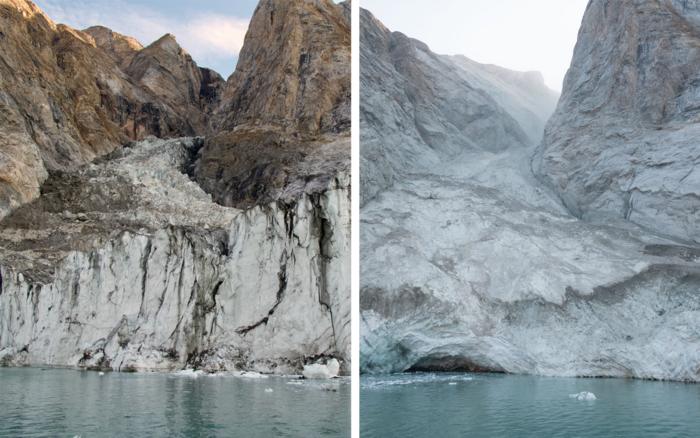
Featured image: A Greenland mountain peak and glacier before (August 2023) and after (September 2023), seen from the fjord. Credit: Søren Rysgaard / Danish Army.
Endnotes
- Yao, L., et al. “A transient global warming event during Earth’s penultimate icehouse.” Proceedings of the National Academy of Sciences, 10 August 2026. DOI: 10.1073/pnas.2601643123.
- Chinese Academy of Sciences. “Ancient icehouse hyperthermal event offers insights into modern climate change.” EurekAlert!, 11 August 2026. https://www.eurekalert.org/news-releases/1139776



Leave a Reply