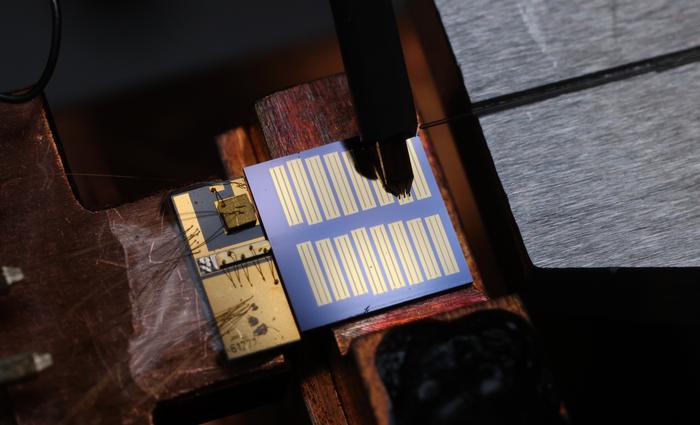
Teams at Rensselaer and NC State merged several bound states in the continuum in a photonic crystal slab, then shrank the device to under 15 square micrometres by shaving its edge holes.
A laser is only useful if it emits one colour. Real cavities support many modes, and as the power rises, modes that were too lossy to matter begin to lase as well. The output turns from a line into a thicket, which is why so much laser engineering is the suppression of everything except the intended mode.
Writing in Light: Science & Applications, teams led by Professor Wei Bao at Rensselaer Polytechnic Institute and Professor Qing Gu at North Carolina State University report a photonic crystal laser that held single-mode operation up to 80 times its threshold power, and a second version small enough to be measured in square micrometres.
Light that should escape and does not
The mechanism is a bound state in the continuum, usually shortened to BIC. The name describes something slightly paradoxical: a state that remains confined even though it sits at an energy and momentum where it ought to be free to radiate away.
In a periodic structure such as a photonic crystal, this can happen because the available escape routes interfere destructively. The light has somewhere to go and the paths cancel, so it stays. A confined state in a structure with no barrier holding it in has, in principle, an infinite quality factor, the measure of how long a cavity stores energy.
Two kinds matter here. A symmetry-protected BIC is confined because its field pattern is the wrong shape to couple to anything escaping; the protection comes from symmetry and is robust. An accidental BIC arises when parameters happen to make the escape channels cancel, which makes it tunable and fragile.
Pushing them together
The design moves several accidental BICs toward the Γ point, the centre of momentum space, until they merge with a symmetry-protected BIC already sitting there.
The purpose is not a single better state but a broader one. An isolated BIC has a high quality factor at exactly one point, and in a real finite device the mode is spread over a range of momenta, most of which fall outside that point and leak. Merging several BICs widens the high-Q region, so more of the mode is protected.
The device is a suspended two-dimensional InGaAsP photonic crystal slab operating near telecom wavelengths. Suspending the slab leaves air above and below it, which maximises the refractive index contrast confining light vertically; InGaAsP is a standard semiconductor for emission in the 1.5-micrometre band used by optical fibre.
The 80-times-threshold result came from the pre-merging BIC device, a 20-by-20 unit-cell array. Eighty times threshold is a demanding test: this is the regime in which single-mode lasers usually stop being single-mode.
The trade-off the paper does not hide
Merging lowers the threshold, which is the expected benefit. It also reduces loss for nearby higher-order modes, which increases mode competition.
That is worth stating plainly, because it is the kind of detail that gets lost in summaries. A mechanism that protects the desired mode by suppressing radiation does not discriminate perfectly, and some of that protection extends to modes nobody wants. Lower threshold and cleaner single-mode behaviour pull in opposite directions.
Fifteen square micrometres
The more striking device is the small one: a 5-by-5 period array with a patterned area under 15 square micrometres.
Shrinking a photonic crystal laser is difficult for a reason intrinsic to how it works. The confinement comes from periodicity, and periodicity requires periods. With 25 unit cells there is barely any lattice, the boundary is most of the device, and light leaks out the sides faster than the structure can hold it.
The fix was edge engineering: slightly reducing the diameter of the air holes at the boundary. Smaller holes mean more semiconductor and a higher effective refractive index at the rim, so the edge behaves as a mild barrier reflecting light back inward rather than as an abrupt discontinuity scattering it away.
With that modification the compact device lased and stayed single-mode up to 10 times threshold. That is less than 80, but it is for a device with a twentieth of the patterned area.
The team also confirmed the mode’s vortex character through far-field interference patterns. A symmetry-protected BIC at the Γ point carries a winding phase, which produces a beam with a phase singularity at its centre — a property of interest for optical communications, where such states can carry additional information, and a useful signature that the mode is the intended one.
No one is quoted
The release carries no quotations from any researcher, which is unusual and worth flagging: everything above comes from the release’s own description of the work rather than from anyone explaining it. The full author roster is not given either; the image credit reads “Wei Bao et al.”
What the result does not address is the practical question of integration. A suspended membrane is mechanically delicate and thermally isolated, which complicates both packaging and heat removal, and the measurements reported are of optical behaviour rather than of a device operating continuously under load. A laser that occupies 15 square micrometres is interesting mainly if thousands of them can sit on one chip, and that is a different engineering problem from making one work.
The work was supported by the National Science Foundation, the Army Research Office Early Career Program and the Office of Naval Research.
Notes
- Bao, W., et al. Light: Science & Applications, 2026. DOI: 10.1038/s41377-026-02355-w.
- Light Publishing Center, Changchun Institute of Optics, Fine Mechanics And Physics, CAS. “Robust single-mode laser via merging bound state in the continuum.” EurekAlert!, 3 August 2026. https://www.eurekalert.org/news-releases/1138548.



Leave a Reply