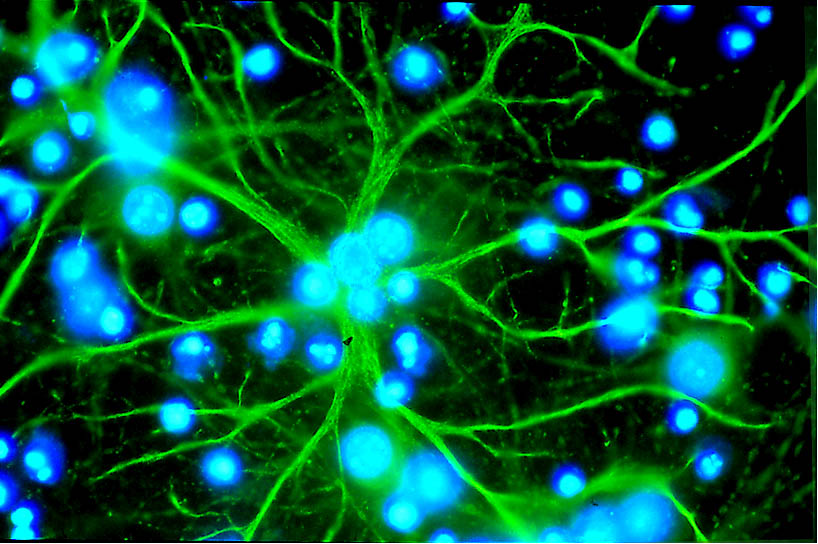
Hippocampal tissue from 29 epilepsy patients showed that abnormal immature astroglia accumulate with age, and that higher numbers tracked poorer performance on tests of fluid intelligence.
Most research on cognitive ageing concerns neurons: how many are lost, how well they connect, what happens to the proteins inside them. A study from the Keck School of Medicine of USC points instead at the brain’s support cells, and finds that the more immature ones a person has, the worse they do on tests of reasoning.
The work, published in Frontiers in Cellular Neuroscience, is unusual because it used living human brain tissue rather than mice or post-mortem samples.
“Aging is something we’re all familiar with and all impacted by — it’s a matter of when, not if,” said Michael Bonaguidi, an associate professor of stem cell biology and regenerative medicine, gerontology, biomedical engineering and neurological surgery at USC, and co-corresponding author.
Tissue from epilepsy surgery
The samples came from 29 patients with mesial temporal lobe epilepsy whose hippocampus was removed to treat severe, drug-resistant seizures.
That source is what makes the study possible. Living human brain tissue is almost never available for research, because there is no reason to remove healthy brain. Epilepsy surgery is one of the few circumstances in which tissue is taken out for clinical reasons and can, with consent, be studied afterwards.
Before their operations, the patients completed cognitive tests covering reasoning, memory, attention, language and fine motor coordination. That meant the researchers could compare what was in the tissue against how the person had performed.
Astroglia that never grew up
The cells in question are astroglia, star-shaped cells belonging to the broader class of glia, which outnumber neurons in the human brain. Once dismissed as packing material, they are now understood to regulate the chemical environment around synapses, supply neurons with metabolic support, help control blood flow and participate in forming and pruning connections.
In the hippocampus, some astroglia arise from neural stem cells, and the study concerns ones that appear to be stuck in an immature state: present, but not developed into the functional form.
The hippocampus is of particular interest because it is one of the few places in the adult human brain where new cells are thought to be produced, a claim that has been contested for a decade. Whatever the resolution of that argument, the region’s stem cell population is where immature cells would be expected to appear if maturation were failing.
“We found that older patients tended to have more abnormal immature astroglia,” said Aswathy Ammothumkandy, an assistant professor of research in the Department of Stem Cell Biology and Regenerative Medicine at USC and the paper’s first author.
The accumulation was not merely an age marker. Higher numbers of these cells were associated with poorer performance on tests of fluid intelligence.
Fluid versus crystallised
Fluid intelligence is the ability to reason through unfamiliar problems, spot patterns and work out what follows, as distinct from crystallised intelligence, which is accumulated knowledge and vocabulary.
The distinction matters for ageing because the two diverge. Crystallised intelligence is largely preserved into old age and can continue improving; fluid intelligence tends to decline from relatively early adulthood. Anyone who has watched an older person recall a word with perfect precision while struggling with an unfamiliar interface has seen the split.
That the astroglia association showed up specifically in fluid intelligence, rather than across the board, is part of what makes it interesting. It points to a process affecting the capacity to do novel reasoning rather than general cognitive function.
A correlation in 29 people
The authors describe this as an early clue rather than proof that these cells cause cognitive decline, and the limits of the design deserve stating.
Twenty-nine patients is a small sample for a correlation between two variables that both change with age. Immature astroglia accumulate with age, and fluid intelligence declines with age; finding that the two relate to each other does not establish that one affects the other, since age could drive both independently.
The patients also all had drug-resistant epilepsy severe enough to warrant removing part of the brain. Epilepsy itself alters hippocampal tissue, and chronic seizures affect cognition, so whether the same relationship holds in brains without epilepsy is an open question.
The direction of causation is open too. Immature astroglia could impair reasoning, or the conditions that impair reasoning could leave astroglia immature, or something else could produce both.
Nor does an association in a cross-section tell you anything about change over time. Each patient was measured once, so the study compares different people of different ages rather than following anyone as they aged, which is a weaker basis for claims about decline.
Why a cell type is a useful target
Despite those limits, the finding has a practical appeal that research on neurons often lacks.
“These findings suggest that astroglia could be a shared therapeutic target,” Ammothumkandy said.
Lost neurons are hard to replace. Glial cells, by contrast, continue to be generated in the adult brain, and pathways governing how stem cells mature are in principle manipulable. A deficit of maturation is a different kind of problem from a deficit of cells, and potentially a more tractable one.
“Shared” refers to the overlap between epilepsy and ageing. Cognitive decline is accelerated in people with epilepsy, and if the same cellular process contributes to both, work on one could inform the other.
“Understanding processes like cognitive decline, which can be accelerated in people with epilepsy,” is part of what this patient group makes possible, said Charles Liu, a professor of clinical neurological surgery at USC and director of the USC Neurorestoration Center. “This group of patients has already made an extraordinary contribution to our understanding of how the brain works.”
That is worth acknowledging directly. Much of what is known about human memory, including the role of the hippocampus itself, came from studying people whose epilepsy was treated surgically. These 29 patients, undergoing an operation for their own seizures, supplied tissue that no animal model could substitute for.
The release does not give the paper’s DOI. The work was funded by the National Institutes of Health, the Cure Alzheimer’s Fund, the Eli and Edythe Broad Foundation, the USC Neurorestoration Center, the Rudi Schulte Research Institute, the American Epilepsy Society, the California Institute for Regenerative Medicine and CURE Epilepsy Taking Flight.
Notes
- Ammothumkandy, A., et al. “An age-related decline in human fluid intelligence corresponds with immature astroglia prevalence.” Frontiers in Cellular Neuroscience, 2026.
- Keck School of Medicine of USC. “Immature brain support cells may be linked to human age-related cognitive decline.” EurekAlert!, 20 October 2026. https://www.eurekalert.org/news-releases/1148191.


Leave a Reply