
Kennedy Addresses Former Anti-Vaccine Group as HHS Secretary: Health and Human Services Secretary Robert F. Kennedy Jr. returned to the Children’s Health Defense conference Thursday, telling the anti-vaccine organization he once chaired that its supporters had a “strong and steadfast friend” in the Trump administration. Kennedy highlighted efforts to scale back childhood vaccine guidance, reshape federal vaccine advisory policy, and reconsider the recommended timing of the measles, mumps and rubella vaccine. Some of those changes have been blocked by a federal judge, while major medical organizations have warned that altering established vaccine recommendations could increase confusion and hesitancy. Kennedy’s appearance comes as the United States experiences its worst measles year since 1991, including four deaths in Pennsylvania among unvaccinated people. Decades of research have found no causal link between vaccines and autism.
Youngest Known Planet Found Still Being Born: Astronomers have confirmed the youngest known exoplanet, catching a giant world less than one million years old while it is still forming. Elias 2-24 b lies about 450 light-years away and remains embedded within the gas-and-dust disk surrounding its young star. Researchers identified the planet by reanalyzing archived observations from the W. M. Keck Observatory and combining them with data from ALMA and the Very Large Telescope. The planet, estimated at roughly two to four Jupiter masses, sits inside a prominent gap in the disk about 55 times farther from its star than Earth is from the Sun. Previous record-holding young planets were more than five million years old. The discovery challenges models struggling to explain how massive planets can assemble so rapidly at such large orbital distances. (NASA Science)
Scientists Watch Quantum Sound Jump in Real Time: Physicists have directly observed individual quantum jumps of sound for the first time, completing a century-long progression from theoretical prediction to experimental observation. Researchers at Stanford University created a mechanical resonator in which vibrations behave as discrete quantum units called phonons. Their device performed hundreds of measurements within two milliseconds, allowing scientists to watch individual phonons suddenly transition between energy levels in real time. Quantum jumps were first observed in trapped ions in 1986 and later in photons, but mechanical vibrations proved much harder to track without destroying their quantum state. Published in Science, the experiment provides a new way to study and control quantum mechanical systems involving sound. Researchers say phonons could ultimately become useful components in quantum computers, communication systems and extraordinarily sensitive quantum sensors. (Stanford Humanities and Sciences)
New Wildcat Species Discovered in Bolivia: Scientists have formally identified a new species of wild cat in Bolivia’s Yungas cloud forests, marking what researchers describe as the first newly recognized wild feline species in more than a century. Leopardus tilcayo is slightly smaller than a domestic cat, measuring roughly 45 centimeters long, with rounded ears and a distinctive spotted coat. Local residents had long known the animal as the tilcayo, but genomic analysis of two individuals revealed that it represents a distinct evolutionary lineage. The research, published in Current Biology, used whole-genome sequencing and museum specimens to reassess South America’s tiger cats, ultimately identifying five distinct species. So far, L. tilcayo has been documented only in Bolivia. Researchers already consider the animal vulnerable and warn that its apparently tiny population and restricted habitat could place it at substantially greater risk of extinction. (Phys.org)
Anthropic Builds Laboratory for AI Biology Research: Anthropic has quietly established a wet laboratory in the San Francisco Bay Area, pushing the AI company from computational biology into experiments involving actual biological materials. The facility will allow researchers to test hypotheses generated with Claude and investigate whether AI agents can design and execute increasingly sophisticated biological experiments. The company’s life-sciences ambitions have expanded rapidly, including work with pharmaceutical companies and development of specialized scientific AI tools. Anthropic says it is particularly interested in biological problems neglected by conventional drug development, including difficult therapeutic targets and diseases with limited commercial incentives. The move also intensifies questions surrounding AI and biosecurity: systems capable of accelerating beneficial biological research could potentially enable harmful applications. Anthropic says human scientists remain involved in experimental oversight and that safety considerations are integral to the program. (Reuters)
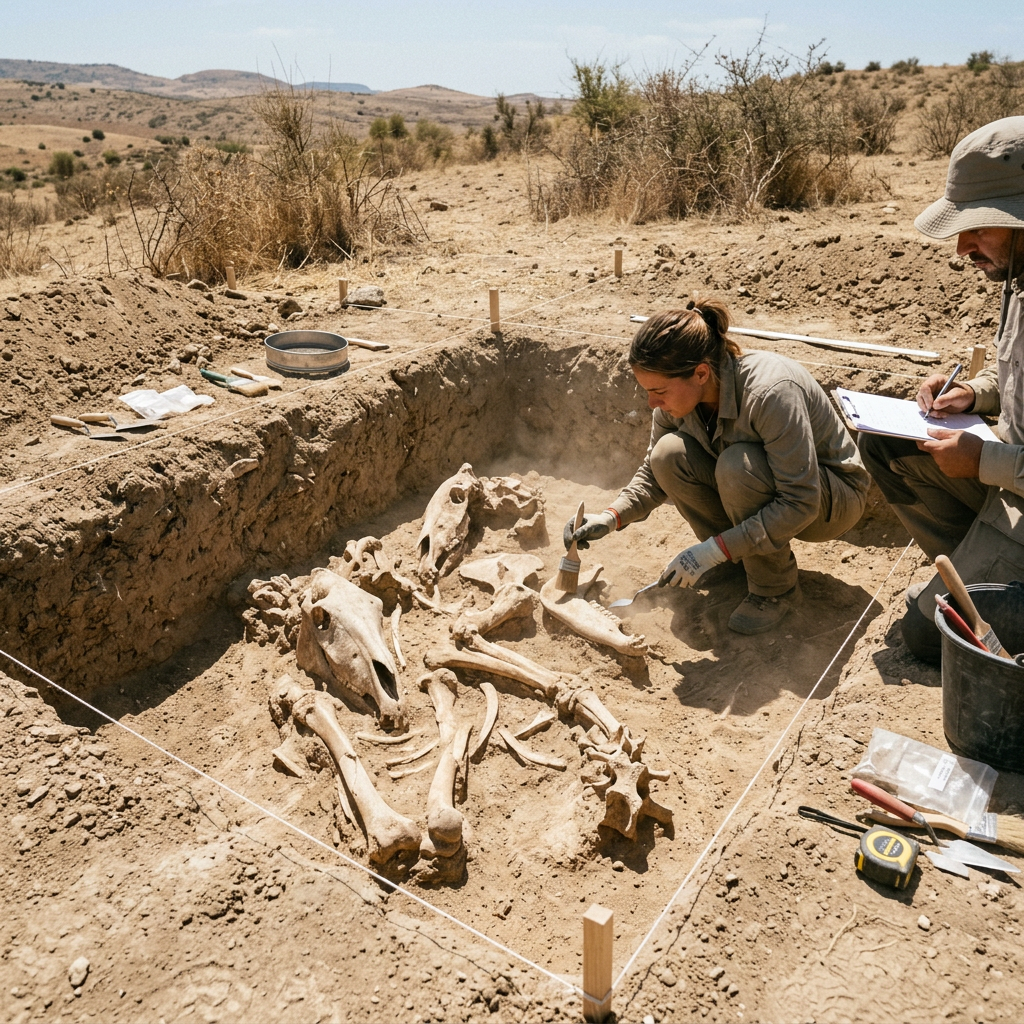
Untouched Chimú Tomb Reveals 38 Burials: Archaeologists investigating the ancient city of Chan Chan have uncovered an exceptionally preserved funerary platform containing the remains of 38 people along with weapons, jewelry and precious-metal objects. The unlooted graves provide a rare opportunity to investigate the Chimú Empire, which dominated much of coastal Peru before being conquered by the Inca around 1470. Several individuals were buried with objects suggesting elevated status, including gold and copper ornaments, while weapons found with other bodies may reveal previously unknown aspects of Chimú social organization. Researchers are examining the skeletons to determine age, sex, health, ancestry and possible relationships among the dead. Because Chan Chan was once the largest city in the Americas, the intact burial complex could provide unusually detailed evidence about hierarchy, ritual practices and everyday life within one of pre-Columbian America’s most powerful states. (nationalgeographic.com)
CREDIT: Gage Skidmore



Leave a Reply