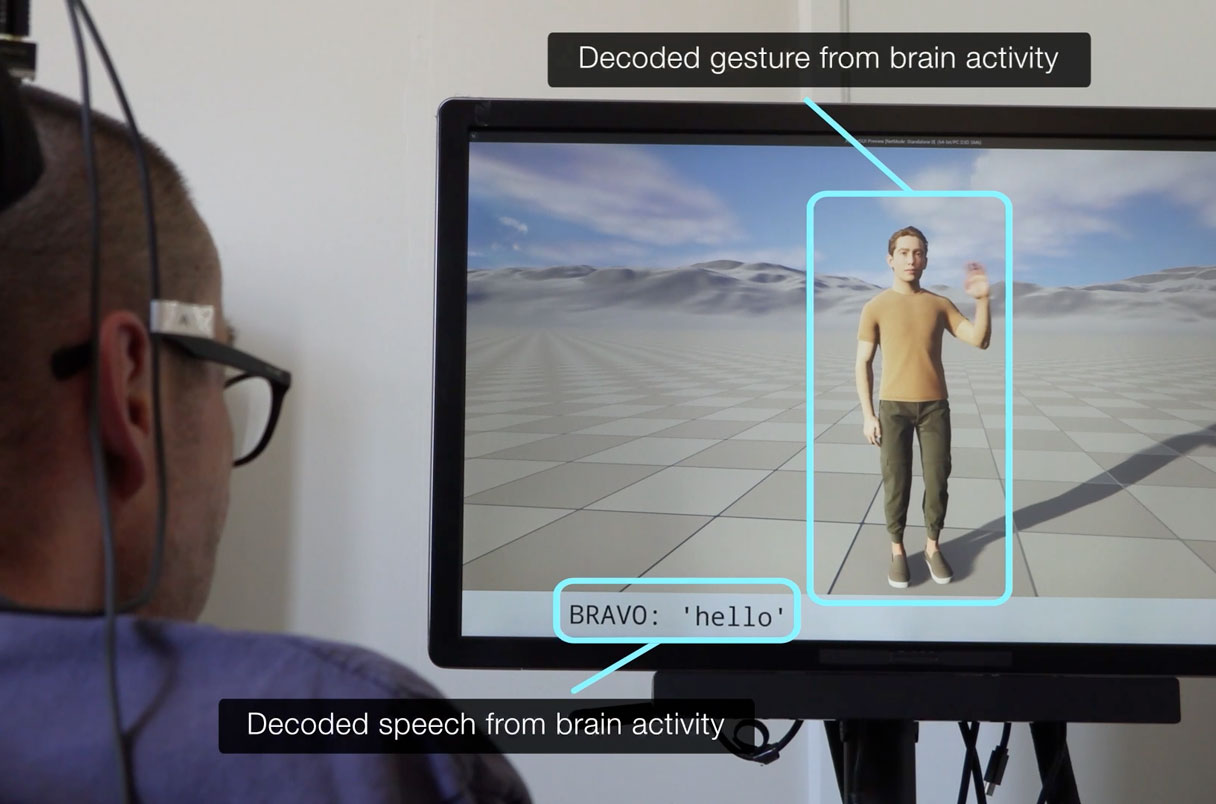
Single Brain Implant Decodes Speech and Gestures: Scientists have shown that a single brain-computer interface can decode both attempted speech and upper-body gestures in people with severe paralysis. Researchers at UC San Francisco placed a grid of tiny electrodes over a broad region of the sensorimotor cortex in two participants, then used machine learning to interpret brain activity as they attempted combinations of words, phrases, and gestures. The system successfully generated real-time digital avatars capable of actions such as waving while saying hello or nodding while saying yes. Unlike many BCIs designed for one task, the approach suggests a single surface implant could restore multiple forms of communication and movement. Researchers say the next challenge is scaling the system to decode far larger combinations without individually training every possible action. (Science)
Pennsylvania Records Third Measles-Associated Death: A 40-year-old Pennsylvania woman has died from complications associated with measles, marking the state’s third reported measles-related death this year. The woman, from Jefferson County, reportedly had chronic obstructive pulmonary disease and asthma, was unvaccinated, and had been exposed to someone with laboratory-confirmed measles. Pennsylvania has recorded 676 measles cases in 2026, the highest total of any U.S. state, with Lancaster County accounting for 295 infections. The state’s two previous measles-associated deaths involved infants, although questions remain over how those fatalities should be classified. Federal officials are developing a standardized definition for measles deaths. Health authorities emphasized that measles can cause serious complications at any age and stressed vaccination, early symptom recognition, and prompt medical care as key protections. (cidrap.umn.edu)
NSF Signals Major Shift in Research Funding: The National Science Foundation has outlined a significant overhaul of how it funds U.S. research, emphasizing administration priorities including artificial intelligence, quantum science, advanced materials, biotechnology, and technology commercialization. A September 10 memo describes a broader “portfolio” approach, combining exploratory grants with larger, longer-term awards and new centralized initiatives. NSF says it remains committed to curiosity-driven fundamental research, while also aligning funding more closely with national scientific and technological priorities. The agency has separately announced $1.5 billion for foundational research across 12 funding opportunities. Critics cited by Science worry that centralized decision-making and shifting workforce policies could weaken traditional investigator-led research and university science infrastructure. The changes arrive as NSF faces staffing losses and substantial uncertainty over future federal funding. (Science)

Brain Implant Restores Speech and Body Language: A brain-computer interface has enabled people with severe paralysis to communicate using speech and gestures simultaneously, bringing neural prostheses closer to reproducing natural human expression. Researchers at University of California, San Francisco implanted electrodes over brain regions controlling movement and used machine learning to decode neural signals generated when three participants attempted combinations of speech and upper-body gestures. The system translated those intentions into words and movements performed by a personalized digital avatar. Previous BCIs have decoded speech or movement separately; this is the first demonstration of both at once. Training algorithms on simultaneous expressions substantially improved performance. Published in Nature Neuroscience, the proof-of-concept remains dependent on surgically implanted hardware, although researchers are preparing to test a fully implantable wireless system. (National Institutes of Health)
Hidden Brain Proteins Linked to Alzheimer’s Disease: Scientists have uncovered more than 1,000 previously unrecognized microproteins in the human brain, revealing an overlooked molecular layer that could reshape research into Alzheimer’s disease. Researchers analyzed hundreds of postmortem frontal-cortex samples and identified 1,067 high-confidence microproteins—tiny proteins generally only 100 to 150 amino acids long that are largely absent from conventional reference proteomes. Several showed altered expression in Alzheimer’s brains independently of the larger, established proteins encoded by nearby genes. One particularly intriguing 63-amino-acid microprotein produced from the MKKS gene was reduced in Alzheimer’s tissue. Experiments showed that removing it impaired mitochondrial respiration in microglia, the brain’s resident immune cells, linking the molecule with cellular energy production. Published in Nature Aging, the atlas opens an unexplored class of potential mechanisms and therapeutic targets in neurodegenerative disease. (Nature)
Denisovan Cave Reveals 120,000 Years of Survival: An extraordinary cave in southwestern China is providing the clearest picture yet of how Denisovans actually lived. Excavations at Bianfu Cave uncovered Denisovan teeth, skull fragments and part of an arm bone alongside more than 1,300 stone tools and tens of thousands of animal remains. Protein analysis confirmed the fossils as Denisovan, while archaeological deposits indicate repeated human occupation between roughly 190,000 and 70,000 years ago. Cut marks and fractured bones show that inhabitants hunted and butchered medium-to-large animals including deer, water buffalo and gaur. Their relatively simple stone technology was supplemented by extensive use of animal bones as tools, suggesting a flexible strategy emphasizing readily available materials. Two studies published in Nature transform Denisovans from a population known primarily through genetics and scattered fossils into increasingly recognizable people with distinctive technologies, hunting practices and ecological adaptations. (Nature)
Venus May Have Swallowed Its Own Moon: Venus may once have possessed a moon but destroyed it because the planet rotates extraordinarily slowly. Researchers led by astrophysicist Stephen Krane at University of California, Riverside modeled hypothetical Venusian satellites of different sizes and found that the planet’s 243-Earth-day rotation would cause moons to migrate inward until eventually crashing into Venus. Earth behaves differently: its rapid rotation transfers energy to the Moon, pushing it outward by about four centimeters annually. The simulations suggest a Venusian moon could have disappeared within the planet’s first billion years. Published in The Astrophysical Journal, the hypothesis provides an alternative to ideas that Venus either never formed a satellite or lost one through a later giant impact. There is currently no direct evidence that Venus ever possessed a moon. (Reuters)
Magnetic Skyrmions Could Slash AI Energy Use: Tiny magnetic structures called skyrmions could provide a radically more energy-efficient way to perform artificial-intelligence computations. An international team involving the University of Edinburgh demonstrated artificial synapses based on nanoscale magnetic skyrmions operating at room temperature. Unlike conventional computing systems that shuttle information repeatedly between processors and memory, neuromorphic devices process and store information together, mimicking aspects of biological neural networks. Researchers showed that manipulating skyrmions can reproduce important synaptic behaviors required for learning while consuming extremely little energy. Their stability, small size and ability to operate under practical conditions make them particularly attractive for future AI hardware. The technology remains experimental rather than a replacement for today’s GPUs, but it addresses a rapidly growing problem: the enormous electricity requirements associated with training and operating increasingly powerful AI systems. (Phys.org)
Quantum Computer Could Transform Electron Microscopy: Researchers in Austria are building an electron microscope connected directly to a quantum computer, potentially allowing scientists to extract substantially more information from every electron used to image a specimen. Conventional electron microscopes construct images largely by counting electrons, effectively discarding additional quantum information they carry. The new approach would entangle electrons with trapped ions that store their quantum states, enabling algorithms to combine information from successive electrons and reveal signals otherwise obscured by noise. Researchers have demonstrated the advantage mathematically and are now constructing an experimental system at TU Wien. If successful, the technique could produce high-resolution images using fewer electrons—particularly important for proteins and other fragile biological specimens that can be damaged by conventional electron beams. (ScienceDaily)
Plastic Waste Becomes Protein-Rich Space Food: Researchers are engineering microbes to transform plastic bottles and agricultural waste into food ingredients. Scientists at Southern Illinois University Carbondale first break polyethylene terephthalate (PET) and plant waste into smaller molecules using high-temperature, high-pressure processing. Engineered yeast then converts those molecules into proteins, fats, acids, beta-carotene and even vanilla flavoring. Researchers combine the resulting ingredients with starch, fiber and sweetener before 3D-printing protein-rich cookies called µBites. Developed partly through NASA’s Deep Space Food Challenge, the system could eventually recycle waste while producing food aboard spacecraft, submarines or in disaster zones. Safety data are encouraging, but formal taste testing awaits institutional approval and the researchers are still working toward producing more of the cookie entirely through microbial fermentation. (ScienceDaily)
Global Warming Disrupts Centuries-Old Ocean Connection: The tropical Indian and Pacific oceans have generally moved in climatic step for centuries, but human-caused warming appears to be disrupting that relationship in an exceptional way. Researchers at Woods Hole Oceanographic Institution combined corals, tree rings and stalagmites with observations and climate simulations to reconstruct ocean variability back to the early 1600s. The relationship remained remarkably stable except between roughly 1810 and 1850, when major volcanic eruptions temporarily weakened Pacific influence over the Indian Ocean. The modern breakdown, however, appears different: greenhouse warming is increasingly overwhelming that historical connection. Published in Nature Communications, the findings matter because interactions between the oceans influence rainfall, temperature and atmospheric circulation across enormous regions. Changing those relationships could complicate climate forecasting based on patterns observed during the historical period. (ScienceDaily)
AI Mines 400,000 Posts for Ozempic Side Effects: Researchers have used artificial intelligence to analyze approximately 400,000 Reddit posts discussing GLP-1 drugs including Ozempic and Wegovy, demonstrating how online conversations might supplement traditional drug-safety surveillance. A system developed at the University of Pennsylvania extracted descriptions of symptoms, experiences and potential adverse effects from users discussing medications such as semaglutide. Unlike formal clinical trials or regulatory databases, social-media posts can capture everyday experiences patients may never report to physicians or regulators. The researchers argue that large language models could continuously organize such unstructured information and potentially flag emerging safety signals earlier. However, Reddit posts are self-reported, medically unverified and susceptible to selection bias, so the system cannot establish that a medication caused a reported symptom. Instead, it offers a potentially powerful hypothesis-generating layer for conventional pharmacovigilance. (ScienceDaily)
Ringed World Chariklo Is Rapidly Changing: Observations from the James Webb Space Telescope indicate that the rings surrounding Chariklo—a small icy body orbiting between Saturn and Uranus—are changing measurably on astronomical timescales. Chariklo became the first known object smaller than a planet to possess rings when astronomers discovered them in 2013. Webb observations now provide exceptionally sensitive measurements of their composition and structure, allowing researchers to compare the system with earlier observations and track changes as Chariklo moves through its orbit. Understanding how its narrow rings evolve could reveal how material migrates, collides and dissipates around small Solar System bodies and help determine whether such rings are temporary structures rather than long-lived features. Chariklo and similar objects provide miniature natural laboratories for studying the same gravitational and collisional processes operating in the much larger ring systems surrounding the giant planets. (Space)
IMAGE CREDIT: Chang Lab/University of California San Francisco.



Leave a Reply