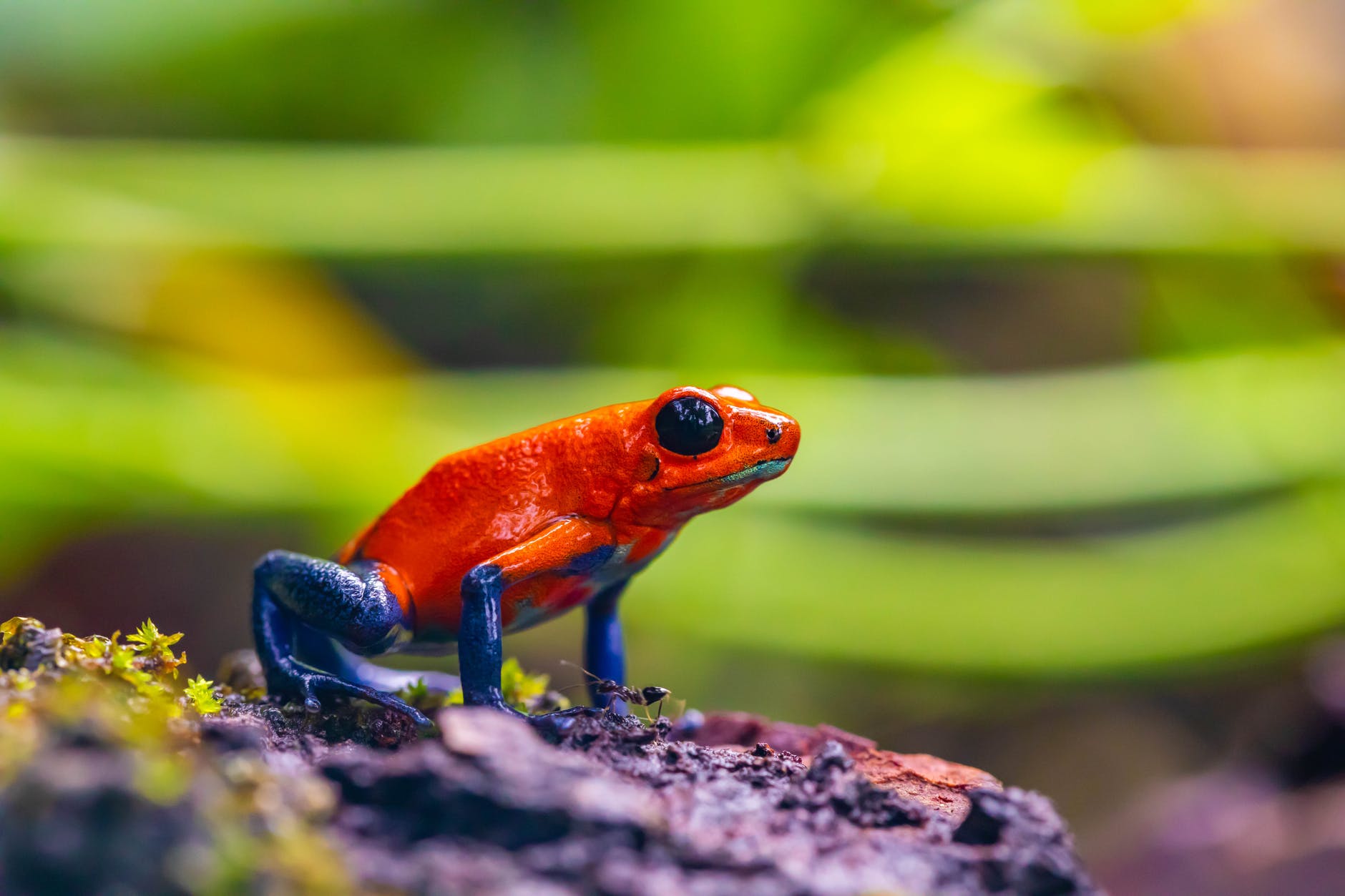
The genus Rhombophryne now holds 27 species, and the work that got there combined leaf-litter fieldwork with DNA sequenced from century-old museum specimens.
Diamond frogs are difficult animals to study because they spend most of their lives out of sight. They burrow in leaf litter and soil on the floor of Madagascar’s rainforests, surface briefly, and look much like one another when they do.
A paper in Vertebrate Zoology describes seven new species of them, bringing the genus Rhombophryne to 27 known species. The work took more than twelve years, and the obstacle was less finding the frogs than working out which names already belonged to which lineages.
“Diamond frogs have been hiding their diversity beneath our feet,” said Mark D. Scherz, Curator of Herpetology at the Natural History Museum of Denmark, University of Copenhagen, and the paper’s lead author. “Many species spend most of their lives beneath the leaf litter, and even when they emerge they can look deceptively similar.”
Five lines of evidence
Species descriptions in a group this cryptic cannot rest on appearance, and this one does not. The team combined fieldwork, DNA analysis, external anatomy, skeletal anatomy and recordings of the frogs’ calls.
Calls earn their place in that list. For animals that find each other acoustically in dense litter, the call is the mating signal, and two populations with different calls are more likely to be reproductively isolated than two that merely look different. Skeletal anatomy adds characters that are hard to change by environment, visible in specimens where soft tissue has long since gone.
Several of the new species have orange or white and black markings on the thighs or lower back — colouration hidden when the animal is at rest and exposed when it moves, a pattern that in other amphibians functions to startle a predator mid-strike. Some of the frogs resemble mainland African rain frogs, a similarity worth noting in a fauna that has been separated from the mainland for tens of millions of years.
Sequencing the type specimens
The part of the project that took years was taxonomic bookkeeping. When a group has been described piecemeal over a century, the older names are anchored to type specimens in museum drawers, and whether a population in the forest today is a new species depends on which of those old names it belongs to.
“When I started this project twelve years ago, we already knew there were several species waiting to be described, and almost every expedition to Madagascar revealed another one,” Scherz said. “Some were relatively straightforward to describe, but others were complicated by uncertainty surrounding older species names. Untangling that puzzle took years.”
The solution came from museomics — sequencing DNA from historical museum material — led by Alice Petzold of the University of Potsdam. Getting usable sequence out of specimens that have spent decades in preservative is technically demanding, and it allows a historical type specimen to be placed directly on a modern genetic tree rather than matched by eye.
“Museum collections are far more than archives of the past – they are essential scientific resources for understanding biodiversity today,” Petzold said. “By sequencing historical specimens, including the original type specimens, we were able to answer questions that have persisted for generations.”
Into a protected area plan
The descriptions have already been used. At a protected area planning workshop in March 2026, held as part of Madagascar’s Biodiversity 30×30 Program, several of the new species — among them Rhombophryne quentini — informed proposals to strengthen and expand protected areas.
That sequence is the practical argument for taxonomy. Conservation instruments operate on named units: a population that has not been described as a species is difficult to list, assess or write into a reserve boundary, however distinct it is biologically. Seven descriptions published before a planning workshop is a different outcome than seven published after it.
“Every newly described species represents millions of years of unique evolutionary history,” Scherz said.
Named is not the same as known
The co-author Andolalao Rakotoarison, of the Institut d’Enseignement Supérieur de Soavinandriana Itasy in Madagascar, set out what a description does not provide.
“For many species, we still know almost nothing about their breeding biology, population sizes or ecological requirements,” she said. “Without that knowledge, it becomes much more difficult to assess their conservation status and protect them effectively.”
This is the bottleneck behind most tropical amphibian conservation. An IUCN threat assessment needs range, population trend and the pressures acting on it, and for a recently described burrowing frog known from a handful of localities, each of those is a research programme. Several of Madagascar’s amphibians sit in the Data Deficient category for precisely this reason, which in practice offers less protection than being formally listed as threatened.
More to come
The authors conclude that undescribed species almost certainly remain in the genus, which is the expected conclusion for a group where twelve years of work raised the count from twenty to twenty-seven and where the animals in question live underground.
“The more we learn about Madagascar’s remarkable amphibians, the clearer it becomes that there is still an enormous amount left to discover,” Scherz said.
Madagascar’s amphibian fauna is almost entirely endemic and concentrated in forest that continues to be cleared, which is why the arithmetic of this paper cuts both ways. A genus growing by a third in a single publication means the baseline was wrong, and losses measured against the old baseline were undercounts.
The paper was published on 22 July 2026. The release does not state the study’s funding sources.
Notes
- Scherz, M.D., Petzold, A., Rakotoarison, A., et al. “A wealth of riches: a comprehensive revision of diamond frogs, genus Rhombophryne.” Vertebrate Zoology, 2026. DOI: 10.3897/vz.76.e172567.
- University of Copenhagen. “Scientists discover seven new frog species in Madagascar.” EurekAlert!, 3 August 2026. https://www.eurekalert.org/news-releases/1138376.
Photo by Diego Madrigal on Pexels.com


Leave a Reply