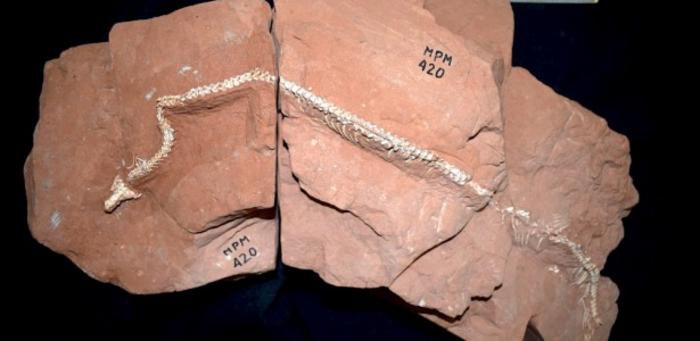
For more than a century, one of the most stubborn arguments in vertebrate paleontology has turned on a deceptively simple question: where did snakes come from? Not which lizards they descend from, though that has been fought over too, but what kind of world the first snakes lived in. Did they slither out of the sea, descendants of swimming reptiles that lost their legs to streamline their bodies? Did they evolve underground, shedding limbs that only got in the way inside a burrow? Or did they start on the surface, hunting across the forest floor like many snakes do today?
A small fossil pulled from a quarry in the interior of São Paulo state offers a surprising kind of answer. The answer, in effect, is all of the above, and earlier than anyone expected. Described in Nature by an international team led by researchers at Princeton University, the University of Helsinki and the University of São Paulo, the 42-centimeter snake Tametara mirim lived roughly 80 million years ago and, by every line of evidence the scientists could bring to bear, spent its life underground.1 Set alongside its contemporaries, it shows that by the Late Cretaceous, snakes had already split into burrowers, surface dwellers and ocean swimmers.
“Almost everything we know about the origin of snakes is based on a very limited number of well-preserved fossils,” said Tiago Simões, a professor in Princeton’s Department of Ecology and Evolutionary Biology and the study’s first author.2
A rare kind of fossil
Simões is not exaggerating. Snake skeletons are made of hundreds of small, delicate bones that tend to scatter after death, and the early fossil record is correspondingly thin. Fewer than ten articulated snake fossils are known from the entire Mesozoic Era, the paper notes, and only three of those are preserved in three dimensions: Dinilysia patagonica and Najash rionegrina from Argentina, and Sanajeh indicus from India.1 Much of what textbooks say about how snakes lost their limbs and stretched out their bodies rests on that handful of specimens.
Tametara joins that short list. William Nava and Giovanna Paixão of the Marília Museum of Paleontology found it in 2020 in a quarry near Presidente Prudente, in western São Paulo state, in sandstones of the Adamantina Formation, part of the Bauru Group, dated to roughly 85 to 75 million years ago.1,2 The specimen preserves the back half of the skull and jaws still connected to about 103 vertebrae, the front portion of the animal’s body. Earlier Cretaceous snakes from Brazil, such as Seismophis and Boipeba, are known only from isolated vertebrae, which makes Tametara the first articulated snake fossil ever found in the country.1
“Every new species from that era with this degree of preservation holds enormous potential,” Simões said.2
The name reflects both the animal and the place. Tametara means “adorned,” a nod to the prominent crest running along the top of its skull, and mirim means “small” in Tupí-Guaraní.1 Small is right: its preserved skull is under 18 millimeters long, with an estimated complete length of about 33 millimeters, roughly the size of a modern pipe snake’s.
Reading a brain from the bone around it
Brains do not fossilize. But the braincase that surrounded one does, and in snakes the fit between brain and bone is unusually snug, especially at the front, where the cerebral hemispheres and olfactory bulbs sit. That makes the internal cavity of a snake skull, called an endocast, a reliable stand-in for the shape of the brain itself.
To get at it, the team used micro-computed tomography, a far higher-resolution cousin of the CT scanners found in hospitals. Gabriela Sobral, an associate researcher at the State Museum of Natural History Stuttgart and the University of Brasília, then did the painstaking work of turning thousands of scan slices into a digital model. “Based on the CT scans, we segment the structures of interest,” she explained, producing a three-dimensional reconstruction that can be rotated and examined from any angle.2
What emerged was the most detailed reconstruction of a stem snake brain yet produced, complete with cranial nerves and the delicate canals of the inner ear.1 (Stem snakes are early lineages that branched off before the last common ancestor of all living snakes.) “From the very beginning, I knew I was looking at a very special fossil,” Sobral said.2
The anatomy told a consistent story. The skull bones were dense and heavily overlapping, an arrangement typical of animals that push headfirst through soil. The inner ear had an enlarged vestibule, the chamber that detects vibration, alongside highly reduced semicircular canals, the structures that track balance and orientation. That combination is common in burrowing snakes and suggests sensitivity to low-frequency vibrations traveling through the ground.1,2
“The reduced semicircular canals indicate that the animal’s spatial orientation isn’t critical,” Sobral said.2 An animal moving through tunnels, in other words, has less need for the acrobatic balance a tree-climber or a fast surface hunter relies on.
The visual system was even more telling. The optic tectum, the part of the midbrain that processes visual information, was poorly developed, shrunk to a thin band. “Atrophied regions indicate that function isn’t vital,” Sobral said, adding, “That’s an extremely unusual condition, even among modern burrowing snakes.”2 The olfactory bulbs were short and transitioned gently into only mildly enlarged cerebral hemispheres, proportions the paper notes are shared with living burrowers such as blind snakes and the Asian pipe snake Cylindrophis.1
Putting numbers on a lifestyle
Paleontologists have argued about the habits of fossil snakes for decades, often on the basis of a single suggestive feature. What sets this study apart is that the team did not rely on qualitative impressions alone. They tested Tametara against living animals with two independent quantitative methods.
The first was geometric morphometrics, a technique that maps the shape of a structure using a set of fixed landmarks and then compares those shapes statistically. The researchers focused on the telencephalon, the forebrain region that houses the cerebral hemispheres and olfactory bulbs, because it is the part of a fossil endocast least likely to be warped by burial and most faithful to the actual brain. They compared it across 58 living squamates, the group that includes lizards and snakes, with known habitats, plus Tametara and Dinilysia.1
Tametara landed squarely in the region of shape space occupied only by burrowing animals. A statistical classification model assigned it to a fossorial, or burrowing, lifestyle with 99.2 percent probability, and the paper describes it as one of the most extreme squamate examples of the pattern.1 The authors are candid that the model is imperfect overall, correctly classifying about 65 percent of living species, but it performs best on burrowers, getting them right about 86 percent of the time.
The second method looked at the bones themselves. The team measured skull bone thickness, compactness and overlap, along with skull elongation and diameter, across more than 100 living squamates. Burrowing species tend to have compact, thick, elongated skulls with tightly overlapping bones. Again, Tametara fell inside the cluster of burrowing snakes.1 Two independent systems, brain shape and bone structure, pointed to the same conclusion. The authors describe the result as quantitative, multi-system confirmation of a burrowing lifestyle in a stem snake, something earlier work had argued for mainly through qualitative or isolated evidence.1
A neighbor that lived differently
The real payoff came from comparison. Dinilysia patagonica, from Argentina, lived during the same broad slice of the Late Cretaceous and is the only other stem snake with a well-preserved braincase and publicly available CT data. Some researchers have long suspected it was a burrower too, and fossorial origins for snakes have drawn support from analyses of Dinilysia and other fossils.3
The new analysis cuts against that. Dinilysia‘s forebrain, with extremely long, curved olfactory bulbs and narrow hemispheres, occupies a region of shape space that no other squamate in the dataset shares. Its closest affinities are with surface dwellers, and the classification model favored a terrestrial lifestyle at 56.7 percent versus 25.7 percent for burrowing. Its bone microstructure fell outside the burrowing cluster.1 The distance between Tametara and Dinilysia in brain-shape space was larger than that between most pairs of snakes in the study.
“They exhibited broad neuroanatomical – and likely sensory – diversity early in their evolutionary history,” Simões said.2
Add the marine simoliophiids, Cretaceous snakes with small hind legs that swam in ancient seas, and the picture becomes one of a lineage already experimenting widely. By about 100 million years ago, the authors conclude, snakes had achieved substantial disparity in the form, and presumably the function, of their forebrains.1
Not one origin story, but several
The team also placed Tametara on the snake family tree, using a large dataset that combines anatomy from 166 fossil and living species with molecular data. Every analysis recovered it as a stem snake, and most put it among the very earliest-diverging snakes known, alongside the legged Argentine snake Najash.1,4 The dated tree supports a Middle Jurassic origin for snakes as a whole and an early Late Cretaceous origin for the crown group that includes all living species.
That position is part of what makes the fossil so interesting. If one of the earliest-branching snakes was a dedicated burrower, it might seem to settle the debate in favor of an underground origin. The authors argue the opposite. Neither Tametara nor Dinilysia sits near the region of brain-shape space that marks the transition from lizards to snakes. Reconstructions of ancestral skull structure place early snakes in an overlap zone between burrowing and non-burrowing forms, less specialized for digging than Tametara itself.1 Known stem species, the paper concludes, do not represent the ancestral condition of crown snakes.
Instead, the data point to repeated switches between burrowing and surface living, both among early stem snakes and later among their modern descendants. Snake origins, the authors write, were not shaped by a single, linear event but by parallel and overlapping experiments in lifestyle, consistent with earlier work from members of the team suggesting the snake brain underwent rapid sensory shifts early in its history.1,5 The study also cautions against treating living blind snakes as simple models for the first snakes, since their skulls turn out to be more varied than often assumed.
The press release is careful on this point as well: the study does not settle where snakes first evolved.2 What it does is narrow the questions. To get closer to the very first snakes, Simões said, “we need to discover highly preserved fossils, such as Tametara,” from earlier periods, especially the Jurassic.2
A basin with more to give
Some questions remain open even for Tametara. The fossil appears to lack forelimbs, but poor rib preservation means that cannot be completely ruled out. Whether it still carried tiny hind limbs, as Najash did, is unknown, because the rear of the body, including the cloacal region, was not preserved.1
The Bauru Group has long been better known for dinosaurs and crocodile relatives than for snakes. Simões noted that “the region’s potential for understanding life in the Cretaceous period has long been recognized internationally,” and the discovery of an articulated, three-dimensional snake there suggests the rocks of western São Paulo may hold more surprises for anyone patient enough to look.2 Sobral, for her part, admitted she missed the moment of discovery. “Unfortunately, I wasn’t part of the discovery of this fossil,” she said.2 Given what this one small, adorned snake has revealed, there will be plenty of reason to go back.
IMAGE CREDIT: Agustín Martinelli
Endnotes
- Simões, T. R., Sobral, G., Macrì, S., Ebel, R., Fachini, T. S., Martinelli, A. G., Nava, W. R., Paixão, G. M. X., Chiappe, L. M., Di-Poï, N. & Hsiou, A. S. “Exceptional brain and ecological diversity in the earliest snakes.” Nature 657, 170–177 (2026). https://doi.org/10.1038/s41586-026-10809-9
- FAPESP. “Fossil discovered in São Paulo reveals new clues about the origin of snakes.” EurekAlert!, 9 October 2026. https://www.eurekalert.org/news-releases/1147186
- Yi, H. & Norell, M. A. “The burrowing origin of modern snakes.” Science Advances 1, e1500743 (2015).
- Garberoglio, F. F. et al. “New skulls and skeletons of the Cretaceous legged snake Najash, and the evolution of the modern snake body plan.” Science Advances 5, eaax5833 (2019).
- Macrì, S., Aalto, I.-M., Allemand, R. & Di-Poï, N. “Reconstructing the origin and early evolution of the snake brain.” Science Advances 9, eadi6888 (2023).



Leave a Reply