For most of human civilization, Earth’s frozen regions have been a quiet constant. Ice sheets capped Greenland and Antarctica, glaciers fed rivers that supported billions of people, sea ice spread across the Arctic each winter, and permafrost held vast stores of carbon locked in frozen ground. That stability, a new assessment warns, is slipping away.
In a paper in Science titled “The Cryosphere Beyond a Planetary Safe Operating Space,” an international team of more than 30 scientists led by Bo Su of the Stockholm Resilience Centre concludes that Earth’s cryosphere, its ice and frozen ground, has moved beyond the conditions that have kept the planet stable for human societies.
“The cryosphere has already exceeded its planetary safe operating space,” said Su, a researcher at the Stockholm Resilience Centre and Beijing Normal University and co-chair of the Cryosphere Stewardship Working Group of the International Association of Cryospheric Sciences.
Measuring Against the Holocene
The study builds on the planetary boundaries framework, which identifies limits on Earth-system processes that humanity should stay within to avoid destabilizing the planet. The idea of a “safe operating space” is that civilization developed during the unusually stable climate of the Holocene, the past 11,700 years, and that pushing Earth’s systems far from Holocene conditions carries rising risks.
The researchers carried out an integrated assessment of four components of the cryosphere: land ice, including ice loss already committed by past warming; sea ice; snow cover; and permafrost. For each, they compared current and committed changes against Holocene conditions.
Their conclusion is that, taken together, the cryosphere is already outside its safe range, and that ongoing changes are pushing it further away.
Feedbacks That Feed Themselves
Part of the concern is that cryosphere loss can accelerate itself. The authors warn that current and committed changes may trigger feedback loops that speed further degradation. Some are well known. When bright sea ice or snow melts, it exposes darker ocean or land that absorbs more sunlight, adding warmth. When permafrost thaws, microbes break down long-frozen organic matter and release carbon dioxide and methane, adding to the greenhouse effect.
The main driver, the study finds, is human-caused climate change. But it is not the only one. Black carbon, soot from burning fuels and biomass that darkens ice and snow and speeds melting, also plays a role, as does the expansion of industry and infrastructure into cold regions.
Why It Matters Far From the Poles
The consequences reach well beyond polar bears and ice shelves. According to the authors, cryosphere loss threatens temperature stability, sea level, ecosystems and freshwater supplies, and raises the risk of floods and droughts. The impacts fall hardest on polar, high-mountain, coastal and low-lying regions.
Melting ice sheets and glaciers raise sea levels, threatening coastal cities and island nations. Mountain glaciers act as water towers for major rivers in Asia and South America, releasing meltwater during dry seasons. As they shrink, communities downstream face less reliable water supplies, and in some places, sudden floods from glacial lakes.
Johan Rockström, director of the Potsdam Institute for Climate Impact Research and co-chair of the Earth Commission, said the study “substantially furthers our understanding of how cryosphere changes are threatening the stability” of the Earth system.
A Case for Precautionary Targets
The authors propose formally adding the cryosphere to the planetary boundaries framework and urge policymakers to use their assessment as a basis for precautionary targets. Those would include limits on greenhouse gas and black carbon emissions, as well as efforts to reduce local disturbances in cold regions.
John Pomeroy of the University of Saskatchewan, who chairs the strategic management committee for the UN Decade of Action for Cryospheric Sciences, said the paper “issues a clear warning on the emergency of cryosphere collapse that global policymakers must heed at COP31,” referring to the United Nations climate summit.
What the Release Leaves Out
The press release does not give the numerical thresholds the team used for each component, the measured values or the statistical methods behind the assessment. Those details are in the full paper. Defining planetary boundaries also involves judgment, particularly about where to draw a “safe” line and how to weigh different components, and some researchers have debated how useful such boundaries are for policy.
Still, the core message aligns with a large body of observations showing shrinking glaciers, thinning ice sheets, retreating sea ice and thawing permafrost. What this study adds is a framework for judging those changes together, and a stark verdict: the frozen parts of the planet have already left the zone in which human civilization grew up.
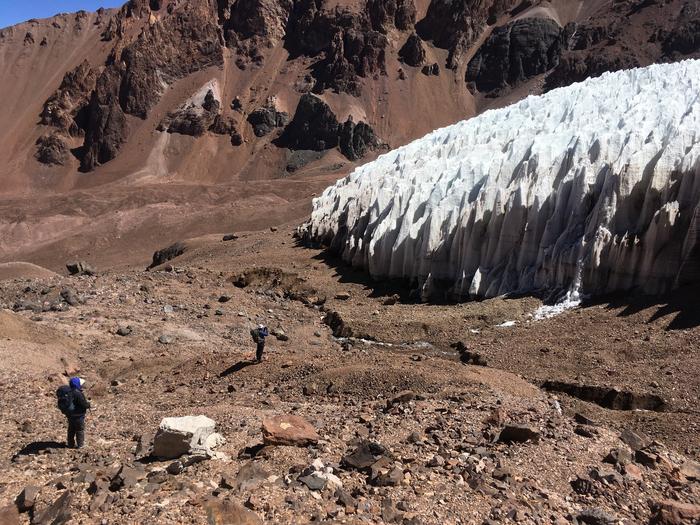
Featured image: Tapado Glacier, March 3, 2022. Credit: Álvaro Ayala. (The press release illustration “Status of the Cryosphere” is by Azote for Stockholm Resilience Centre at Stockholm University.)
Endnotes
- Su, B., et al. “The Cryosphere Beyond a Planetary Safe Operating Space.” Science, 12 November 2026. DOI: 10.1126/science.aef5636.
- Stockholm Resilience Centre, Stockholm University. “Cryosphere decline beyond safe planetary limits, putting conditions for human society at risk.” EurekAlert!, 12 November 2026. https://www.eurekalert.org/news-releases/1150844


Leave a Reply