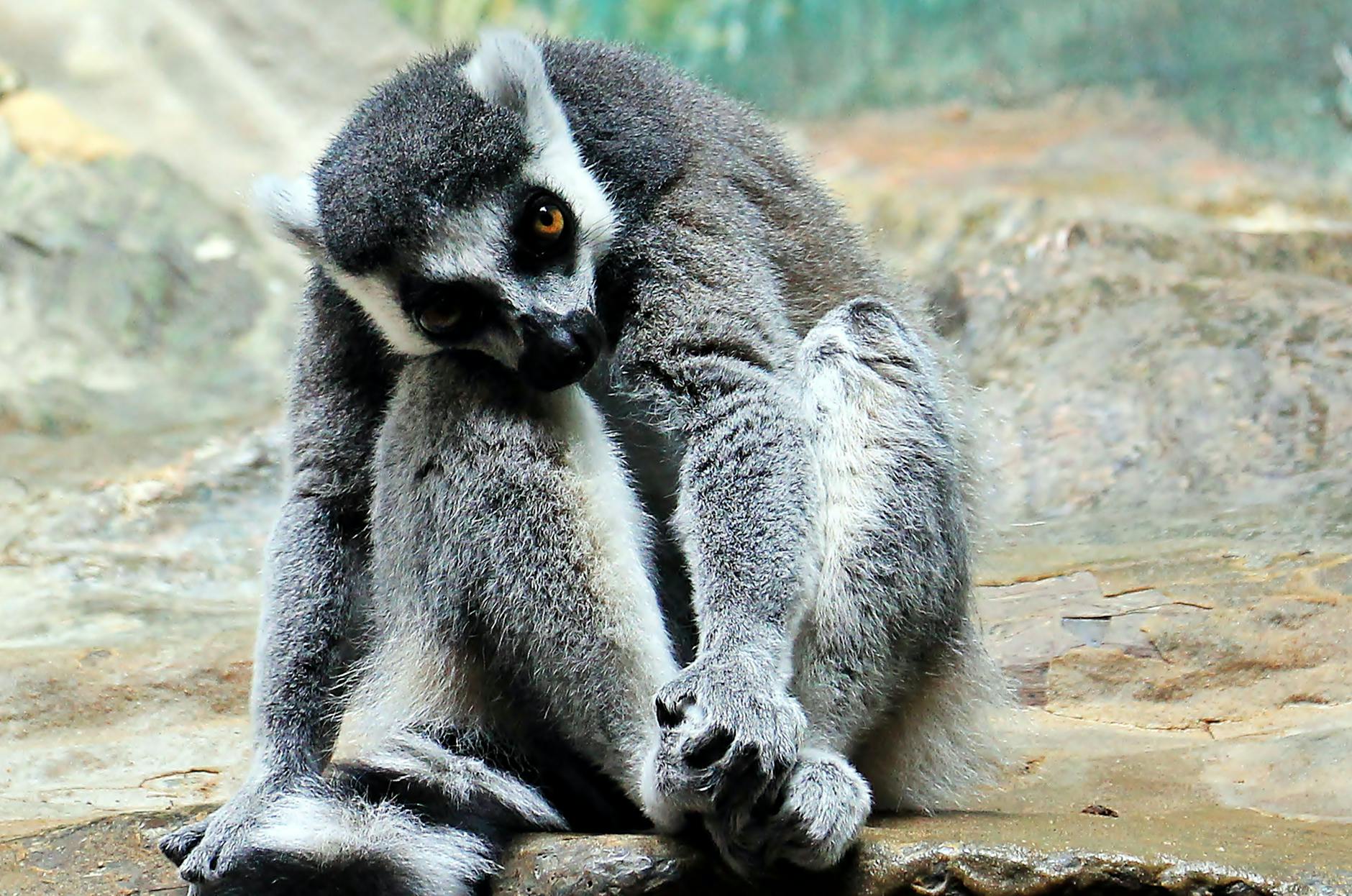
Herpesviruses almost never change host species, which is what makes four fatal cases of human alphaherpesvirus 1 in privately owned lemurs worth reporting.
Herpesviruses are unusually loyal. Each one has co-evolved with a particular host lineage over tens of millions of years, and the result is a family of viruses that are widespread, lifelong and mostly mild in the species they belong to — and dangerous when they land somewhere else.
A case study in the Journal of Zoo and Wildlife Medicine from the University of Florida describes four privately owned lemurs that died after being infected with human alphaherpesvirus 1 — the virus most people carry as cold sores. It is the first confirmation of human herpesvirus in lemurs through molecular analysis.
The animals were two ring-tailed lemurs, a black-and-white ruffed lemur and a Varecia hybrid. In lemurs the virus typically causes fatal encephalitis, which is what makes a mild human infection a lethal one a few branches along the primate tree.
Why host jumps are rare
The senior author, Jim Wellehan, a professor in the University of Florida’s College of Veterinary Medicine, put the general rule first.
“Herpes, as viruses, have amazing host fidelity,” he said. “They don’t do big host jumps very often. Typically, you have to be a pretty close cousin to pick up somebody else’s herpesvirus.”
Alphaherpesviruses have made such jumps over roughly 300 million years — which is to say, a handful of times across a span longer than the existence of mammals. The viruses have largely speciated alongside their hosts instead, which is why herpesvirus family trees tend to mirror host family trees closely enough to be used for dating them.
Lemurs are close enough cousins to be susceptible and distant enough to be badly matched. They diverged from the lineage leading to monkeys and apes somewhere around 60 to 70 million years ago, and the virus arrives in them without the long history of mutual accommodation that keeps it in check in humans. The outcome is encephalitis rather than a cold sore.
The transmission route
All four animals were privately owned, and Wellehan’s account of how one of them was exposed is the detail that explains the paper’s existence.
“I got to put the words ‘lemur yoga’ into print for the first time because one of the lemurs came to us from a yoga class,” he said. “People are doing yoga, and there’s lemurs wandering around, and it’s not good for the lemurs.”
The contrast with managed collections is stark: no cases were reported in lemurs at an accredited zoo in the past twenty years. That difference is the finding with practical consequences, and it is a difference in protocol rather than in luck. Accredited institutions restrict direct contact between primates and the public and require barrier precautions for keepers — which exist for reasons that run in both directions.
“Whenever we have students working with us on cases involving primates, I always make it clear to the students that the reason they wear a mask most of the time is to protect the primate from them and the viruses our bodies are more capable of handling,” Wellehan said.
Most adults carry HSV-1, usually without symptoms and shedding the virus intermittently without knowing it. There is no version of close human contact with a lemur that reliably avoids exposure, which means the risk is not managed by keeping sick people away.
What four cases can and cannot show
This is a case study of four animals, and the limits follow directly.
Four fatal cases do not establish how often this happens, how often exposure leads to infection, or whether any lemurs are infected and survive. Case reports are biased toward severe outcomes by construction: an animal that dies and is submitted for diagnostic workup enters the literature, and one that is exposed and unaffected does not. The lethality described here is the lethality of cases that came to a veterinary pathologist’s attention.
The absence of cases in accredited zoos over twenty years is suggestive rather than conclusive for the same reason — it is an absence of reports, in a setting where animals are closely monitored and causes of death are usually investigated, which makes it reasonably strong evidence but not a controlled comparison.
What the molecular confirmation adds is certainty about the agent. Encephalitis in a lemur has several possible causes, and previous suspicion that human herpesvirus was responsible in such cases now has a sequenced virus behind it rather than an inference from clinical signs.
Disease as a selective force
Wellehan placed the cases in a wider frame.
“Infectious diseases are one of the most significant selective forces acting upon animal evolution,” he said. “When a disease is introduced, survival becomes dependent on having the right immune response to pathogens, rather than on being stronger, faster or smarter.”
The release offers rock pigeons as an illustration, noting that they are found on every continent except Antarctica and linking that success partly to their own herpesvirus — the implication being that a virus a species tolerates can be a liability for the species it meets. How much of the pigeon’s global spread that explains is not something the release quantifies, and human transport of pigeons over several thousand years is the more obvious factor.
The point stands for lemurs in a less speculative form. Nearly all lemur species are threatened in the wild, and the ones in private hands are a population repeatedly exposed to a human virus that kills them, in settings where that exposure is the attraction. The paper’s practical content is a short argument against keeping them that way.
The article was published on 24 July 2026. The release names only the senior author, does not state funding sources, and reports no conflicts of interest.
Notes
- “Human alphaherpesvirus 1 in two ring-tailed lemurs (Lemur catta), one black-and-white ruffed lemur (Varecia variegata), and one Varecia hybrid lemur (Varecia variegata x Varecia rubra).” Journal of Zoo and Wildlife Medicine, 2026. DOI: 10.1638/2025-0008.
- University of Florida. “Lemurs fall prey to human herpes virus.” EurekAlert!, 4 August 2026. https://www.eurekalert.org/news-releases/1138770.
Photo by Pixabay on Pexels.com

Leave a Reply