An INRS-led team suppressed superconductivity in a cuprate with a laser pulse and watched the mysterious pseudogap appear, then fade as superconductivity returned, evidence that the two states compete rather than cooperate.
The copper oxide superconductors have an unexplained companion state. Above the temperature at which they superconduct, and in certain ranges of doping, part of their electronic structure goes missing: a gap opens where there should be available states for electrons to occupy. Physicists call it the pseudogap, and they have argued about it for nearly 40 years.
The argument has two sides. One holds that the pseudogap is superconductivity’s precursor, electrons beginning to pair without yet forming a coherent state. The other holds that it is a rival, a different ordering that competes for the same electrons.
The stakes are not merely taxonomic. In the conventional theory of superconductivity, electrons pair and become coherent at the same temperature. In the cuprates the two may happen separately, and the pseudogap is the main candidate for a regime where pairing exists without coherence. Whether that is what it is has shaped a generation of theoretical work.
A team led from the Institut national de la recherche scientifique in Montréal has now tested the question directly, by switching superconductivity off with a pulse of light and watching what filled the gap. Their answer, published in Nature Physics, favours competition.
“The pseudogap is one of the greatest mysteries in condensed-matter physics,” said Fabio Boschini, an INRS professor and Canada Research Chair in Quantum Materials’ Dynamics, who led the team. Understanding how it interacts with superconductivity, he added, is essential to explaining why these materials conduct electricity without loss at unusually high temperatures.
Taking the superconductivity away
The experiment used time- and angle-resolved photoemission spectroscopy, or TR-ARPES, at INRS’s Advanced Laser Light Source.
Photoemission spectroscopy works by shining light on a material and measuring the electrons knocked out of it. The energy and angle at which they emerge reveal the electronic states they came from, which is how physicists map a material’s electronic structure. The time-resolved version adds a second pulse: one to disturb the material, another a known interval later to photograph the result, building up a film of how the electrons respond.
The team used that capability to suppress superconductivity temporarily and track what happened as it recovered, which is a different kind of experiment from warming a sample up. Heating changes everything at once; a light pulse of the right strength can knock out the superconducting state while leaving the material otherwise intact.
“Thanks to the unique capabilities of the TR-ARPES system at the ALLS laboratory at INRS, we were able to directly observe” what happens when superconductivity disappears and returns, said Dario Armanno, a PhD student at INRS and the paper’s first author.
“It is a bit like uncovering missing frames from a film that scientists have been trying to piece together for decades,” he said.
One state replaces the other
The observation was a first: a light-induced transient pseudogap, revealing electronic states that conventional techniques had not reached.
The pattern was clear in both directions. When superconductivity was suppressed, the pseudogap appeared in its place. When superconductivity returned, the pseudogap faded.
That reciprocal relationship is what the paper rests on. Two states occupying the same electrons, each present only when the other is absent, behave like competitors for a shared resource rather than stages of one process. A precursor would be expected to persist underneath the superconducting state, not to vanish as it forms.
The finding challenges the long-standing idea that the pseudogap is a precursor to superconductivity, which has been among the more popular interpretations.
“The pseudogap and superconducting states in cuprates are among the most complex phenomena to reproduce theoretically,” said Olivier Gingras, an associate research scientist at the Flatiron Institute’s Center for Computational Quantum Physics. The study, he said, shows the two states compete, and gives new insight into how they behave when both are excited at once.
Why the question matters
The practical significance runs through what a theory of these materials would allow. Cuprates were discovered in 1986 and earned their discoverers the Nobel Prize in Physics the following year, and they remain among the most promising high-temperature superconductors. But nearly four decades of study have not produced an accepted account of how they work.
Without that account, improving them is guesswork. If the pseudogap were a precursor, strengthening it would be a route to higher critical temperatures; if it competes, strengthening it would suppress superconductivity, and the strategy would be to get rid of it. Those are opposite instructions, which is why settling the matter has consequences beyond the theoretical literature.
It is worth noting what the result does not settle. The experiment concerns one material under non-equilibrium conditions created by a laser pulse, and what happens in the brief window after an optical kick is not automatically what happens in a sample sitting at a fixed temperature. The release reports no quantitative measurements beyond dates, so the magnitudes involved are not stated.
The pseudogap also appears across a range of doping and temperature in these materials, and a competition observed in one regime need not describe all of them.
A laser laboratory and a long game
The release frames the work as fundamental research that could contribute to next-generation superconductors and more energy-efficient technologies, which is the honest framing for a measurement of this kind.
“This research is essential to advancing the quantum technologies of the future,” said François Légaré, director of the INRS Énergie Matériaux Télécommunications Research Centre. “It contributes to the training of highly qualified personnel,” he added, in a field he described as important to Canada’s technological sovereignty and its National Quantum Strategy.
Armanno’s co-authors included Gingras, Légaré, Boschini and more than a dozen others; the release does not give affiliations for most of them. The work was supported by the Canada Foundation for Innovation, the Alfred P. Sloan Foundation, the Natural Sciences and Engineering Research Council of Canada, the Canada Research Chairs Program, Fonds de recherche du Québec – Nature et technologies, Québec’s Ministry of Economy, Innovation and Energy, PRIMA Québec, and the Gordon and Betty Moore Foundation’s EPiQS Initiative.
Notes
- Armanno, D., et al. “Light-induced asymmetric pseudogap below the critical temperature in cuprates.” Nature Physics, 2026. DOI: 10.1038/s41567-026-03446-6.
- Institut national de la recherche scientifique. “A new light on one of modern physics’ greatest mysteries.” EurekAlert!, 20 October 2026. https://www.eurekalert.org/news-releases/1148409.
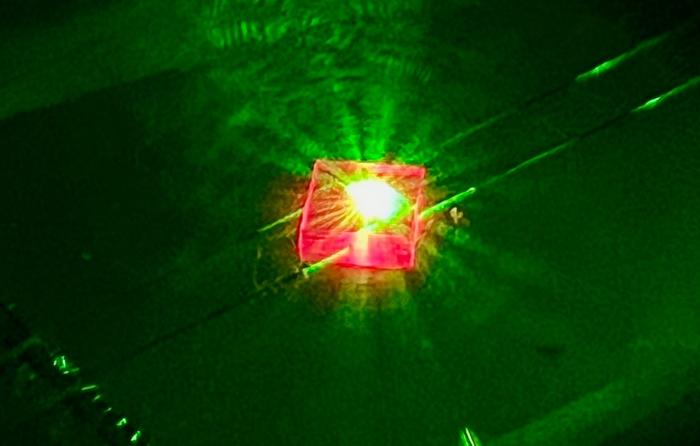
Laser laboratory. (CREDIT: Chong Zu laboratory, Washington University in St. Louis)

Leave a Reply