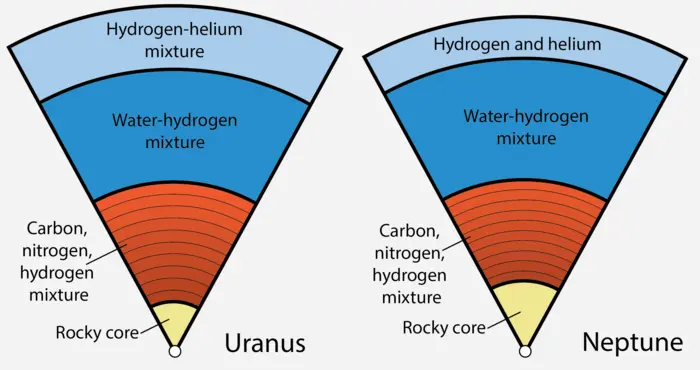
UNLV physicists compressed solid water past 222 gigapascals and found it adopting a lower-symmetry structure, the opposite of what compression usually does, under conditions resembling the interiors of Uranus and Neptune.
Squeeze most materials hard enough and their atoms settle into tidier arrangements. Pressure pushes particles together, and the configurations that pack most efficiently tend to be the most symmetric. It is one of the reliable rules of high-pressure physics.
Water, it turns out, does not follow it. Physicists at the University of Nevada, Las Vegas report in Communications Chemistry that solid water compressed above 222 gigapascals adopts a structure of lower symmetry than the one it had at lower pressure.
“Water beyond Earth-like conditions has more complex behavior than we ever previously imagined,” said Ashkan Salamat, the UNLV physicist who led the research and directs the Nevada Extreme Conditions Lab. “It’s amazing how water can behave under pressure.”
Thirty-five million pounds per square inch
The pressures involved are difficult to picture. The team applied the equivalent of 35 million PSI. A car tire runs at about 30.
Reaching such pressures requires a diamond anvil cell, in which a sample is squeezed between the polished tips of two diamonds. Because the tips are tiny, a modest force concentrates into an enormous pressure, and because diamond is transparent, the sample can be studied while compressed.
The team used spectroscopy, which reveals how molecules vibrate and therefore how they are bonded, together with X-rays to determine the arrangement of atoms. The combination is necessary at these pressures, where samples are microscopic and conventional measurements are impossible.
The ice in question bears no resemblance to the ice in a freezer. Water has well over a dozen known solid phases, distinguished by how the molecules are arranged, and most exist only under pressure. At the extremes studied here, the familiar picture of discrete H₂O molecules begins to break down as hydrogen atoms sit between oxygen atoms rather than belonging to one.
A gigapascal is roughly 10,000 times atmospheric pressure, so 222 of them is on the order of two million atmospheres. For comparison, the pressure at the centre of the Earth is about 360 gigapascals, which places these experiments within the range of conditions found inside planets rather than merely deep within one.
Why lower symmetry is a surprise
Symmetry, for a crystal, describes how many ways the structure can be rotated or reflected and still look the same. Higher symmetry generally means a simpler, more regular arrangement.
The expectation that compression increases symmetry comes from treating atoms as spheres being packed. At sufficient pressure, that picture usually prevails, which is why finding the opposite is interesting: it means something other than packing efficiency is governing the structure, most likely the behaviour of the hydrogen bonds that make water unusual in the first place.
Water is already the great exception among simple molecules. It expands when it freezes, has an unusually high boiling point for its molecular weight, and reaches maximum density above its freezing point, all because of hydrogen bonding. The new result suggests those bonds continue to assert themselves at pressures where most substances have long since surrendered to geometry.
If the pressure were released, the researchers say, the water would likely rearrange into a structure more common on Earth. The low-symmetry phase exists only while the squeeze is on.
Establishing which phase a sample is in, at these conditions, is itself the hard part of the work. Spectroscopy indicates how bonds are vibrating and X-ray diffraction indicates the spacing and arrangement of atoms, and a structural assignment rests on both pointing the same way. That is why the paper’s title speaks of evidence for symmetry reduction rather than a flat declaration of a new phase.
The point is Uranus and Neptune
The pressures are not arbitrary. They approximate conditions inside Uranus and Neptune, the solar system’s ice giants, whose interiors are thought to consist largely of water, ammonia and methane in a hot, dense, metallic-like state.
Those planets have been visited once, briefly, by Voyager 2 in the 1980s. What is known about their interiors comes from their gravitational fields, magnetic fields and bulk densities, interpreted through models of how their constituent materials behave. Those models require laboratory measurements as input.
“We can’t enter the crust or atmospheres of these planets because of distance, but we have data from things like the Voyager program,” Salamat said. “We have an idea of their compositions, and interior pressure and temperatures. And in labs like mine, we can mimic the chemistry and experiment with what could be occurring inside these planets.”
The structure water takes under those conditions is not an academic matter. It affects how heat moves through a planet’s interior, whether material convects or stays layered, and how electrical conductivity varies with depth. Conductivity in turn bears on magnetic fields, and the magnetic fields of Uranus and Neptune are peculiar: both are strongly tilted from the rotation axis and offset from the planet’s centre, unlike Earth’s or Jupiter’s. Explanations have centred on conducting fluid in the interior behaving differently from the deep dynamos of other planets.
Beyond the solar system
The relevance extends further. Planets of roughly Uranus and Neptune size are among the most common found around other stars, and water-rich worlds are a major category in the search for habitable environments. Interpreting a measurement of such a planet’s mass and radius depends on knowing how water behaves across the range of pressures its interior spans.
“Understanding the mechanisms of our solar system and our observable universe is critical for the endeavor of human knowledge,” Salamat said. “When we eventually get to these worlds, what are we going to see? We’re really the initial pioneers in trying to answer these questions in the laboratory.”
That framing is fair. Diamond anvil work is slow and difficult, and each experiment produces a narrow result at a specific set of conditions. Assembled over years, those results become the equations of state that planetary models run on.
The work was carried out with collaborators at the University of California, Berkeley and Argonne National Laboratory, whose synchrotron provides the intense X-rays such measurements require. Co-authors were Zachary Grande, Victor Robinson, Dean Smith, Jesse Smith, Oliver Tschauner and Burkhard Militzer.
Notes
- “Evidence for symmetry-reduction in solid H2O above 222 GPa.” Communications Chemistry, 15 October 2026.
- University of Nevada, Las Vegas. “Water as we’ve never known it: Physicists test water beyond Earth-like conditions.” EurekAlert!, 20 October 2026. https://www.eurekalert.org/news-releases/1148561.
Burkhard Militzer, UC Berkeley



Leave a Reply