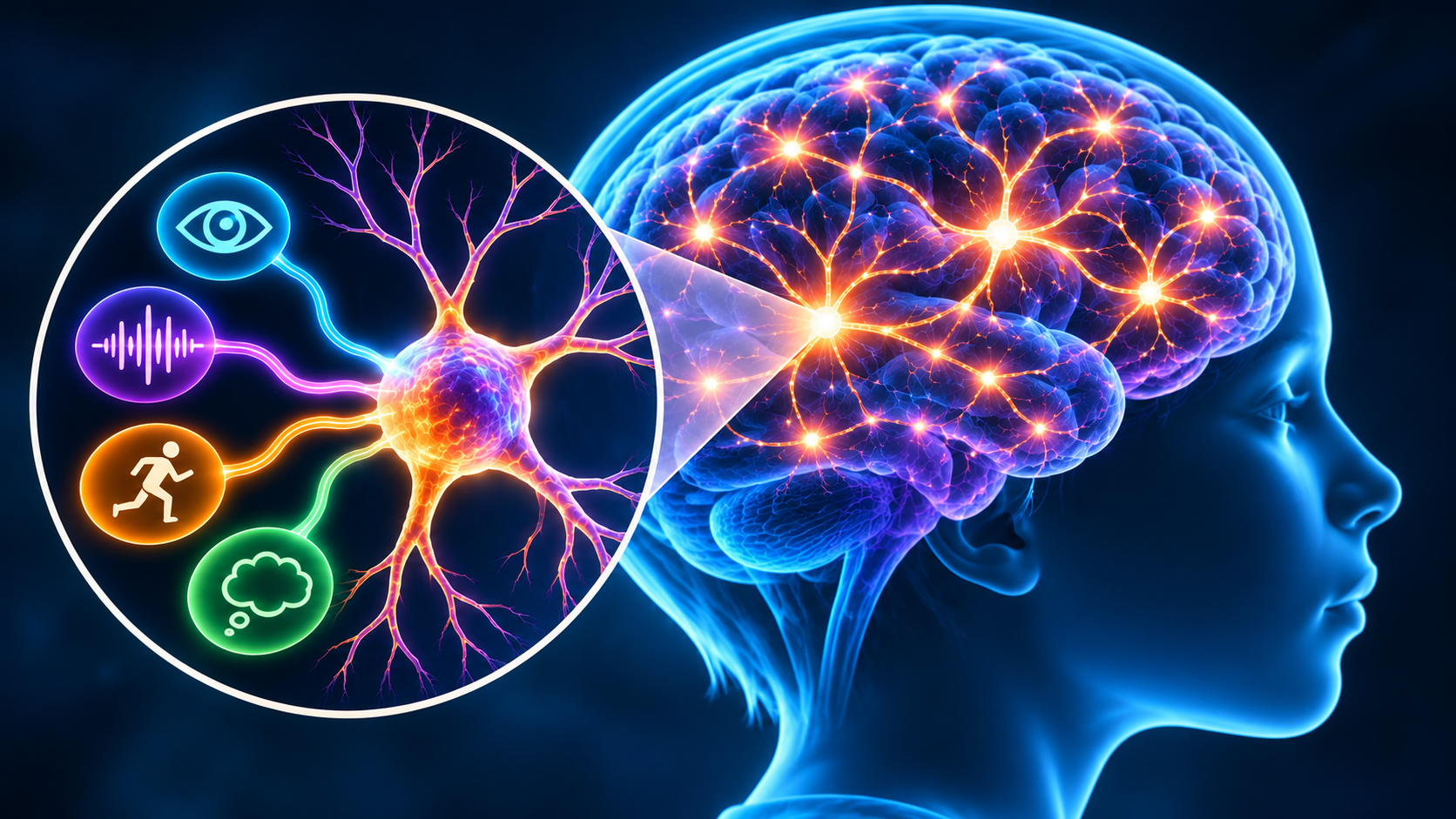
Most Brain Cells Are Multitaskers Rather Than Specialists, Major Study Finds
Neuroscientists at Columbia University’s Zuckerman Institute have challenged a longstanding assumption about how individual neurons contribute to brain function. Analyzing an extensive collection of neural recordings from 43 regions of the mouse brain, researchers discovered that most neurons respond to multiple types of information rather than performing narrowly defined functions. Although some cells exhibit considerable specialization, the majority display remarkably diverse patterns of activity. This flexibility may help explain how biological brains perform complex cognitive tasks without requiring dedicated neural machinery for every individual operation. Published in Nature and reported November 26, the findings could influence computational models of cognition and investigations into neurological disorders. The research also challenges simplistic descriptions of brain organization, although the extent to which these findings apply to human cognition requires further investigation. (ScienceDaily / Columbia University)
Fossil Thought to Be an Early Reptile Turns Out to Be an Aquatic Animal
Paleontologists have overturned decades of scientific thinking about a 345-million-year-old fossil that occupied an important position in the evolutionary history of terrestrial vertebrates. Known as Westlothiana lizziae, the specimen was discovered in Scotland in 1984 and previously classified near the evolutionary origins of reptiles. Researchers from the American Museum of Natural History and the University of Oxford used advanced synchrotron X-ray imaging to reconstruct anatomical structures concealed within the surrounding rock. They discovered internal gills, primitive skull characteristics and thousands of tiny teeth resembling those found in fish. Published in Nature, the findings indicate that the animal was probably aquatic or amphibious. The discovery suggests that certain anatomical adaptations traditionally associated with terrestrial life may have evolved considerably earlier in vertebrates that remained dependent on water. (ScienceDaily / American Museum of Natural History)
Scientists Produce an Exceptionally Detailed Map of Matter in the Distant Universe
An international collaboration involving researchers from 30 institutions has produced an exceptionally sensitive map of matter distribution using observations from the South Pole Telescope. Scientists analyzed measurements of the cosmic microwave background, radiation originating in the early universe, collected during 2019 and 2020 across approximately 1,500 square degrees of sky. As this ancient radiation travels through space, gravitational forces generated by intervening matter subtly distort its path. Measuring these distortions allows researchers to reconstruct the distribution of matter, including invisible dark matter. The resulting map provides an important independent means of investigating how cosmic structures developed over billions of years. Reported November 25 by Argonne National Laboratory, the findings could help scientists test competing cosmological models. The underlying research was released as an arXiv preprint rather than a peer-reviewed publication. (Phys.org / Argonne National Laboratory)
Redesigned Molecular Machinery Improves Precision Gene Insertion 100-Fold
Researchers at St. Jude Children’s Research Hospital have significantly improved an experimental genome-engineering system capable of inserting DNA at selected genetic locations. The technology uses CRISPR-associated transposases, molecular complexes that combine programmable genetic targeting with DNA integration. Scientists employed cryo-electron microscopy and computational protein design to investigate how the individual components assemble and recognize appropriate genetic targets. By redesigning components of the molecular machinery, researchers achieved a 100-fold improvement in activity while maintaining targeting specificity. Published in Nature, the findings could contribute to a new generation of gene therapies capable of replacing defective genes with functional copies rather than correcting individual mutations. Such an approach could eventually address multiple disease-causing mutations through a common treatment platform. However, clinical effectiveness, delivery and long-term safety remain important unresolved challenges. (Phys.org / St. Jude Children’s Research Hospital)
Genetic Evidence Reveals Hidden Extinction Risks Among Deep-Sea Animals
Marine scientists at Florida International University have discovered concerning genetic changes among deep-sea animals inhabiting the Gulf of Mexico. Researchers analyzed DNA from 486 specimens representing three lanternfish species and two shrimp species collected between 2011 and 2023. All five species exhibited genetic characteristics associated with increased extinction vulnerability, including relatively small effective breeding populations. One lanternfish species experienced an approximately 8% decline in genetic diversity over 12 years. Climate projections also indicated that suitable habitats for four of the five species could shrink substantially, with potential reductions reaching 70%. Published in Nature Communications, the findings challenge assumptions that extensive deep-ocean habitats provide reliable protection against biodiversity loss. Researchers have not established whether the genetic changes resulted from the Deepwater Horizon oil spill or other environmental pressures. (ScienceDaily / Florida International University)



Leave a Reply