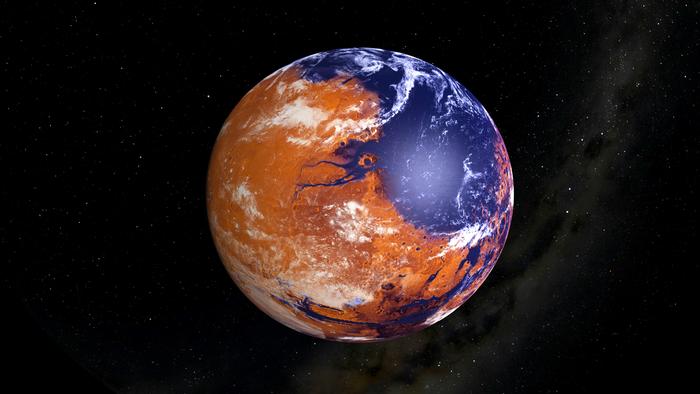
Simultaneous observations from NASA’s MAVEN and China’s Tianwen-1 show that Kelvin–Helmholtz waves at the edge of the Martian upper atmosphere can carry off ions in bulk, mostly on one side of the planet.
Mars was not always the cold, dry world it is today. Ancient river valleys, lake beds and water-formed minerals show that liquid water once flowed across its surface, which would have required a much thicker atmosphere than the thin veil of carbon dioxide that remains. Where that atmosphere went is one of the central questions in planetary science.
“Mars is thought to have once been potentially habitable, with a thicker atmosphere and surface liquid water,” said Chi Zhang, a research scientist at Boston University’s Center for Space Physics.
In a study published in Science Advances, Zhang, Chuanfei Dong and colleagues identify one way the Sun has been carrying that atmosphere off. Using data from two spacecraft orbiting Mars at the same time, they show that the solar wind can whip up large waves at the edge of the planet’s upper atmosphere, and that those waves help clouds of charged particles escape to space.
A planet without a shield
The solar wind is a constant stream of charged particles flowing outward from the Sun at hundreds of kilometers per second. Earth is protected from much of it by a global magnetic field, which deflects the particles around the planet. Mars has no such shield. Its global magnetic field faded billions of years ago, leaving the solar wind to interact directly with the upper layers of its atmosphere.
There, sunlight strips electrons from atoms and molecules, creating ions, which are electrically charged and can be swept away by the magnetic and electric fields carried by the solar wind. Over billions of years, losses of this kind are thought to have removed a large share of the Martian atmosphere.
Scientists have studied the process for years using NASA’s MAVEN mission, which arrived at Mars in 2014 specifically to measure how the planet loses its atmosphere. But a single spacecraft cannot simultaneously measure the solar wind arriving at the planet and the ions leaving it, which makes it difficult to link cause and effect.
MAVEN, short for Mars Atmosphere and Volatile EvolutioN, has already shown that the Martian atmosphere leaks to space through several routes, and that losses rise sharply during solar storms, when bursts of energetic particles and stronger winds slam into the planet. Those observations helped establish that the Sun has played a major role in thinning the Martian atmosphere over time.
Two spacecraft, one picture
The new study solves that problem by combining MAVEN with China’s Tianwen-1 orbiter, which has been circling Mars since 2021. In the observations the team analyzed, Tianwen-1 monitored the incoming solar wind while MAVEN measured atmospheric ions escaping from the planet. That arrangement allowed the researchers to connect conditions in the solar wind to escape events in real time.
What they found were Kelvin–Helmholtz waves, a phenomenon familiar from everyday life. The waves form wherever two fluids slide past each other at different speeds, such as wind blowing over the surface of a lake. Friction at the boundary pulls the slower fluid along, and the boundary rolls up into waves and swirling vortices. The same instability can be seen in clouds that curl like breaking ocean waves and in the bands of Jupiter’s atmosphere.
At Mars, the fast-moving solar wind stirs the boundary of the upper atmosphere in a similar way. The resulting waves help form clouds of plasma, or ionized gas, that break off and carry atmospheric ions away in bulk, rather than one particle at a time.
A lopsided loss
The process does not happen evenly around the planet. “Instead, it is mainly observed on one side of the planet, depending on the direction of the solar wind electric field,” Zhang said.
That asymmetry reflects the geometry of the solar wind. As the charged particles flow past Mars, they carry a magnetic field that creates an electric field oriented in a particular direction. Ions on one side of the planet are pushed outward by that field, while those on the other side are not, so the plasma clouds and the escape they drive tend to concentrate on one hemisphere.
What comes next
The researchers now want to understand when and how strongly the waves form. Zhang said future research will focus on identifying the conditions that favor the formation and growth of Kelvin–Helmholtz waves and on how much they contribute to atmospheric escape. Dong, an assistant professor of astronomy at Boston University, said the team wants to know when the waves are most likely to form and how they evolve.
Answering those questions matters for estimating how much atmosphere Mars has lost through this route compared with other processes, such as the steady trickle of individual ions or the loss of neutral atoms that gain enough energy to escape gravity.
New data will help. MAVEN is entering the closing stage of its mission, Zhang noted, but NASA’s ESCAPADE mission, a pair of small spacecraft that has already launched, will offer a new way to study how the solar wind strips the Martian atmosphere. Because ESCAPADE uses two spacecraft, it is designed to make the kind of simultaneous measurements that made the new study possible.
Beyond Mars
The findings may apply well beyond the red planet. “This process could also occur on other planets that lack a strong magnetic field, including some exoplanets,” Dong said.
Venus, for example, also lacks a global magnetic field, and many planets around other stars orbit close to active host stars that produce intense stellar winds. Understanding how those winds erode atmospheres could help astronomers judge which distant worlds are likely to keep the air, and possibly the water, needed for life.
The work was supported by NASA and the Alfred P. Sloan Foundation. For Mars, it adds another piece to the story of how a once-wetter world turned into a desert, one wave at a time.
Notes
- “Simultaneous Mars-Orbit Observations Reveal Kelvin–Helmholtz–Instability–Driven Bulk Atmospheric Ion Escape.” Science Advances, 2026. DOI: 10.1126/sciadv.aed9072.
- Boston University. “How the sun is stripping away Mars’ atmosphere.” EurekAlert!, 31 July 2026. https://www.eurekalert.org/news-releases/1138427.
NASA/MAVEN/The Lunar and Planetary Institute


Leave a Reply