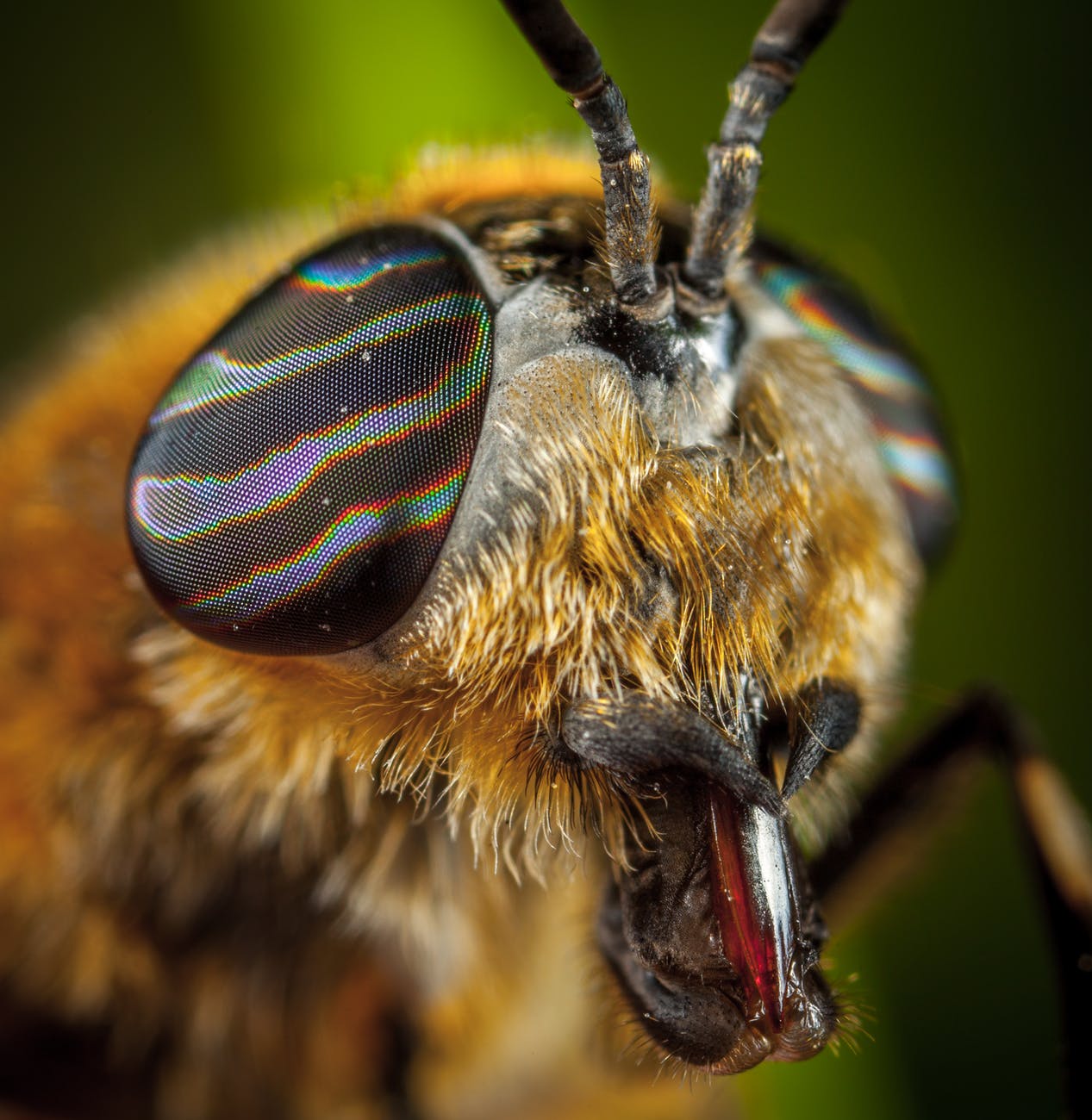
A Nature Reviews Biodiversity paper led by researchers at Binghamton, UConn and the UK Centre for Ecology and Hydrology shows that birds, mammals, reptiles and amphibians rely on insects for far more than a meal.
Ask most people why insects matter, and they will probably mention bees and pollination, or perhaps the beetles and flies that break down dead plants and animals. Some might add that insects are food for birds and bats. A new review argues that this is only a small part of the story.
In a paper published in Nature Reviews Biodiversity, an international team synthesizes hundreds of studies spanning several decades to show how vertebrates, from hummingbirds to grizzly bears, depend on insects not only for food but also for shelter, nesting material, protection and even medicine.
“Insects are sometimes called the ‘little things that run the world’ because they are so important to life on Earth,” said Eliza Grames, an assistant professor of biological sciences at Binghamton University and one of the paper’s co-lead authors. “We often hear about their importance as pollinators, or decomposers, or food for insectivores like birds and bats, but we forget about all the other things they do for us and for other species.”
The phrase Grames quotes comes from the biologist E.O. Wilson, who used it in a 1987 address to describe the outsized role of invertebrates in keeping ecosystems running.
More than a meal
The review gathers examples from across the animal kingdom. Chimpanzees have been observed applying insects to wounds. Some herons use insects as bait to lure fish. Birds and reptiles nest in termite mounds, which keep temperatures stable. In deserts, some frogs live inside ants’ nests, where the air is more humid.
One of the strangest partnerships involves sloths. Moths live in sloths’ fur, and according to the release, sloths depend on these moths to maintain the algae growing in their coats. The relationship has long fascinated biologists: the moths lay their eggs in sloth dung, and their presence has been linked to the growth of the algae, which may give the slow-moving mammals camouflage and possibly extra nutrients.
Vertebrates also use insects in other ways. Some birds build their nests with insect silk. Others place nests near stinging insects, which can help keep predators away. Some birds groom themselves with crushed ants, a behavior known as anting, and many species time their breeding to coincide with peaks in insect abundance. In some owl and kingfisher nests, insects even help keep the nest clean.
Insects also produce substances that other species eat, including honeydew, honey and wax. And the sheer number of insect species, estimated in the release at 14 million to 30 million, means that their interactions with vertebrates are likely to be far more extensive than scientists have documented.
Even the most familiar dependence, food, runs deep. Most songbirds feed their chicks largely on insects, including many species that eat seeds as adults, because the young need protein-rich food to grow quickly. A single pair of chickadees has been estimated to need several thousand caterpillars to raise one brood.
Pulling the evidence together
The review was led by Grames, Rob Cooke of the UK Centre for Ecology and Hydrology and Chris Elphick of the University of Connecticut, with co-authors from eight countries. Other Binghamton authors include Lindsey Swierk and two recent graduates, Julianna Yager and Suyeon Jang. Jang created the paper’s main illustration as an independent study project.
The project began in 2022 with an NSF-funded research coordination network called “Status of Insects,” which grew out of Grames’s doctoral work in Elphick’s lab. Its goal was to consolidate decades of studies that had been scattered across many fields and journals.
Elphick, an ornithologist, hopes the review will encourage researchers who study vertebrates and those who study insects to work together more closely. “If you want to have vertebrates, then you’ve got to be thinking about insect conservation,” he said, “and we don’t do that nearly enough.”
A quiet decline
The review comes amid growing concern about the state of the world’s insects. Some insect populations have declined sharply in recent decades. One widely cited study, published in 2017, found that the biomass of flying insects in protected areas in Germany had fallen by more than 75 percent over 27 years.
“We’re losing insects at a rate of about 1-2% per year,” Grames said. “When you scale that up across a few decades, we’re talking about a major change to ecosystems.”
Yet according to the release, few studies have examined how insect declines affect vertebrates beyond the loss of food. If vertebrates rely on insects for shelter, nesting, protection and other needs, then the consequences of losing insects could ripple through ecosystems in ways that are not yet appreciated.
Grames argues that this should change how conservation priorities are set. “Insect conservation should be a top priority for anyone worried about the future of biodiversity,” she said.
What a review can and cannot show
As a review, the paper compiles and organizes existing research rather than presenting new data. The release does not say how strong the evidence is behind each of the relationships it describes, some of which may rest on observations of a small number of species.
Its value lies in bringing those scattered findings together into a single picture of interdependence, one that makes clear how much of vertebrate life is bound up with the small, often overlooked animals that outnumber them.
Notes
- “The importance of insect biodiversity for vertebrates.” Nature Reviews Biodiversity, 30 September 2026.
- Binghamton University, State University of New York. “Insects are essential to vertebrate life — as food, shelter and medicine.” EurekAlert!, 30 September 2026. https://www.eurekalert.org/news-releases/1145790.
Photo by Egor Kamelev on Pexels.com

Leave a Reply