Nanoparticles Reprogram Immune Cells Inside Living Bodies
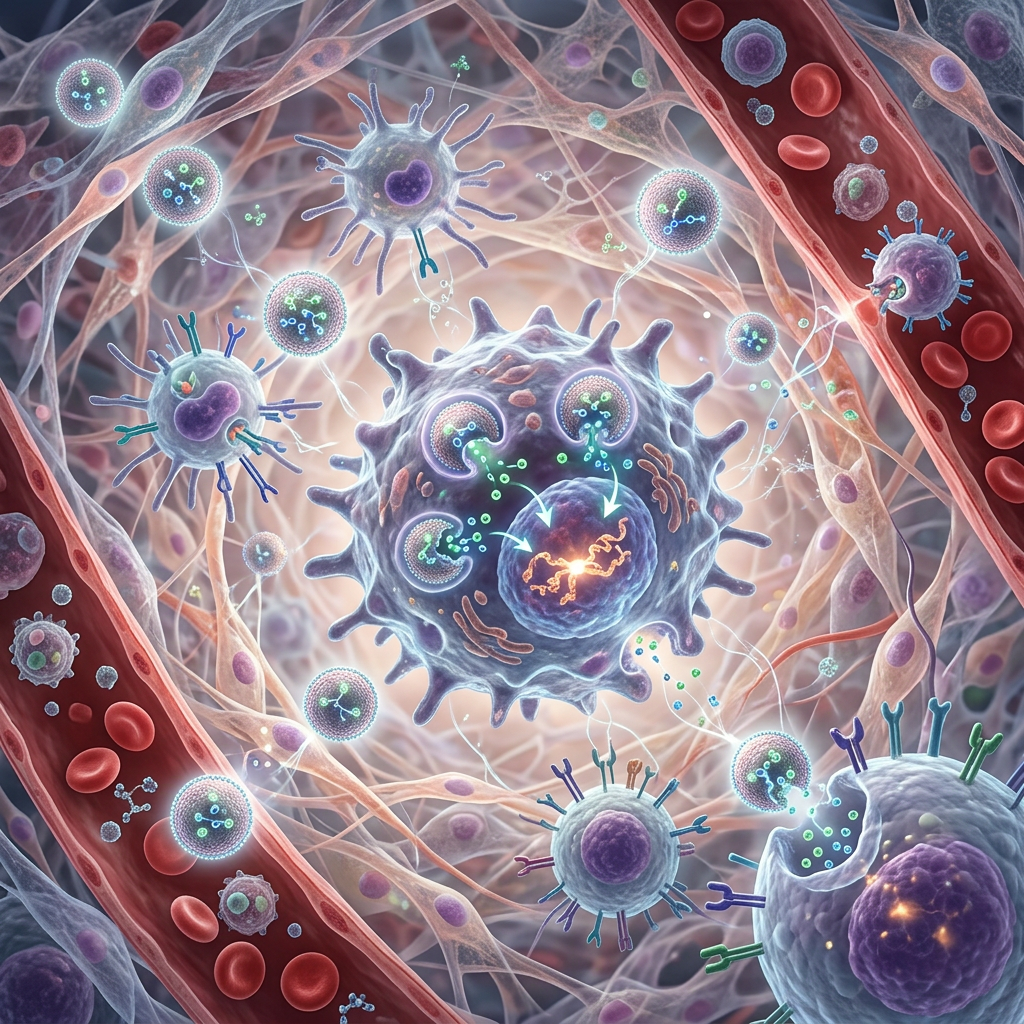
Researchers at Massachusetts Institute of Technology have developed a technique that transforms ordinary immune cells into cancer-fighting cells without removing them from the body. The approach uses specially designed lipid nanoparticles to deliver messenger RNA directly into natural killer cells, programming them to recognize and destroy diseased cells. In mouse experiments, approximately 80% of targeted immune cells were successfully reprogrammed. Three of five mice with aggressive melanoma achieved complete remission, while separate experiments eliminated T-cell lymphoma tumors after five injections. Remarkably, a single injection also reversed liver damage in mice with autoimmune hepatitis. Published in Nature Biotechnology, the findings suggest that nanoparticle-based immune engineering could eventually simplify expensive cellular therapies. However, the treatment remains preclinical, and its safety and effectiveness in humans have not been established. (MIT News)
Century-Old Fossil Reveals Europe’s First Megaraptoran Dinosaur
A dinosaur fossil overlooked in a museum collection for approximately a century has been identified as Europe’s first known megaraptoran, revealing an important missing chapter in dinosaur evolution. Researchers examining a partial skull collected from England’s Isle of Wight in 1924 identified a previously unknown predator named Invictibellatrix amberina. The animal lived approximately 120 million years ago, measured three to four meters long and probably possessed enormous curved claws and feathers. Unlike tyrannosaurs, which relied primarily on powerful jaws, megaraptorans used their muscular arms and claws to capture prey. CT scans and evolutionary modeling confirmed the fossil’s distinctive characteristics. Published in Royal Society Open Science, the discovery supports the hypothesis that megaraptorans migrated from Asia through Europe before spreading into southern continents, where some eventually became gigantic apex predators. (Natural History Museum)
Simple RNA Droplets Gain Cell-Like Abilities Through Mutation
Scientists have demonstrated that a handful of genetic mutations can transform simple molecular droplets into structures exhibiting surprisingly sophisticated cell-like behaviors. Researchers at Heidelberg University created synthetic droplets from RNA molecules capable of assembling themselves into microscopic compartments. When researchers introduced mutations into the DNA templates producing the RNA, the droplets unexpectedly developed stable internal cavities called vacuoles. These compartments redistributed material, allowing the droplets to move, collide, fuse and absorb molecular cargo. A mutation rate of approximately 3% was sufficient to produce the transformation. Published in Nature Chemical Engineering, the findings demonstrate how relatively simple genetic changes can generate new physical structures and functions without elaborate biological machinery. Although the droplets are not living organisms, the experiments offer clues about how primitive cellular complexity might have emerged during life’s earliest evolution. (Heidelberg University)
Webb Spots Possible Supernova in Early Universe
Astronomers using the James Webb Space Telescope may have detected a stellar explosion just days after it occurred in the early universe. The transient, designated AT 2026abck, appeared in a galaxy at redshift 5.017, corresponding to a time when the universe was approximately 1.2 billion years old. Researchers estimate that Webb observed the event only four to ten days after the explosion in the galaxy’s own reference frame. Its extraordinary brightness and estimated temperature of 17,000 kelvins suggest a massive star undergoing core collapse, possibly surrounded by dense circumstellar material. Unlike previously confirmed explosions at comparable distances, the event was detected without gravitational magnification. The findings, reported in an arXiv preprint, remain preliminary because astronomers have not obtained a spectrum confirming the object’s nature. Nevertheless, the discovery demonstrates Webb’s growing ability to investigate stellar deaths in the young universe. (Phys.org)
AI Reveals Why Immune Cells Avoid Tumors
An artificial intelligence system has uncovered potential molecular explanations for why immune cells infiltrate some tumors while avoiding others. Researchers at University of Texas MD Anderson Cancer Center developed SPACER, a computational model that analyzes spatial gene-expression patterns to identify signals attracting or repelling immune cells. Examining 37 datasets representing multiple cancers, the system proved four to 21 times more effective than existing methods at identifying biologically meaningful cellular recruitment signals. One particularly intriguing finding implicated mucins, large sugar-coated proteins frequently overproduced by cancer cells. Tumors with elevated mucin expression showed reduced immune-cell infiltration and poorer responses to checkpoint immunotherapy. Published in Nature Biomedical Engineering, the research suggests that tumors may use physical and molecular barriers to evade immune attack. The findings could eventually guide treatments designed to overcome those barriers, although the proposed mechanisms require further experimental validation. (UT MD Anderson)
Walnuts May Shift Diets Toward Lower Inflammation
Adding walnuts to an otherwise unchanged diet may modestly reduce its inflammatory potential, according to results from the two-year Walnuts and Healthy Aging randomized trial. Researchers followed 319 older adults in California, assigning roughly half to eat 1–2 ounces of walnuts daily while controls avoided walnuts and largely limited other nuts. Participants received no other dietary instructions. After two years, the walnut group registered slightly but significantly lower scores on the Dietary Inflammatory Index, which estimates the inflammatory potential of an overall eating pattern. The finding does not demonstrate that walnuts directly reduce inflammation or disease risk, but suggests a relatively simple food substitution can improve overall diet quality. The study appeared in the Journal of the Academy of Nutrition and Dietetics. (Medical Xpress)
Prenatal Mediterranean Diet Linked to Healthier Infants
What mothers eat during pregnancy may influence whether their babies develop both colic and eczema. Harvard-led researchers analyzed 1,324 mother-child pairs from Project Viva and compared prenatal dietary patterns with infant outcomes. Each additional point on a Mediterranean Diet Score was associated with a 15% lower risk of an infant developing both conditions, while each point on a dietary inflammation index corresponded to a 34% higher risk. Seafood stood out: every additional weekly serving was associated with a 25% lower chance of colic plus eczema. Dairy, eggs and nuts showed no comparable relationship. Because the study was observational, it cannot prove prenatal diet caused the differences. Researchers say the results strengthen the case for supporting access to balanced diets during pregnancy. (Harvard Public Health)
Gut Microbes Change the Mathematics of Calories
Calories listed on a food label do not necessarily equal the energy a person actually absorbs. Arizona State University researchers developed a mathematical system called DAMM—Digestion, Absorption and Microbial Metabolism—to incorporate the role played by intestinal microorganisms. Testing the model against controlled feeding data showed that people eating a fiber- and resistant-starch-rich diet absorbed roughly 116 fewer calories per day than people eating a more processed Western-style diet, despite reporting no greater hunger. The model also estimated that microbial products absorbed from the colon contribute roughly 140 calories daily on average. DAMM predicted observed energy absorption more accurately than traditional Atwater calculations. Researchers emphasize that it remains a research framework rather than a tool for prescribing personalized diets, but it highlights how profoundly microbiomes complicate calorie accounting. (ScienceDaily)
Nordic Diet May Extend Life Not Protect Liver
A healthy Nordic diet rich in whole grains, berries, plant foods, low-fat dairy and fatty fish may improve longevity without necessarily protecting against serious liver disease. Researchers used 24 years of dietary and medical data from more than 64,000 Swedish adults and applied a target-trial-emulation approach to estimate what might happen under different long-term dietary patterns. Following a healthy Nordic diet was associated with an estimated 2.67-percentage-point reduction in 24-year all-cause mortality compared with usual eating habits. However, researchers found no statistically convincing reduction in major liver outcomes such as cirrhosis and liver cancer. Because researchers modeled dietary interventions rather than actually assigning people to diets for decades, causal conclusions remain limited. The study was published in the American Journal of Clinical Nutrition. (Medical Xpress)
Healthy Diets Show Mixed Cognitive Benefits
Researchers combining data from eight European and American cohorts found intriguing—but complicated—connections between healthy dietary patterns and cognition. The analysis included 17,368 participants and standardized adherence to seven eating patterns, including Mediterranean, DASH, MIND, EAT-Lancet and Healthy Eating Index diets. Cross-sectionally, closer adherence to a continuous Mediterranean diet correlated with better overall cognition, while both Mediterranean and DASH patterns correlated with stronger executive function. The picture weakened when researchers examined changes over time. Most dietary patterns were not significantly associated with slower cognitive decline, although MIND-diet adherence in three U.S. cohorts was associated with better longitudinal executive function. Published in The Journal of Nutrition, the study suggests diet quality may support brain health but cautions against treating any single eating pattern as a proven defense against cognitive aging. (Newswise)
Food May Rival Water as PFAS Source
Food could represent a substantial and underappreciated source of exposure to PFAS “forever chemicals.” University of Montreal researchers tested foods purchased in Quebec supermarkets for 76 PFAS compounds and detected contamination across multiple categories. Average concentrations were highest in fish, seafood and meat, while dairy and plant-based products generally contained lower levels. Researchers then combined contamination measurements with typical consumption amounts to estimate actual dietary exposure. Some fish, seafood and meat samples potentially delivered substantially more PFAS than drinking water. The researchers caution that individual samples varied considerably, making it premature to recommend avoiding particular foods or species. Instead, they argue that governments should monitor PFAS in food more systematically, much as drinking water is already monitored. The study appeared in the Journal of Food Composition and Analysis. (Phys.org)
Peanuts Leave Distinct Metabolic Fingerprint in Blood
Peanuts appear to remodel circulating blood lipids in a distinctive way that may help illuminate their association with reduced diabetes risk. Researchers combined a six-month randomized dietary intervention involving 63 young adults with data from the EPIC-Potsdam cohort of more than 27,000 people. Using high-resolution lipidomics, they identified a “peanut lipidomic signature” characterized partly by increases in very-long-chain saturated fatty acids, including C22:0 and C24:0, distributed across particular lipid classes. The researchers then examined whether that signature related to development of type 2 diabetes and cardiovascular disease in the larger cohort. The work does not establish that eating peanuts prevents diabetes, but provides a potential biological pathway linking a specific food with metabolic outcomes. The research was published in the American Journal of Clinical Nutrition. (Medical Xpress)
Diet Drinks Match Water for Weight Loss
Replacing caloric drinks with either water or non-nutritively sweetened beverages produced similar long-term weight outcomes in a randomized trial. The SWITCH study enrolled 493 adults with overweight or obesity and assigned them to consume either water or at least two daily servings of diet beverages while participating in a structured weight-management program. Among the 220 participants who completed two years, those assigned diet drinks lost an average 4.8 kilograms versus 3.7 kilograms for the water group, but the difference was not statistically significant. Both groups regained some weight after the structured intervention ended. Dropout was substantial, and some metabolic measurements involved very small subsets. The American Beverage Association funded the research. Published in the British Journal of Nutrition, the results provide no clear evidence that diet drinks outperform water for weight control. (News-Medical)
Vegan Diet Cuts Liver Fat in Diabetes
A 16-week low-fat vegan intervention produced substantial metabolic improvements among adults with type 2 diabetes, although the absence of a control group limits the conclusions. Participants were encouraged to eat vegetables, whole grains, legumes and fruit until satisfied without counting calories or restricting portions. Average body weight declined by six kilograms, liver fat dropped 33%, visceral fat decreased and multiple measures of insulin sensitivity and pancreatic beta-cell function improved. HbA1c fell by one percentage point, while total and LDL cholesterol also declined. Researchers additionally observed reductions in advanced glycation end products, compounds associated with metabolic dysfunction. The diet provided roughly 75% of calories from carbohydrates, 15% from protein and 10% from fat. The single-arm clinical trial was published in BMJ Open Diabetes Research & Care. (Medical Xpress)
Researchers Propose Safety Test for AI Diets
Generative AI can effortlessly produce convincing meal plans, but researchers warn that plausible-sounding dietary advice is not necessarily nutritionally accurate or medically safe. A new Frontiers in Nutrition paper proposes VALID-Diet, a staged framework for testing AI systems that generate personalized menus, recipes and nutrition recommendations. The system separately evaluates whether nutrient calculations are correct, whether recommendations actually respond appropriately to user information, whether advice remains safe under adversarial or high-risk scenarios, and whether proposed diets are practical and inclusive. Higher-risk applications would require stronger human oversight and prospective evidence before deployment. The authors stress that a plan can appear clinically sophisticated while failing nutrient targets or creating risks for people with kidney disease, allergies, pregnancy-related requirements or medication interactions. VALID-Diet is a proposed evaluation framework, not a regulatory standard. (Frontiers)



Leave a Reply