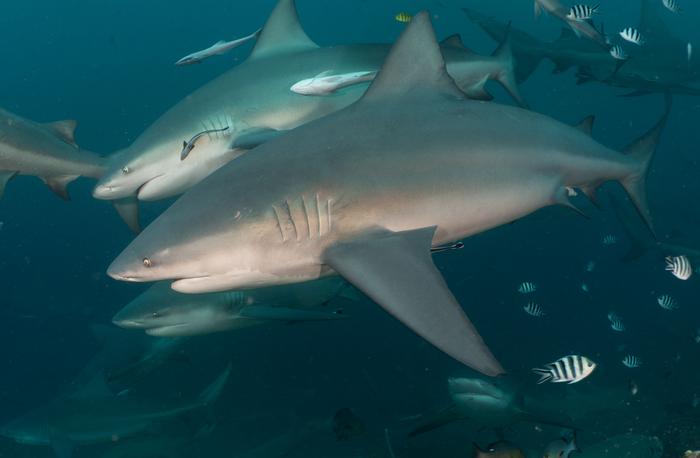
Genetic data paired with observations at a Fijian marine reserve point to a modest kinship effect in a predator long assumed to be solitary.
Sharks have been studied for decades as animals that aggregate without associating — gathering where food or conditions bring them together, without preference for particular individuals. That picture has been eroding, and a paper in Ecology and Evolution adds a further wrinkle to it: among bull sharks at a Fijian reserve, who an individual spends time near is slightly predicted by how closely related the two are.
The study pairs genetic data with six years of observations at Shark Reef Marine Reserve in Fiji, where adult bull sharks gather regularly. The lead author is Natasha D. Marosi of the University of Exeter, who founded the Fiji Shark Lab, with Dr Andrew Griffiths of Exeter and contributions from Lancaster University.
Two ways of measuring a social preference
The analysis distinguishes two kinds of social data, which matters for how strong a claim it can make. The first is proximity — “associations”, defined as two sharks within one body length of each other. The second is directed interaction: parallel swimming, lead-follow configurations, and what the researchers term “joining”.
Proximity alone is weak evidence of a relationship, because two animals drawn to the same place will be near one another whether or not they have any interest in each other. Directed interactions are harder to explain that way: parallel swimming and lead-follow require one animal to be tracking another’s movement.
Kinship appeared to contribute to both measures, and the effect was clearest between pairs of male sharks.
Marosi said the work indicates that “bull sharks actively choose their social partners”, and described what she called “the ‘kinfluence’ effect we have uncovered” — the term the authors coined for the influence of kinship on social structure and behaviour.
A small effect in a population of strangers
The size of the finding needs stating carefully, because the release’s framing is more emphatic than the result.
Most sharks at the reserve are not closely related to one another. Individuals are only slightly more likely to associate with relatives than with unrelated sharks, and the kinship effect is weaker than the effects of sex, age and body size, which remain the main predictors of who associates with whom. This is a detectable tendency layered on top of a largely unrelated crowd, not a society organised around family.
There is also a demographic reason to expect it to be small. Young bull sharks suffer high mortality in the river and coastal habitats where they spend their early years, largely from illegal fishing, so relatively few relatives survive to adulthood in the first place. Whatever preference exists has few opportunities to be expressed.
That observation cuts in an interesting direction for the study’s interpretation. If kinship structures bull shark society at all, then mortality among juveniles is removing not just individuals but relationships — and a social effect this modest in a depleted population says little about how strong it might have been in a population that was not.
Why relatedness could matter
In species where kin association is well documented, the usual explanation is kin selection: helping a relative propagates shared genes, so tolerance or cooperation directed at kin can be favoured even at a cost. Whether anything of that sort is operating here is not something this study can show, because it observed association patterns rather than any benefit flowing from them.
A simpler explanation is available and not excluded. Related sharks may share a natal river or nursery area, arrive at the reserve on similar schedules, or have overlapping habitat preferences for inherited reasons that have nothing to do with recognising each other as kin. Correlated behaviour among relatives can arise without any social preference at all.
What the study establishes is the pattern. Explaining it would require knowing whether sharks can recognise relatives, and whether association with them confers anything.
Against the solitary predator
Griffiths placed the result against the public image of the animal. “The results are fascinating, especially as sharks are still widely perceived as fearsome and solitary animals,” he said. “This paints these animals in a completely new light.”
Marosi was similarly struck: “To discover that some of these large, apex predators choose to socialise with their relatives is truly exciting,” she said.
The broader point is reasonable even if this particular effect is small. Social structure in sharks has been consistently underestimated, partly because the animals are hard to observe individually over long periods, and six years of repeated observation at a single site with identified individuals is the kind of dataset that makes the question answerable at all.
The limits of one reef
Shark Reef Marine Reserve is a protected site where adult bull sharks gather regularly and are habituated to the presence of divers, which is what makes the observations possible and also what limits their reach. A provisioned, protected aggregation is not a natural one, and association patterns recorded there need not describe how the same animals behave elsewhere.
The study is also observational and correlational, with no manipulation of who encounters whom. It is a single site, a single population and a single species, and the effect reported is a tendency rather than a rule.
There is nonetheless a conservation argument in it. If sharks have social preferences — kin-based or otherwise — then fishing pressure removes relationships as well as individuals, and a population reduced to the same number of unconnected animals is not the same population. Whether that matters for survival or reproduction is unknown, which is itself a reason to find out.
The work was supported by the Hai Stiftung Shark Foundation, the Rufford Foundation, the Waitt Foundation and the Fiji Shark Lab. The release does not list the full author team.
Notes
- Marosi, N.D., Griffiths, A., et al. “Is Blood Thicker Than Water? The Influence of Kin Within a Bull Shark Social Network.” Ecology and Evolution, 2026. DOI: 10.1002/ece3.74050.
- University of Exeter. “Family ties shape social lives of bull sharks.” EurekAlert!, 4 August 2026. https://www.eurekalert.org/news-releases/1138396.
Natasha D. Marosi



Leave a Reply