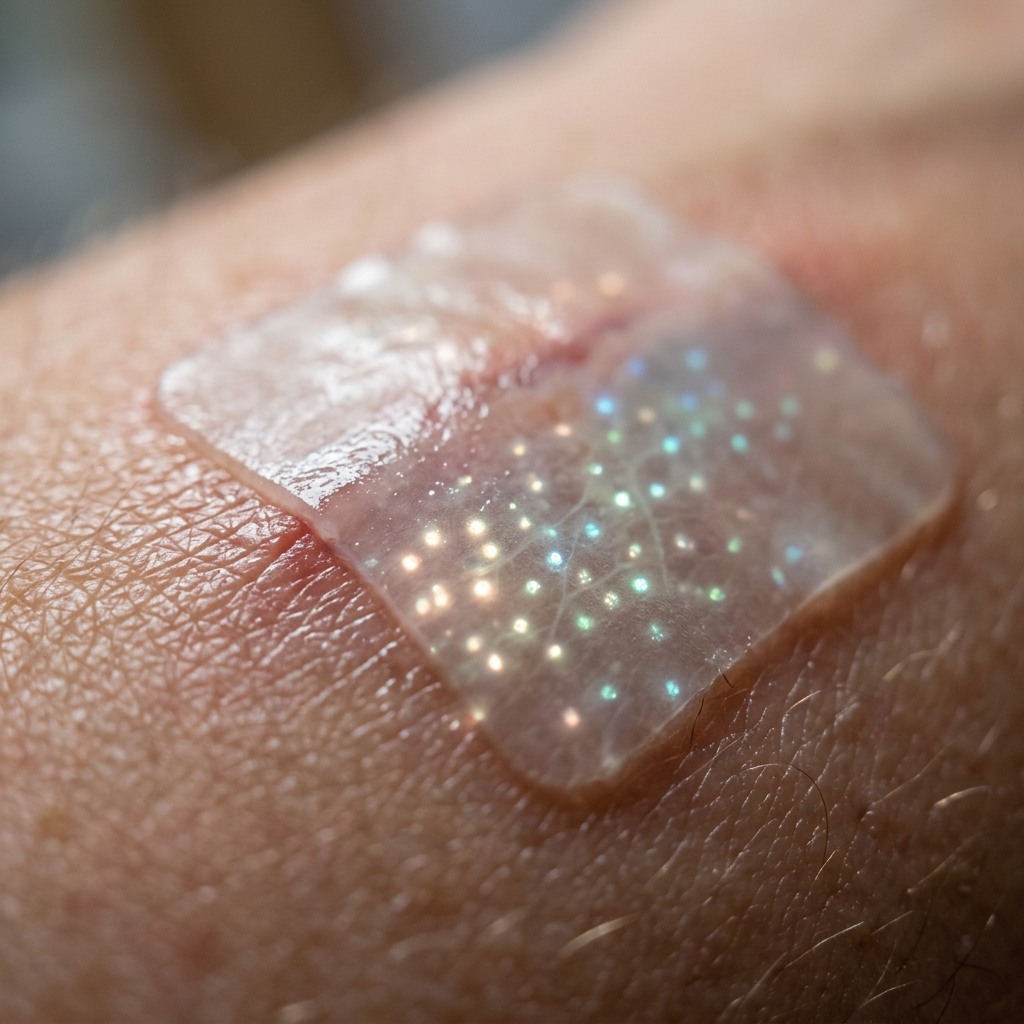
Wearable health monitors often lose their wireless connection the moment a person bends an elbow, reaches overhead, or starts to run, because stretching an antenna shifts the radio frequency it is tuned to receive. “For an antenna, you actually change the resonance frequency” when it stretches, said Huanyu “Larry” Cheng, the Penn State engineer who led a team that designed a soft, stretchable antenna built to resist that effect, publishing the work in Nature Communications. Ordinarily, he said, “you won’t be able to receive that signal or energy” once an antenna detunes.
The antenna is made from liquid metal particles embedded in Ecoflex, a soft, rubber-like material, with a cross-shaped opening cut into its center that guides the internal signal path so the device compensates for shape changes as it stretches. The researchers chose that cross shape over a simple circular hole or a single slot after testing which design best balanced efficiency with multidirectional performance. In lab tests, the antenna held a stable resonance frequency even when stretched up to 45% in different directions.
The antenna can also harvest radiofrequency energy to power small sensors directly. In an energy-harvesting demonstration, it kept a small LED lit while being stretched about 30% in multiple directions; a conventional stretchable antenna, by comparison, lost stable power at around 5% stretch. Mounted on a smart T-shirt wired with ECG electrodes and a Bluetooth Low Energy system, it transmitted stable heart-signal data from roughly 6 to over 300 feet away, including while a volunteer raised their arms, stretched, and ran outdoors toward the receiver.
“The medical application is the top priority for us,” Cheng said, pointing to continuous health monitoring during everyday activity, exercise, or rehabilitation as the clearest near-term use, with longer-term possibilities such as mounting similar antennas on flying robots for environmental monitoring, including tracking pollinators. The work was funded by the National Institutes of Health’s National Institute of Biomedical Imaging and Bioengineering and the U.S. National Science Foundation.
Endnotes
- Huanyu Cheng et al., “Multidirectional strain-insensitive stretchable RF electronics,” Nature Communications, June 27, 2026, DOI: 10.1038/s41467-026-74900-5.
- Penn State, “Stretchable antenna keeps wearable health sensors in tune with human health,” news release via EurekAlert!, July 27, 2026.



Leave a Reply