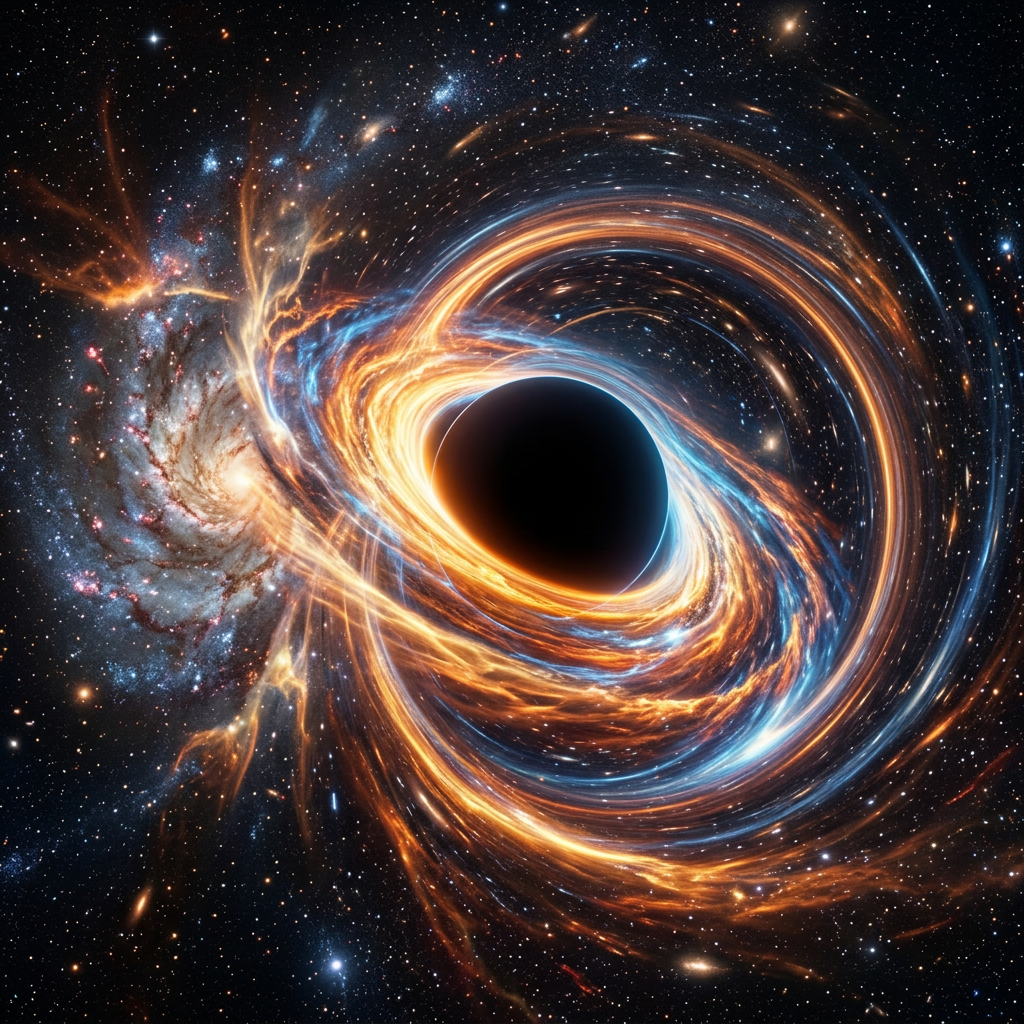
University of Maryland astronomers used AI to spot a dormant black hole 30,000 light-years from its galaxy’s center, revealed only when it shredded a passing star.
Supermassive black holes are supposed to stay home. Astronomers have long found them anchored at the hearts of large galaxies, including our own Milky Way, where they sit like gravitational keystones millions or billions of times the mass of the Sun. Theory has predicted that some of them should be adrift, kicked loose or stranded when galaxies collide. But a black hole that isn’t eating anything gives off no light, which makes a wanderer nearly impossible to find.
Now a team at the University of Maryland has caught one. In a study published July 27 in The Astrophysical Journal Letters, the researchers describe a dormant supermassive black hole lurking about 30,000 light-years from the center of its galaxy. It gave itself away in the only way such an object can: by tearing apart a star that strayed too close and flaring briefly into view. It is the first time scientists have detected a dormant black hole so far from a galaxy’s core.
“This is a novel result. What’s new is that, until now, we’ve started with the assumption that supermassive black holes reside in the centers of massive galaxies,” said study co-author Suvi Gezari, an associate professor of astronomy at UMD. “This discovery will have a huge impact. It means that we’re going to find many more examples of wandering black holes, and we can understand how galaxies and their black holes merge and build up over time.”
Invisible until it eats
The difficulty with wandering black holes is that most are quiescent, meaning they aren’t swallowing gas or dust and so emit no light. They drift through the outskirts of galaxies effectively invisible to telescopes.
There is one exception. When a star wanders too close to a black hole, the black hole’s gravity stretches and rips it apart, an event astronomers call a tidal disruption event. As the shredded star’s debris spirals in, it heats up and produces a distinctive flare of light that rises and fades over weeks to months. Tidal disruption events are well documented at the centers of galaxies, where black holes are expected to be. Finding one far from the center would be a telltale sign of a black hole where none was supposed to be.
Teaching an AI to look everywhere
To catch such a flare, the team turned to the Zwicky Transient Facility, a survey that uses two telescopes at Palomar Observatory in San Diego County, California, to scan the entire northern sky every two days. The facility “searches the whole universe,” said lead author Robert David Stein, a Neil Gehrels Prize Postdoctoral Fellow at the Joint Space-Science Institute, a partnership between UMD’s departments of astronomy and physics and NASA’s Goddard Space Flight Center.
That breadth creates its own problem. The survey records hundreds of thousands of changing objects every night, far too many to check by hand. So the researchers built an artificial intelligence program that recognizes the characteristic light pattern of a tidal disruption event and, crucially, looks for it anywhere in the sky rather than only at galaxy centers.
The team launched the program in August 2025. Three months later, it found what they were looking for.
“I remember the moment we discovered it very clearly. It was a Saturday, and everyone was very excited to be messaging. We dropped everything and started triggering all kinds of other instruments to get more data,” Stein said. “We weren’t really sure we would be successful so quickly, so it’s amazing that we found one so fast.”
A black hole without a home
The object, cataloged in the paper as TDE 2025abcr, sits 9.3 kiloparsecs, or roughly 30,000 light-years, from the center of its host galaxy. Its mass is about the same as that of Sagittarius A*, the black hole at the center of the Milky Way. What surprised the researchers was what wasn’t there: no visible galaxy surrounding it.
“To have such a big black hole outside of a galaxy is surprising to me,” said co-author Sylvain Veilleux, a professor of astronomy at UMD. “There should be a Milky Way-like object around it—and that’s definitely not the case.”
The team sees two plausible origin stories, both rooted in galaxy collisions. In the first, a large galaxy swallowed a smaller one and gradually stripped away its stars until only the smaller galaxy’s central black hole remained, drifting through its new home. In the second, a galaxy already had two black holes orbiting closely at its center, a so-called binary black hole. When a third black hole arrived through another merger, the gravitational tug-of-war among the three flung the smallest one outward. Continued observations of the flare could help distinguish between the scenarios, the authors said.
Why wanderers matter
Dormant black holes are the norm, not the exception. Most black holes in the universe, including the one at the center of the Milky Way, are quiet most of the time. Understanding how they behave, and where they end up after galaxies merge, is central to understanding how galaxies themselves grow.
Whether the Milky Way harbors any wanderers of its own is unknown. Stein, for one, isn’t worried about Earth stumbling into one. “We’re very unlikely to meet one, at least in our lifetime,” he said.
The team is now searching for more, hoping to “understand how galaxies form and how many black holes are whizzing around,” Stein said. The discovery also shows that finding them doesn’t require exotic or expensive techniques, only a standard sky survey paired with machine learning.
“It is super exciting,” Gezari said. “It’s an example of machine learning opening up a whole new area of research.”
A flood of discoveries ahead
The next generation of instruments should make wandering black holes far easier to find. Stein expects the search could turn up dozens or even hundreds each year using the NSF-DOE Vera C. Rubin Observatory in Chile, which began operations last year with the largest digital camera in the world. Veilleux pointed as well to the Lowell Discovery Telescope’s Rapid infrared IMAger-Spectrometer, a collaboration among Goddard, UMD’s astronomy department and Lowell Observatory that debuted in June 2025 and should allow astronomers to detect tidal disruption events at even greater distances.
For now, TDE 2025abcr stands alone as the clearest example yet of a supermassive black hole caught far from home.
“This is the strongest case of a wandering black hole that we know,” Veilleux said. “This is going to set the standard.”
UMD astronomy adjunct professor Stephen Bradley Cenko and postdoctoral associate Jillian Chin Rastinejad also co-authored the study, which was supported by the U.S. National Science Foundation, the Gordon and Betty Moore Foundation, the Heising-Simons Foundation and other funders.
Endnotes
- Stein, R. D., et al. “TDE 2025abcr: A Tidal Disruption Event in the Outskirts of a Massive Galaxy.” The Astrophysical Journal Letters (published July 27, 2026). DOI: 10.3847/2041-8213/ae77f3
- University of Maryland. “First-ever ‘wandering’ black hole spotted at the edge of a galaxy.” EurekAlert!, July 27, 2026. https://www.eurekalert.org/news-releases/1137732




Leave a Reply