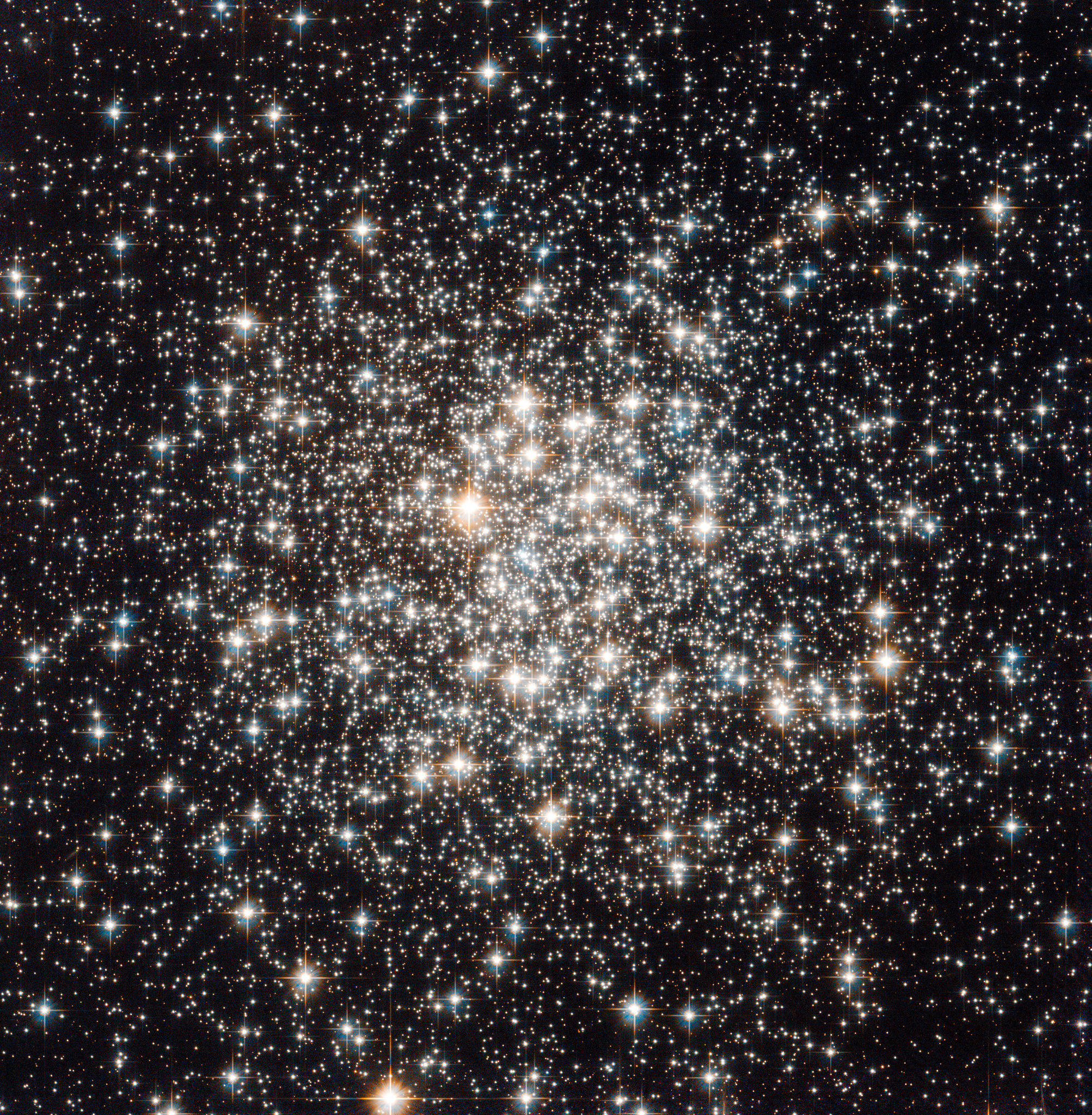
A new study led by astronomers at The University of Texas at Austin proposes a theory that could solve two astronomical riddles at once: the nature of Little Red Dots and the origin of globular clusters. Rather than representing distinct objects, the study suggests that one may be the ancestor of the other — that Little Red Dots are, in fact, an early form of globular clusters.
First detected by the James Webb Space Telescope in 2022, Little Red Dots are mysterious objects that appear 600 million years after the Big Bang, only to seemingly disappear 1.5 billion years later. They are compact, luminous, and shine with a distinctive combination of red and ultraviolet light. One theory holds that Little Red Dots represent supermassive black holes enshrouded in dense clouds of gas, pulling young stars in to a dramatic death — a scenario that explains many of the objects’ signature properties. But an early globular cluster with a supermassive star at its heart would also look a lot like a Little Red Dot.
“These may not be just a strange new JWST population with no connection to the universe around us today. Instead, Little Red Dots may persist past the early universe, evolving into something relatively familiar,” said John Chisholm, astronomer at UT Austin and lead author of the study.
Globular clusters are dense collections of ancient stars found orbiting galaxies; the Milky Way alone contains around 150 of them, each hosting hundreds of thousands or even millions of stars. Although astronomers have studied these objects for well over a century, their origins remain unknown. “We usually see them after billions of years of evolution, at a time when their massive stars are gone, their gas has been cleared out, and dynamical processes have changed their masses and structures. That makes it very hard to reconstruct the original conditions they formed in,” said Danielle Berg, astronomer at UT Austin and co-author.
The stars in globular clusters are all the same relative age, developing during a burst of stellar activity in the early universe. While astronomers would expect stars from this era to have relatively straightforward chemistry, some clusters show unexpected patterns that are hard to explain — an abundance of helium, nitrogen, sodium, and aluminum, with low carbon, oxygen, and magnesium. “This specific pattern indicates nuclear fusion at very high temperatures, much higher than in the cores of even massive normal stars. A supermassive star is precisely the kind of environment that could produce this combination,” said Mike Boylan-Kolchin, UT Austin co-author.
Such a gigantic star — up to hundreds of thousands of times more massive than the Sun — could have formed from a series of stellar collisions early in a globular cluster’s life, as stars merged with one another over and over again until a central supermassive star formed. Though short-lived, this star would be an incredibly powerful chemical furnace, forging material in its core in unusual ways. “When they die, they would blow that material back out, seeding the next generation of stars with the chemical fingerprints we still see in globular clusters today,” Berg said. “In our model, the supermassive star that helps make the object look like a Little Red Dot would live for only a short time. Once that star dies, the object may no longer look like a Little Red Dot, even if the cluster itself survives billions of years,” Chisholm added.
Additional clues could link the two objects: the distribution of Little Red Dots in the early universe corresponds with the distribution of globular clusters in the present day, models of Little Red Dot evolution show their mass could readily transform into that of today’s globular clusters, and Little Red Dots appear in the universe at roughly the same time the oldest globular clusters are expected to have formed. “There’s no single smoking gun at this point that says Little Red Dots are globular clusters, but it would explain a lot of diverse and surprising observations,” Boylan-Kolchin said. “Little Red Dots could be galaxies, they could involve black holes, or they could be something even more unexpected. Our work shows that forming globular clusters with supermassive stars should be part of that conversation,” Chisholm said.
Additional UT Austin co-authors on the study are Lukas Furtak, Vasily Kokorev, and Julian Muñoz.
Journal: The Astrophysical Journal
DOI: 10.3847/2041-8213/ae6dae
Article Title: Little Red Dots as Globular Clusters in Formation
Publication Date: 2-Jun-2026
Source: EurekAlert



Leave a Reply