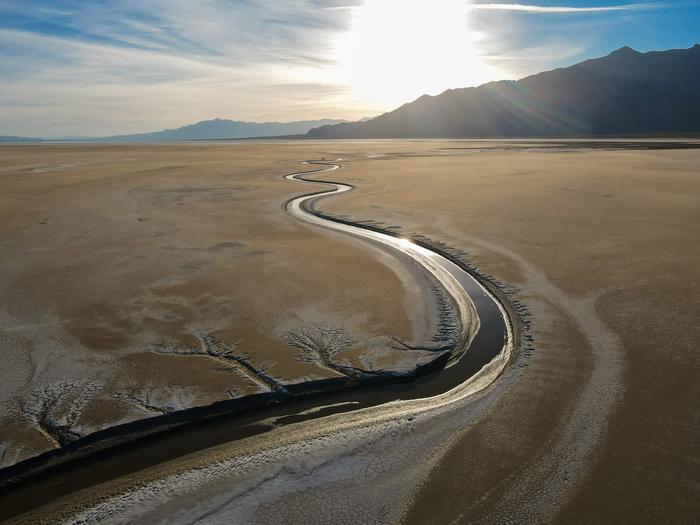
As rising sea levels push saltwater further into rivers and estuaries, MIT researchers have found that increasing salinity reshapes microbial communities — reducing their diversity while leaving their overall growth rate and biomass production largely intact.
The study, led by lead author Jana Huisman, an MIT postdoc originally from the Netherlands, and senior author Jeff Gore, an MIT professor of physics, found that as salinity rises, faster-growing microbial strains come to dominate communities that once held a greater mix of species. The work builds on earlier findings from Gore’s lab showing that temperature shifts can similarly favor slower-growing bacteria.
Co-author Martina Dal Bello, a former MIT postdoc now an assistant professor at Yale, helped lead sampling efforts across a range of natural salinity levels: the Charles River (4 grams of salt per liter), Boston Harbor (30 g/L), and a beach in Nahant, Massachusetts (35 g/L). The team then grew populations from these sites in the lab at salinities of 16, 31, and 46 g/L over two weeks to track how community composition shifted.
To test whether the lab findings held up in nature, the researchers cross-checked their results against public genomic data from the Chesapeake Bay, the Gulf of Mexico, and the Baltic Sea, using 16S rRNA gene copy number as a proxy for growth rate. The pattern held: higher salinity was consistently associated with lower diversity but stable community-wide growth.
The research was supported by a Human Frontier Science Program Fellowship and a Schmidt Science Polymath Award.
Journal: Nature Microbiology
DOI: 10.1038/s41564-026-02422-3
Article Title: Predictable shifts in microbial species composition lead to community-wide robustness to environmental stress
Publication Date: 17-Jul-2026
Source: EurekAlert

Leave a Reply