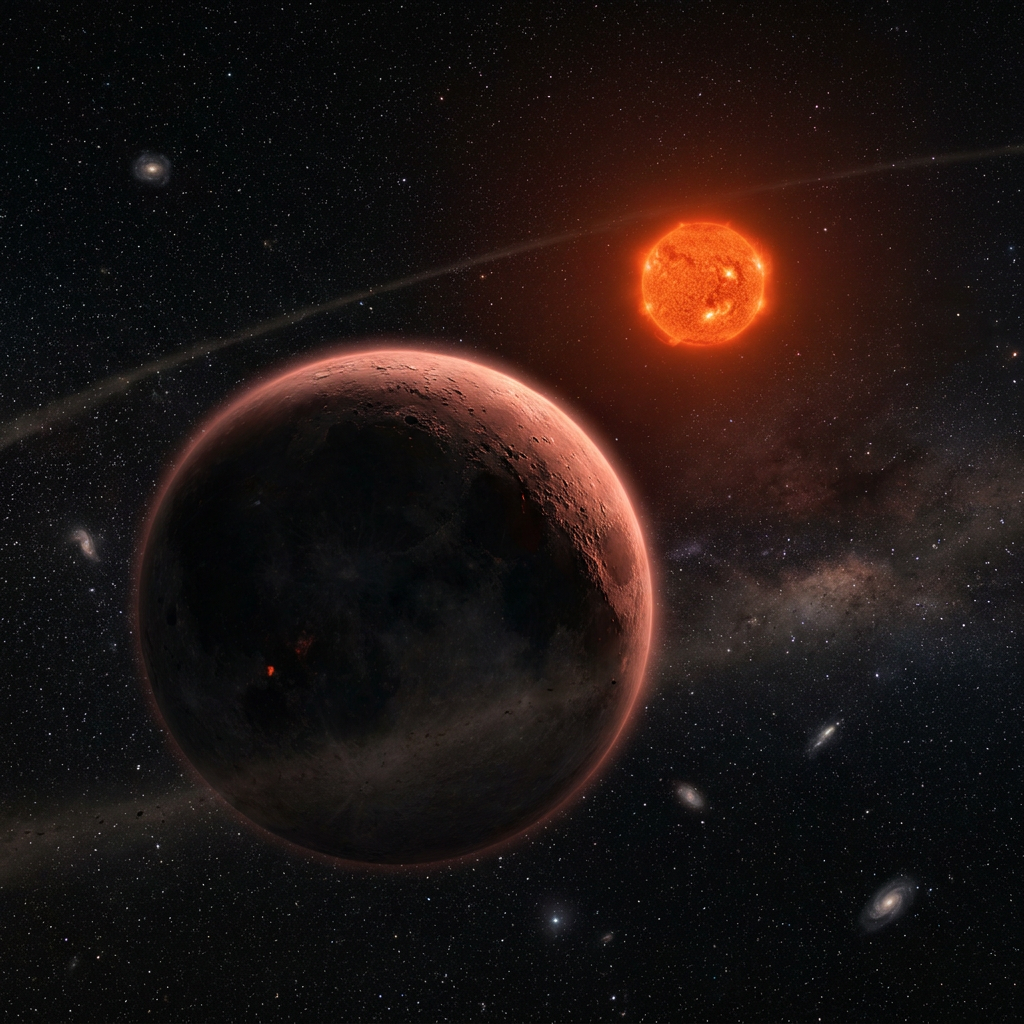
A research team headed by Harvard University’s Collin Cherubim, alongside Carnegie astronomers including Shreyas Vissapragada, has identified atmospheric evidence on a rocky planet in its star’s habitable zone. This discovery, published in Science, represents a significant advancement in understanding potentially habitable worlds beyond our solar system.
Theoretical frameworks emphasize that atmospheres play an essential role in habitability by protecting planets from cosmic radiation, preserving surface water, and maintaining climate stability. While gas giants have yielded atmospheric detections, confirming atmospheres on rocky exoplanets within habitable zones has proven technologically demanding.
Red dwarf stars offer advantages for such investigations due to their modest size and cool temperatures. Vissapragada explained the team’s strategy: “Red dwarf stars present a good opportunity for this kind of search because they are small and cool, so habitable-zone planets orbiting these stars are relatively accessible using the transit method.”
The team focused on LHS 1140 b, a super-Earth discovered in 2017. This world orbits its red dwarf host every 24.7 days with a mass approximately 5.6 times Earth’s and radius around 1.7 times larger. It receives 42 percent of Earth’s stellar radiation, placing it in the habitable zone.
Using the WINERED spectrograph at Carnegie’s Las Campanas Observatory, researchers observed helium escaping from LHS 1140 b’s atmosphere in 2024. Vissapragada noted: “This was clear evidence of an atmosphere on a habitable-zone exoplanet. It was an absolute thrill to see the transit spectra.”
The 2025 observations revealed no escaping helium, suggesting variable atmospheric escape. The findings point toward a layered atmosphere with helium and hydrogen dominating upper regions while other species like water remain trapped lower in the atmosphere.
The research team also examined LHS 1140 c, a smaller, more heavily irradiated planet in the same system, which showed no atmospheric evidence—potentially indicating these worlds occupy opposite sides of the “cosmic shoreline,” dividing planets that retain atmospheres from those losing them rapidly.
Journal: Science
DOI: 10.1126/science.aea9708
Publication Date: July 16, 2026
Source: EurekAlert




Leave a Reply