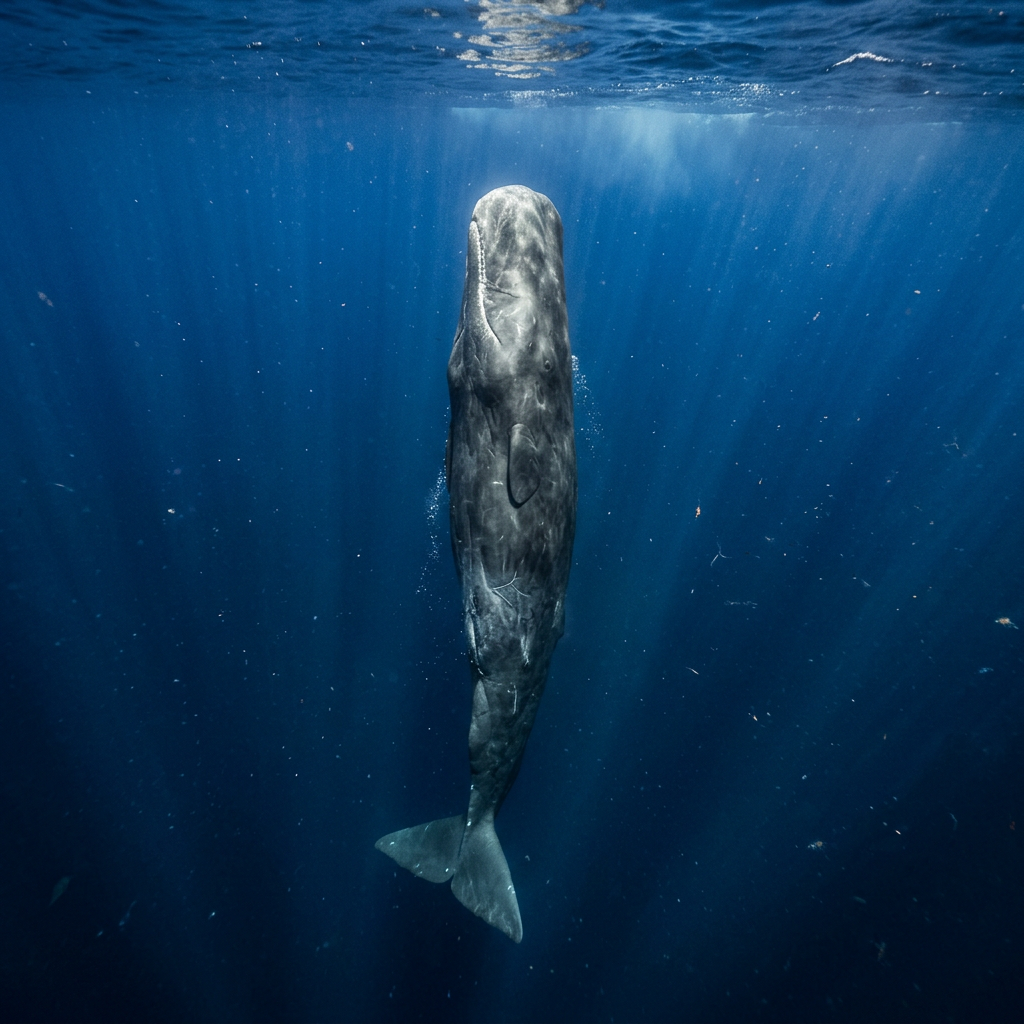
Of all the whales in the ocean, only one species sleeps standing up. Sperm whales are known for resting in short, vertical postures just beneath the surface, drifting motionless like enormous exclamation points suspended in blue water. Researchers have long suspected the behavior helps them rest efficiently — sheltered from the buffeting of surface waves, without spending the energy needed to dive to greater depths. What they haven’t understood, until now, is exactly how a sperm whale manages to hold that position at all.
A new study from researchers at the University of St Andrews and the Université de Neuchâtel, published in the Journal of Experimental Biology, has identified the mechanism: while resting, sperm whales release small bubbles of gas to actively regulate their buoyancy, holding themselves just below the surface rather than drifting up into the waves or sinking away from them.
The physics working against a resting sperm whale are considerable. The animals are naturally positively buoyant, largely because of the enormous reservoir of spermaceti oil housed in their heads — the same waxy substance that gave the species its name and once made it a prime target of the whaling industry. Left alone, that buoyancy would tend to push a resting whale toward the surface. Compounding the problem, sperm whales are breath-hold divers: any air trapped in their lungs during a shallow rest will expand as the whale drifts upward, further increasing its buoyancy in a feedback loop that would otherwise carry it straight to the surface.

To find out how the whales counteract that drift, researchers attached small, suction-cup tags to sperm whales off the coast of Norway. The tags, designed to record both sound and detailed three-dimensional movement, captured something the team wasn’t necessarily expecting to hear so clearly: distinct bubble sounds released by resting whales. Combining the acoustic data with the whales’ recorded movements, the researchers built a simulation incorporating tissue density, drag through water, and the volume of gas held in the animals’ bodies, then used it to test whether bubble release alone could explain how the whales stay submerged.
It could. The simulation confirmed that releasing bubbles functions specifically to counteract the whales’ natural positive buoyancy, allowing them to remain at a stable depth just under the surface rather than slowly rising into the waves. The data also revealed a related detail: whales beginning a resting dive start out with noticeably less gas in their lungs than they carry into deep foraging dives, suggesting the animals may partly prepare for rest by adjusting their gas load before they even begin to sink.
“This study confirms that sperm whales exquisitely control their buoyancy by releasing gases to remain submerged with near-neutral buoyancy just below the sea surface,” said Professor Patrick Miller of the Sea Mammal Research Unit at the University of St Andrews. “It is particularly fascinating they are able to make these fine-scale adjustments while they are thought to be asleep, a challenge totally alien to terrestrial mammals like us humans.”
That last detail is what makes the finding stand out beyond basic marine physiology. For a land mammal, maintaining continuous, precise physical adjustments while unconscious is essentially unheard of — human sleep involves losing, not fine-tuning, muscular control. A resting sperm whale appears to be managing something closer to an autonomous buoyancy-control system, quietly venting gas to hold position while functionally asleep.
The researchers also see a possible second purpose behind the bubbles beyond simple buoyancy control. They suspect the behavior could be tied to off-gassing excess carbon dioxide or nitrogen from the whale’s tissues into its lungs for release — a process with implications for how the animals manage metabolic gas exchange during rest, and potentially a clue toward understanding how deep-diving mammals avoid the physiological hazards, like decompression stress, that come with repeated pressure changes.
Endnotes
- Patrick Miller et al., “Buoyancy regulation through modulation of onboard gas volume by resting sperm whales (Physeter macrocephalus),” Journal of Experimental Biology (2026), https://doi.org/10.1242/jeb.251920
- University of St Andrews, “Sperm whales blow bubbles to achieve restful, vertical sleep,” EurekAlert!, July 23, 2026, https://www.eurekalert.org/news-releases/1136950



Leave a Reply